Facts & Arguments is a daily personal piece submitted by readers. Have a story to tell? See our guidelines at tgam.ca/essayguide.
Autumn is that time of year when things start dropping from trees. Peculiar things, such as the corkscrew-shaped seedpods from the honey locust, spiky burrs from the chestnut or those funny, elongated bean pods from the catalpa. It's nature's way of reminding us of all the productivity that has been going on overhead for the past six months. Fall. Could a season have a simpler, more apt name?
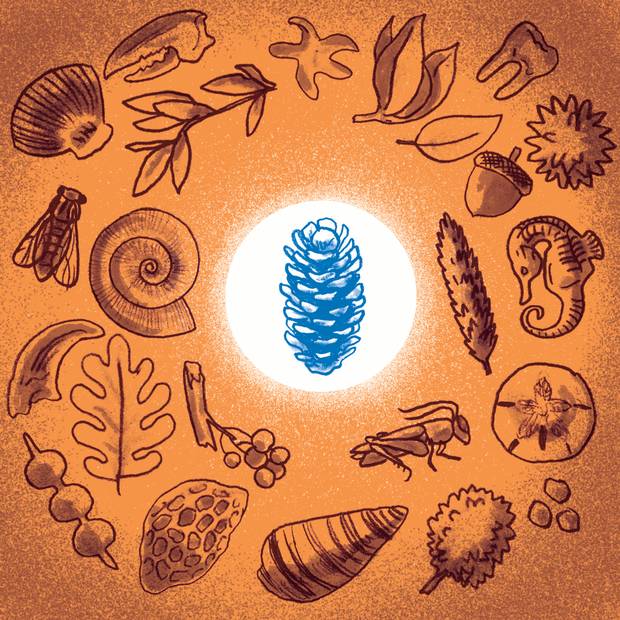
During the fall, 22 years ago, while pushing my daughter Emma around the neighbourhood in her stroller, I came across a pine cone on the sidewalk. Kneeling beside her, I placed it in her small hand and said, very purposefully, "pine cone."
Drew Shannon for The Globe and Mail
Unlike her possessions at the time, this one wasn't colourful or shiny or soft to the touch. She seemed puzzled. I repeated the words several times. Clutching the strange toy I had just given her, she gazed up at me through her eyelashes and murmured – "by-doh."
It was one of her first spoken words and it filled me with joy. To this day, a pine cone in our household is fondly called a "by-doh."
On the walk home, I remember thinking to myself, this is something I can teach Emma about – nature. We'll search for other objects and I'll explain to her where they come from and why they exist. Together, we'll build a collection, one specimen at a time.
We started out with readily available objects – acorns, snails and bees located near to our house. On the day we found a dead cicada on the driveway, its chalky, olive-green abdomen and delicate wings perfectly intact, we knew our collection was getting serious. I bought some glass-topped circular tin containers and we placed each treasure inside, carefully perched atop a piece of cotton batten to keep them from moving about. The tins gradually started to fill the large wooden tray on which we displayed them.
Summer trips to Georgian Bay added pink and purple crayfish claws to the mix, along with wild lily seedpods, lichen-covered rocks, beetles and exoskeletons from assorted insects. When visiting a beach, we would comb it for shells, seahorses, sea urchins and bits of coral. And, I have to confess, we purchased specimens we knew we would probably never find on our own. Items such as a snake's vertebrae, a bear's claw and the architecturally complex Venus's flower-basket sponge.
Once we had filled the wooden tray, we started another. The tins housed our smaller specimens and larger ones, such as bird nests, feathers, porcupine quills and milkweed pods, stayed protected in clear plastic containers or archival boxes.
Along the way, Emma learned some basics about form, colour, texture and pattern. As she got older, the collection encouraged discussions about seasons, life cycles, growth patterns, camouflage and other aspects of nature. We uncovered interesting facts about pieces in our collection. Take the pine cone, for instance – it's a fine example of a Fibonacci sequence, a growth pattern formed by two spirals expanding from a common nexus in opposite directions. The Fibonacci sequence, which helps maximize a plant's exposure to the sun, is also evident in sunflowers, pineapples and Romanesco cauliflowers.
When Emma was in Grade 6, she showed our amassed curiosities to a friend. Afterward, she approached me and very thoughtfully said: "Dad, to be fair, this is no longer our collection – it's your collection."
Thud. My heart sank. But I knew she was right. I had gained as much from this adventure as she had, maybe even more. The truth of the matter is that I was not particularly good at the sciences in school, and by investigating nature with my daughter, item by item, I'd found a way to connect with a world that utterly fascinated me.
The inherent art and design of nature provides a gateway for me to revisit a subject that overwhelmed me when I was growing up. Whenever I see the intricate pattern of a strawberry snail, the elegant structure of a chambered nautilus or the remarkable craftsmanship of a wasp's nest, it entices me to investigate deeper. The physical collection has guided me to research and read about topics as varied as cabinets of curiosity, camouflage, evolution, botany and biomimicry.
Emma has become a keen observer of the world. I attribute this, in part, to the nature collection. She understands the big picture while remaining sensitive to the details. All of which has influenced her personality and sense of curiosity. Yes, she likes science, but her real passions are world history and literature. Recently, she informed me that certain cultures see the pine cone as a symbol of enlightenment.
Many autumns ago, thanks to that lone "by-doh" on the sidewalk, the two of us set out on a quest to explore nature. It resulted in a wonderfully eclectic and enchanting collection.
Emma may say it's mine, but it really is ours.
Bob Hambly lives in Toronto.