It's extraordinary the lengths people will go to find division. Last year, we spent six months living in an alpine village in France – a place where most folk are white, Christian and wear hiking boots and fleece. Their kids all go to the one high school and families have known each other their entire lives. You would think that in such a homogeneous place, there would not be any "us" versus "them."
You would be wrong. We discovered the people of the valley floor were at odds with those up the mountain. Those living on the mountain top where the upscale ski resorts are were seen as snobs, while the ones living on the valley floor are mostly farmers and felt looked down upon – literally and socially. Distance between the two: 40 kilometres.
Then, the people from our village felt snubbed by those from the next village over because of the shadow cast by a low sun over the mountain, which meant that our village received a bit less of that precious winter sunlight. And so, the two villages have strained relations. Distance: 300 metres.
Within our village of 50 souls, two families haven't spoken to each other for generations, something about a cow, a piece of land, no one really remembers. But still, the Mercier family doesn't speak to the Arpin family. Distance: 1.5 metres.
Though there is one group that is universally disliked: les Anglais.
In this region that depends entirely on tourism, the British are omnipresent – their singsong accents are everywhere as they've bought lots of holiday homes, come in on the cheap flights straight from London and splash around their still strong British pound. In fact, many have settled down. There is quite a little community of Brits, raising families, going about the ordinariness of daily life. And the Brits tend to stick to their own.
Given these petty rivalries at every turn, I was pleased and surprised to hear about an evening of joint French and British Christmas caroling. There would be a priest who promised not to pray or give a sermon so that there would not be any Protestant versus Catholic tensions, hymns would be chosen in each language and played on a rickety old piano. We'd sing a carol in French, and then the next in English, and so on.
We arrived with the kids on an ideal evening: a bit of moonlight, lots of stars. The austere tiny church had hard wooden pews for maybe 30 people and was lit up by the gilded altar and a manger scene.
There was goodwill in the room, a willingness to find some common ground. After so much separation, so much us versus them in daily life, this was a night for fellowship, for loving thy neighbour and setting aside differences.
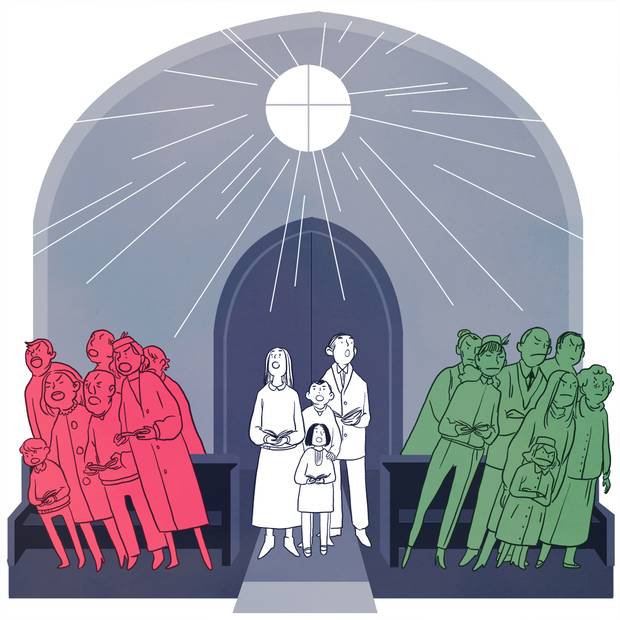
So it was odd when the caroling started. Whenever it was a French hymn, all stayed seated but only the French sang; the British, not knowing these particular carols or maybe feeling awkward about their accented French, stayed quiet. Then, when the priest spoke, the French stood up only to promptly sit right back down whenever the piano started. When it intoned that unmistakable 4/4 beat of a protestant hymn, sure enough the Brits all stood up to sing, surprising the French who stayed quietly seated. As soon as the hymn was finished, the Brits would sit and the French would pop to their feet as the priest spoke – to introduce the next hymn – and then sit right back down to sing it (if it was French).
People stood and sat in diametrically opposed manners, never singing all together, but taking turns. As Canadians, it felt a little odd. I remembered the year before, at a Christmas concert in Ottawa, a school choir sang a Muslim song to greet yet-to-arrive Syrian refugees: talk about acceptance. Yet, here we were in this tiny Alpine chapel, full of families living only a few kilometres from each other who still couldn't find a way – for one night – to live in harmony. What should we, the lone Canadians, do?
We decided to sing all the hymns: We like singing and for us, the French Minuit Chrétien and the English Away in a Manger both have a comforting familiarity. But we also decided to stay standing (it's hard to sing lustily while sitting).
Often, we were the only four standing up in the church. This disconnect, even in the midst of the goodwill of the season, lasted through Silent Night and Sainte Nuit – the exact same carol. It was sung twice, once by the standing British and then again later by the seated French. We Canadians stood for both.
For everyone, I think it was a lovely evening, a magical moment of music, of ritual and of feeling some Christmas spirit – a night to accept differences. Even if it felt odd and the "them" didn't quite sing like "us." Even if neither of the groups could embrace the difference enough to join the other in their weird ways of celebrating Christmas, they could, at least, whisper it. Just like the old French woman did, startled when I first rose to my feet, "Please," she said. "Don't change your way of doing things."
Christine Hodge lives in Ottawa, but spent six months in the French Alps.
Facts & Arguments is a daily personal piece submitted by readers. Have a story to tell? See our guidelines at tgam.ca/essayguide.