Facts & Arguments is a daily personal piece submitted by readers. Have a story to tell? See our guidelines at tgam.ca/essayguide.
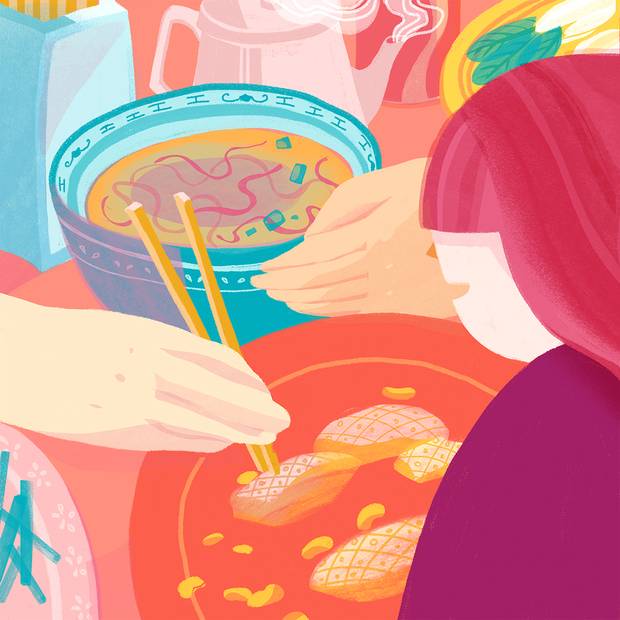
In my relatively short lifetime, I have come upon just a handful of destinations that I can associate with pure, perfect comfort. I have moved houses twice, I have moved schools three times, but there is one restaurant that has been more consistent than either house or any school. It's where my mother studied in university and where my father ordered barbecue pork and noodle soup even after they took it off the menu. Indeed, my family and I have frequented Lee Garden – the famed Toronto Cantonese eatery – approximately twice a month since my birth.
Consumption of Lee Garden's dishes is perhaps more sacred of a tradition for my Jewish clan than any high-holiday synagogue attendance or bar mitzvah chant. On Sunday evenings at around 5 p.m., the words start bouncing around the walls of my house.
Murmurs of "Lee Garden?" and "What about Lee?" slip from family member to family member and are rarely met with any opposition. Soon, it's 6:30 and I'm rolling out of my sweats and into some jeans, enticed by No. 17 on the menu (Chicken and Black Bean Sauce), its greasy smell already lingering before my nose.
The drive down is conducted in near silence, the heated air of the car filled with anticipation. There is not – and has never been – any mystery to this evening. There will be a wait of roughly 20 minutes, there will be a table for four and we will order numbers 16, 17, 74 and 76, the digits corresponding to our tried-and-true favourites from across Lee's sprawling menu. If it's early September, one of the older waiters, knowing well the devoted clientele, might come over and wish us Shanah Tovah (Happy Jewish New Year) in a thick Cantonese accent. Within an hour, we'll be out. The efficiency and the almost bizarre familiarity, just as much as the outstanding taste, is part of the experience, and it's one I've comprehensively loved for 17 years.
Of course, people have long speculated about the connection between Jews and Chinese restaurants. There have been Seinfeld episodes, Atlantic magazine investigations, even quips about the phenomenon during a U.S. Supreme Court confirmation hearing, but most conclude that the linkage was fostered out of simple convenience: on Christmas and New Year – when the rest of North America has always been closed – Chinese restaurants have always been open.
And, while we may have inherited a taste for Shanghai Noodles (No. 86) through this quasi-cultural circumstance, my family's Chinatown pilgrimage is like that of many other Canadian familes: We like good food and want a casual place to in which to eat it, several times a month, together.
But, earlier this year, my mother knocked on the door of my room. Delicately, she informed me of a new development. Lee Garden, without further explanation, had announced that they were permanently closed. Shocked (and given the seasoning provided by the 2016 election cycle), my first utterance was, "Mom, that must be fake news!"
But alas, the Internet quickly verified the claim. Lee Garden, my culinary home away from home, my Sunday destination, my Christmas Eve refuge, was no more.
For some time thereafter, I set aside my English essay and my history presentation to indulge in my depression. I thought carefully about why this restaurant meant so much to me. I considered the nights spent beneath its flickering fluorescent glow, the evenings running past the lineup with my father illegally parked outside, to hurriedly pick up takeout. I reflected on the fact that I had never said a formal goodbye – or a thank you, for that matter – to the owners and servers who made such memories possible.
I also realized that Lee Garden's closing represented something much broader for me than the end of great Chinese food. I was in the penultimate month of my Grade 12 year and this news was evidence of a substantial paradigm shift in my life. By November, I'll be studying in Montreal and eligible to vote – the neon "No MSG" sign in the window of Lee Garden will be but a speck in my mind's rear-view mirror. The comforts of family will be 4 1/2 hours away, and, for the first time, I'll have to chart my own lo mein territory on unfamiliar streets with a yet-unknown band of fellow explorers.
I am not just bidding farewell to an old restaurant, but to the childhood of which it was so firmly a fixture.
Never again will I spill a cup of Diet Coke onto a starched white tablecloth while passing the Cashew Chicken (No. 16) to my brother. Gone are the nights where, about 10 minutes into the meal, I must sheepishly ask the waiter for a fork.
But ahead, there remains news to be discussed, politics to be haggled over, friends to greet and orders to negotiate. There will be new people and new cities, new jobs and even new cuisines to try. There will be other restaurant windows such as Lee's, through which one can watch generations grow and thrive – new tables at which families will sit on Sunday nights, reviewing it all.
Lee Garden's death is a timely beginning.
And besides, there's always King's Noodle down the street.
Sarah Farb lives in Toronto.