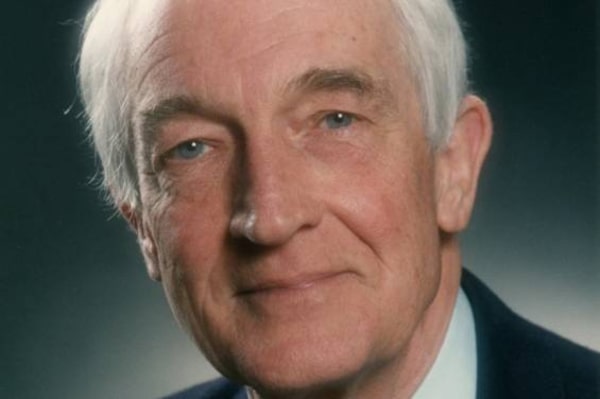
Peter Rechnitzer
Physician. Cellist. Role model. Friend. Born Dec. 27, 1925, in London, Ont.; died April 15, 2017, in London, Ont.; of congestive heart failure; aged 91.
When Peter died this spring, sunshine and warmth had finally come to London. It was the kind of weather that, years ago, would have seen Peter arrive at the hospital sporting a bow tie, Bermuda shorts and knee-high socks, his doctor's black leather bag tucked under his arm.
So, at the funeral home visitation, Karel, Eric and Michael – his stepsons – wore bow-ties, Bermuda shorts and knee-highs. The sight brought smiles to a room full of Peter's friends – old classmates, fellow opera and music lovers, former patients, University of Western Ontario faculty, past students and medical and nursing colleagues. (Erica and Mark, children from his first marriage, could not be present.)
Stories were told – of the too-young-to-go-to-war student talking the Dean into stretching the rules so he could graduate with both a BA and an MD ("we'll call it even," the Dean said), of the young specialist-in-training at Duke University pedalling around campus with his cello strapped to his bicycle, of his role in Guys and Dolls at the Grand Theatre in London, Ont., and of the athlete on long racing blades gliding around Western's outdoor rink.
We also heard how a suitcase full of notes became, on Peter's retirement, a biography of Dr. Maurice Bucke, the 19th-century pioneering superintendent of the London Asylum for the Insane and one of the founders of Western's medical school. Like Peter, Bucke easily bridged the gap between the arts and medicine. He was a close friend of the poet Walt Whitman and Canada's pre-eminent physician, Sir William Osler.
Peter specialized in cardiology. Over 40 years ago, he questioned conventional heart-attack treatment, which involved weeks and even months of bed rest, and sought an alternative. Starting with a brave group of four patients, whose own doctors warned them of sudden death, he and colleagues in Western's kinesiology faculty studied an early program of physical fitness. Their research showed that it was not dangerous – and that patients felt a whole lot better. That led to another legacy – Western's Canadian Centre for Activity and Aging.
Peter's research had another lasting consequence. He fell in love with his research assistant, Lili. Both were married with children and so there were difficult times. However, they survived and Peter gained a whole new family – a wife and three teenaged sons he adored right up to the moment of his death.
Peter cared for my aging father. He used both conventional and whimsical treatments – including a jar of jellybeans, labelled "Substance 90" (Dad was in his early 80s), with directions for twice daily dosing. Follow-up included a letter (mailed from New York where Peter and Lili had travelled to see the opera) purporting to be a market survey of the commercial possibilities of this life-enhancing elixir. My father, a retired professor of marketing at Western's business school, was delighted.
Peter's career was focused on the heart and it was his own heart that, ultimately, failed him. But his mind did not, and when the end approached he was ready. As he said, "I've had a good life."
John Thompson is Peter's friend and colleague.
To submit a Lives Lived: lives@globeandmail.com
Lives Lived celebrates the everyday, extraordinary, unheralded lives of Canadians who have recently passed. To learn how to share the story of a family member or friend, go online to tgam.ca/livesguide