Facts & Arguments is a daily personal piece submitted by readers. Have a story to tell? See our guidelines at tgam.ca/essayguide.
The first time I saw her, four years ago in Mexico, Betsy was wearing crisp, neat clothes appropriate for the heat: lightweight tan pants, a pale printed blouse in shades of green, her skinny arms poking out of the short sleeves. She leaned slightly forward and her arms hung straight down. It was this posture that seemed to contribute so much to her appearance of age.
She was a thin woman, bony and a bit on the tall side. I called her, in my mind, "the waif." She seemed old and feeble.
All of us at the bed and breakfast saw her careful, hesitant walk, the vague expression on her long, thin face, the posture somehow both limp and rigid, toneless. There seemed to be a slightly pathetic quality about her. A blandness, a helplessness. We all seemed to feel it. We watched her navigate the small stairway and hall between the back patio and the front patio. There was something about the way she looked at the stairway, assessing it as though it might be perilous … something that made us uneasy.
A few times I saw Betsy looking in my direction. "Waif alert," I told myself. Partly, it was her apparent neediness that worried me. I don't want to be needed. I had already taken care of a sick mother, a sick husband and other relatives. I couldn't do it any more. But it was more than that. I didn't want to appear to be like her, to be part of a pair of waifs.
I clearly am old; I even looked like her, skinny, pale, straight white hair. We were certainly members of the same little-old-lady club. I didn't want to look helpless, the way she did. And so I avoided her.
And then one evening, as three or four of us sat on the patio, she made her approach: "May I join you?" And so she joined the conversation. A couple of people were talking about looking up friends through Google. Betsy said, "There are an awful lot of people with my name. It's so ordinary. … You have to put in a middle name to get to me." And she spelled it for us. Hmm.
She certainly piqued my interest, and later I checked with Mr. Google. And what did I learn? Betsy spent a lot of time in Taiwan. Her family has been a political presence in the Far East for generations. She had written several books on translating Cantonese, a trilogy of books on learning Cantonese and a couple of books on aspects of Chinese history. For several years she worked at the China desk of a U.S. government agency. Our Betsy.
She had given me a lesson about age: Behind that bland exterior there existed a real person. Her odd posture and restraint seemed to have come from years spent in the foreign service in the Far East.
I was truly ashamed of myself! I had judged age in exactly the way I don't want to be judged myself. I don't want to be dismissed as a feeble old lady, but I had done exactly that to someone rather like me.
After that Betsy and I walked around the park in the evenings, enjoying the Mexican children, the bright lights and gaiety of Semana Santa, the week before Easter. The whole park was done up like a fairground, with games and food, vendors of shoes and jewellery. We bought bags of excellent fresh potato chips. She had hers with hot sauce, I took mine with a squeeze of lime. We walked, we talked.
She was concerned about aging. "I lose things," she said. "… And I forget things."
The following year Betsy's holiday in Mexico was a time of constant distress. On the first day she lost her wallet, containing everything – her identification, credit cards and bank cards. So she phoned her son to cancel them. She wore her room key on a string around her neck, because she always lost it. Then she found her wallet, not lost after all. But all her cards were now useless and she had no access to funds. The turmoil around that problem lasted for weeks.
"I never put anything away now," she said. "I keep everything spread out on my bed. That way I can see where everything is."
I asked if she would be coming to Mexico next year.
"I'd like to," she said, "but I'm getting very decrepit."
"Are you worried about that?"
"Well, I do worry, of course. And I have a heart condition. I have a doctor here, but … well, you know. I am beginning to be afraid to travel. And I don't want it all to be terrible, at the end. I wonder if you can just stop taking the pills you're supposed to take."
But the following year we were together, at our bed and breakfast. Betsy seemed less distressed, perhaps because she had some medication to stabilize her actions, her thoughts, her distractions.
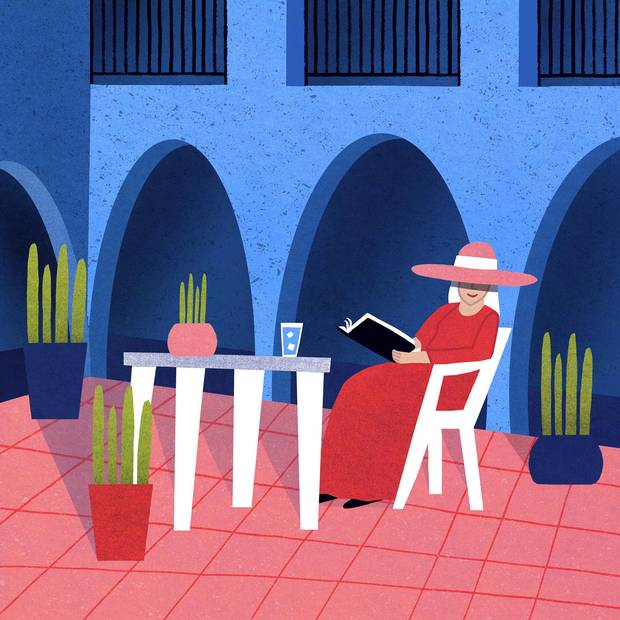
One Saturday afternoon Betsy was reading on the back patio, warm in the glorious sunshine, wearing a big decorative cotton hat with a wide brim. She seemed now to be in control of her … what? … decrepitude? Not a nice word, but I can't find another one for that aged state Betsy and I shared. We had lazy, quiet afternoons, sitting and reading. One afternoon I watched as she folded her arms on the table, put her head down and dozed. After some minutes she lifted her head and tilted it back, leaning comfortably, the pink and white hat shading her upper face. I watched her mouth fall open in the stillness of that warm afternoon. A few breaths and it closed again. I was suddenly awash with seeing her independence and ease, there in the chair, there on the patio … "Oh, Betsy, how I adore you," I heard my mind saying. "I want to be just like you when I grow up."
Laurie Lewis lives in Kingston.