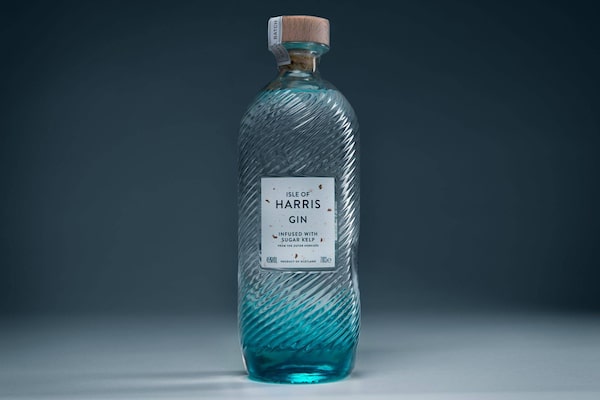
A new distillery on the Isle of Harris produces gin with flavours of juniper, citrus and, most uniquely, kelp.Courtesy of Isle of Harris/The Globe and Mail
Even by Scottish standards, the Isle of Harris qualifies as rugged and remote. Located off the mainland's northwest coast in the archipelago known as the Outer Hebrides, it is mountainous, windswept and not exactly teeming with hipster night life (population: 2,000).
But it has long enjoyed one global claim to fame, Harris Tweed. The iconic woollen fabric, which according to parliamentary decree must be handwoven by islanders in their homes, has been gaining stature on high-fashion runways – exposure that's helping to bring a bit of monetary comfort to the economically challenged region.
Now Simon Erlanger, a veteran Scotch whisky executive, is intent on making a name for Harris with something else: gin. Launched last week in Ontario (its only cross-Atlantic market so far), Isle of Harris Gin is made by a new, independent distillery that Erlanger helped set up. Though crafted in the classic London-dry style, with prominent juniper, citrus and spice flavours, the white spirit boasts the subtle maritime essence of a distinguishing Hebridean ingredient, sugar kelp.
"I'm learning a lot about seaweed now," said Erlanger, managing director of Isle of Harris Distillers, on a recent visit to Toronto, where his gin was the featured pour at a promotional event for Harris Tweed and the Prince of Wales's Campaign for Wool. (The handsome decanter-style bottle features a swirled, bas-relief pattern designed to evoke the woven twill of the island's famous cloth.)
To stand out in today's flourishing gin sector, it helps to play up offbeat local ingredients as part of the "botanical" mix. That's why Erlanger, who spent 25 years in the Scottish whisky trade, including 15 as commercial director for Glenmorangie, and his team decided to scour the Harris coastline, which happens to be rich in Saccharina latissima. Sugar kelp, also known as devil's apron, is a yellow-brown algae that grows under water in large, floppy sheets and looks, at least to me, like it could be the decayed wing of a dead stingray.
In fairness, the ingredient's fishy, lagoon-like aroma is barely discernible after its short infusion in the base spirit with eight other botanicals; mostly you may detect a delicate oyster-like note in the gin's background.
While it may stand out for its signature ingredient and hefty price (at $80, it's not a dram to drown in Schweppes or Fresca), Isle of Harris Gin is part of a booming category in a country synonymous with another spirit, whisky. Recently, a white tide has risen from that sea of brown, with Scotland now boasting more than 50 gin producers (and about 100 gins). There's been a 50 per cent spike in numbers over the past year alone, according to Visit Scotland, the national tourism organization. Most are small, craft-size operations, though a few established whisky distillers have seized on the trend with bigger-batch offerings.
"It's just exploded," Erlanger said. "There's hardly a bar in Scotland now that has less than 20 gins. Every weekend somewhere there's a gin festival. There are gin clubs, gin apps, gin maps.… It's becoming the new single malt in a way."
Underscoring the trend, this past September saw the inaugural Scottish Gin Awards, where the top prize went to Verdant Dry Gin from Dundee, a small distillery that produced its first batch only in May. Other noteworthy players include Kirkjuvagr from the Orkney Islands, which features such local botanicals as ramanas rose and burnet rose; Lussa Gin from the Isle of Jura, using lime flowers and bog myrtle; and House of Elrick, which is made with water from – yes, it had to happen – Loch Ness.
With some notable, longer-established exceptions, few brands have washed ashore in Canada, alas. Among those that have are the Botanist from Bruichladdich distillery in the Inner Hebrides, Caorunn from the Balmenach Distillery in Speyside and the much-lauded Edinburgh Gin, which in Canada is available only in Quebec and Alberta.
Then there's the $50-a-bottle global conqueror that got the superpremium-gin party started, Hendrick's. A brainchild of the family that owns whisky maker William Grant & Sons of Glenfiddich fame, it is made in South Ayrshire and was launched in 1999 with a brilliantly distinctive flavour based on an infusion of rose and cucumber.
And yet, one could debate whether Hendrick's should be considered Scottish at all, stylistically speaking. Dave Broom, a veteran spirits writer and author of Gin: The Manual, notes that "the brief" for Hendrick's distiller Lesley Gracie at the time was to make it smell like sitting in an English country rose garden eating cucumber sandwiches.
"I'd say the first Scottish-distilled gin to try and link botanicals to the immediate environment was Botanist," Broom told me, referring to a product that's uses 22 hand-harvested local ingredients from the island of Islay. He added that it's the producers that manage to make "a balanced, complex, characterful gin, and not just a London dry gin made in Scotland, which excite me the most."
Me, too. And that point is particularly noteworthy in the case of Scotland when one considers that the country has long turned out some of the biggest-volume "English" brands, including Tanqueray and Gordon's. Don't tell your friends in England – gin's traditional stronghold – but Scotland quietly accounts for 70 per cent of Britain's gin production.
At Isle of Harris, Erlanger knows his algae-infused spirit, made in a 300-litre pot still at a rate of just three batches a day, is destined to remain a niche product. And that's fine with him.
Eventually whisky will flow from Isle of Harris Distillers, for one thing. Spirit laid down for that purpose is resting in oak casks and will take several more years to mature. In the meantime, the gin, bottled fresh off the still, was created to get cash flowing.
In any case, Erlanger says the entire project was initiated by founder-chairman Anderson Bakewell, an American-born former musicologist who had long owned property in the region, mainly to create sustainable jobs and stem the population decline on Harris. "He spent three years trying to find a place to build a distillery," Erlanger said of the entrepreneur, who developed a love affair for the region since first visiting in the 1960s. "There's very little flat land on the island. It's mostly peat bogs and very, very tough granite."
Bakewell eventually recruited Erlanger and a former finance director at distiller Whyte & Mackay, who helped draw up a business plan that secured $18-million in grants and private equity. "We travelled to the U.S., to Europe, to Asia, and talked to a lot of people and told them our vision for the distillery," Erlanger said. "We explained that nobody was going to get rich out of this thing but that they would be part of something very special."
In that spirit, they chose to hire only island locals, who rely on consulting advice from two whisky-business veterans, including the former head of the Scotch Whisky Research Institute. That meant no workers with prior distilling experience, since there had never been a legal still on Harris. They are "the proudest people on the planet," Erlanger said of the five-member distilling team.
An Edinburgh resident, Erlanger flies in to spend two or three days a week at the distillery in the tiny village of Tarbert. He keeps a 500-cc Indian-made Royal Enfield motorcycle at an airport in Stornoway, an hour north, riding over rugged terrain, past green hills dotted with sheep, usually through fierce wind and rain, to get to the office. "Best commute in the world," he said.
Best, perhaps, as long as there's a bracing glass of fine gin waiting at the other end, I'd say.