
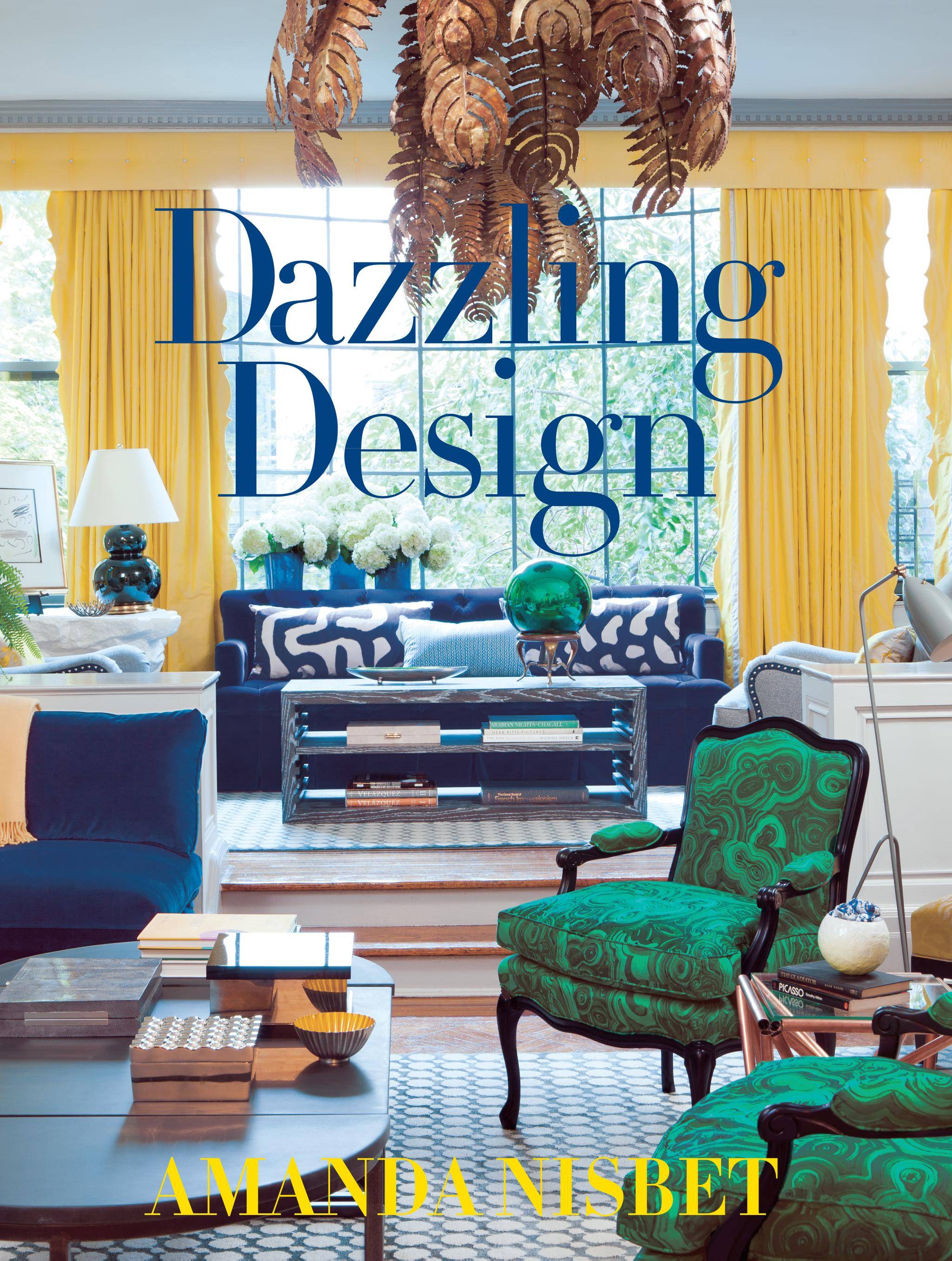
As with fashion today, when it comes to interiors, the magic is in the mix. And it's precisely that creative juxtaposition of colour, prints, textures and sensibilities that Canadian-born, New York-based Amanda Nisbet advocates. The much-lauded interior designer and author of the instructive book Dazzling Design, is a self-proclaimed "colour whisperer," with an inherent ability to create spaces that are simultaneously comfortable and elegant.
Nisbet left Montreal in 1980 for an American boarding school and, much to her parents' chagrin, never came back. A former aspiring actress, Nisbet studied art history and later worked with gemstones at Christie's auction house. Her time there honed her colour sense, and her acting training gave her the nerve to launch an interior design firm in 1998, despite not having any formal training.
Nisbet, much in demand for her unpretentious eye, now has her own lines of fabrics and lighting and is in Toronto this weekend for an appearance at the Interior Design Show. I spoke with Nisbet from New York to learn more about her bold design philosophy, how to give a room "soul," and how examining your own wardrobe can help you design your space.
You certainly didn't take a conventional path to interior designing. When did you first become so passionate about it?
As an acting student, I thought I was destined for fame and fortune, but I didn't get around to pursuing it until I got to New York when I was married and pregnant. Needless to say, auditioning for the ingénue roles when you're nine months pregnant doesn't amount to much. I did a short stint Off Broadway but was disappointed by the rejection that can easily happen. In the meantime, I was making the little apartment that I shared with my husband and my daughter a jewel box. My friends kept saying, "I love what you've done! It's so different!" I really didn't think it was that different, but by the time I had my son, when I was 28, I decided that I was ready to hang out a shingle and become an interior designer. I had absolutely no training in any facet of the business. I just wanted to earn a living and I really jumped off the cliff and the parachute came out. Thank god!
Where did your gutsiness come from?
It's sort of exciting. Maybe I just like to be busy and so I just went for it. And it turns out I loved it! As you know, anything you love doing is, for the most part, enjoyable. There's 10 per cent that's a pain in the neck, but I love it, so that keeps me going.
You mix colours in ways that require a lot of nerve. When did you start making that your signature?
When I started out, I had smaller budgets, and the easiest way to transform a space is with a bucket of paint. I love colour, and growing up in Montreal, my mother had a really colourful house – I guess to help ease the dark winters. So that's something I've always gravitated to and it became a signature inadvertently. I started out doing those small New York apartments – you really have to work with something like colour to give it some oomph.
But sometimes colour can close you in a little too much.
Oh, I've made some horrible mistakes!
I just made one recently on myself. I tried to do this sophisticated shade that I thought would be a yummy butterscotch pudding colour, and it turned out to be something that looked like an animal had been sick, so I had to get rid of it. We all make mistakes, but I do love playing with colours and how they can transform a space. And I love the juxtaposition of really odd colours – that is always fun to play with, instead of colours that match.
The juxtaposition of prints is also something that you have great fun with. How would you encourage people to be a little more experimental in their own homes?
With regards to pattern, I think it's nice to play small against big. So, for instance, if you were doing your curtains in a large-scale floral, maybe you can have some chairs in a smaller scale or a pinstripe so it's not all floral on floral. I think if you play with variations of scale and pattern, it helps make it more interesting. That's when I have fun.
It's almost the way people are dressing now. Look at what Gucci's sending down the runway. It's all a mishmash of wonderful patterns and colours and styles. How much would you say fashion inspires interior design?
So much. I feel so lucky that I live in New York and can just run across to the Bergdorf windows, which are some of the most fabulous windows in the world for fashion, and instantly be inspired for interior design. I think interior design really does follow fashion trends for the most part and, like you, I am incredibly inspired by what Gucci's doing right now. It takes a very eccentric client who can go that far with their interiors.
If one was trying to find a sense of style for their own environment, what would be your first piece of advice to them?
Often I tell people to just look at their own wardrobe. If you look in your wardrobe and you see a sea of light blue, clearly that's a colour you feel comfortable in.
If there's a lot of light blue in your closet, and if you veer towards very traditional tailoring, then you'd probably be more comfortable in a traditional room. Whereas, if you've got a Marni-type closet with a lot of asymmetrical lines, then maybe you're a little more adventurous in your furniture style and layout. I think that people don't even realize what they're looking at sometimes. If you look to your fashion closet, it often can dictate your interior design world.
Another big movement in fashion in recent seasons has been this idea of comfort first and foremost, which doesn't mean that you can't still be elegant. How does comfort versus a kind of sophistication factor in your work?
One of the foundations of my work is believing that elegance and comfort are not mutually exclusive. I lived in a beautiful, beautiful home but there were about six rickety chairs that we weren't allowed to sit in, so that drove me crazy. Since I started my career at the same time that I had young children, I've always tried to make comfort the driving force. But then you weave it in with elegance, because I couldn't stand the way rooms used to be, where you'd have the playroom and then the kids were always put in the basement. That's how we grew up. I wanted to make sure that in the living room, where we all sat, we could also watch TV, have a cocktail, play board games…but also that the room didn't feel like a playroom.
How well do you feel you have to get to know your clients before you launch into giving them your take on the way they should be living?
It's a very intimate relationship. I mean, I'm designing their personal space where they bring their family and their friends. So you really have to get to know the client and I try to do that through a series of two or three initial interviews, where I ask probing questions about how they like to live, down to where they like their socks in the drawer, and how they like to go to bed at night, and who leaves the light on and who doesn't if they're a couple. It's a pretty intimate relationship and it has to be because I've got to get inside their head and make it a home that looks like I was never there or never had any part of it. It has to be their home, [a place] that truly reflects them. I'd rather a room say that it's "Joe and Sue Smith" rather than "Amanda Nisbet-designed."
Amanda Nisbet will speak with Jeanne Beker during the Interior Design Show's Globe Style Saturday on Jan. 21 at 3 p.m. For more information, visit http://www.interiordesignshow.com/.
This interview has been condensed and edited.