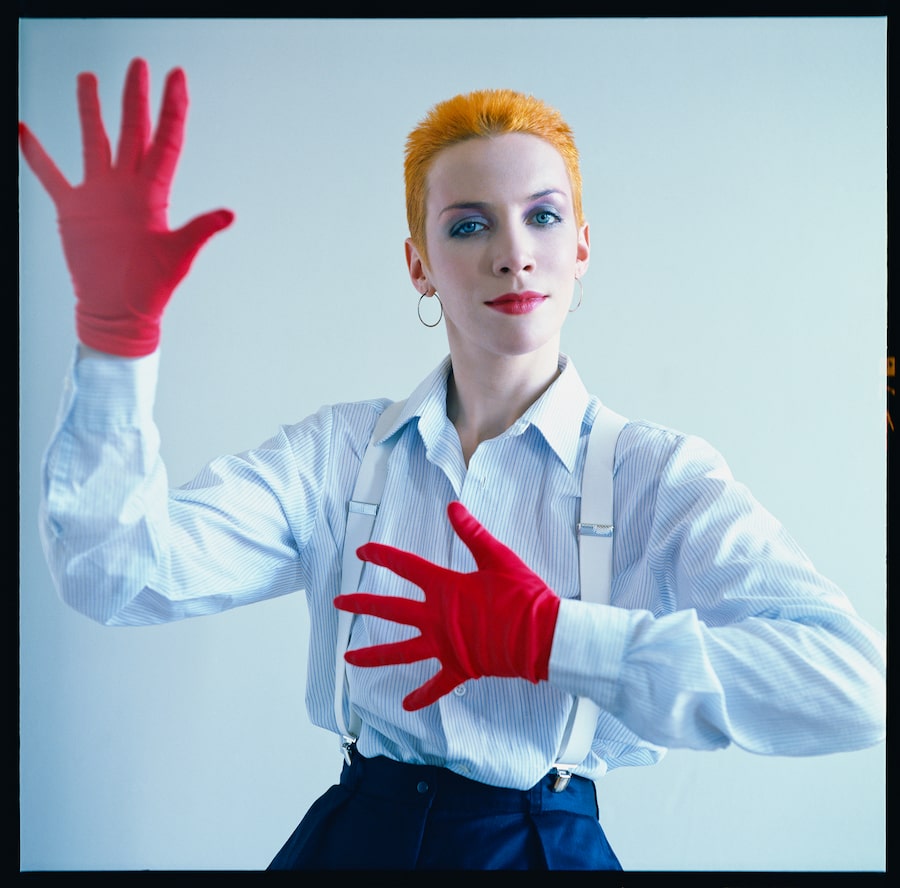
In the atrium of New York’s Bowery Hotel, pop music iconoclast Annie Lennox settles into a velvet chaise, dressed in a crisp tunic blouse, bright orange cardigan and relaxed jeans. For more than an hour, beside a sunny iron-framed window, she reflects on Retrospective, her new visual memoir published by Rizzoli. “Visionaries and petty thieves – I’ve been photographed by them both,” she says, flipping through marked pages.
She begins to comb through seven chapters that trace her five-decades-plus career in music – an archive of chart-topping and headline-grabbing moments across eight Eurythmics albums and six solo records. While it does contain the word retro in its title, the volume presents a modern chronicle of Lennox’s artistic and sartorial choices, ones that she regards as acts of resistance.
She is careful not to let her wardrobe be misunderstood as a superficial flex. “My clothes were not about making fashion statements,” she clarifies, gesturing toward book stills of herself in vintage men’s suits – the now-iconic outfits from Sweet Dreams (Are Made of This) and Love Is a Stranger. “They were experimentations – me using style as a tool to communicate and send the message that I was an equal partner in Eurythmics, not just another sexualized female singer, which was so expected in those days.”
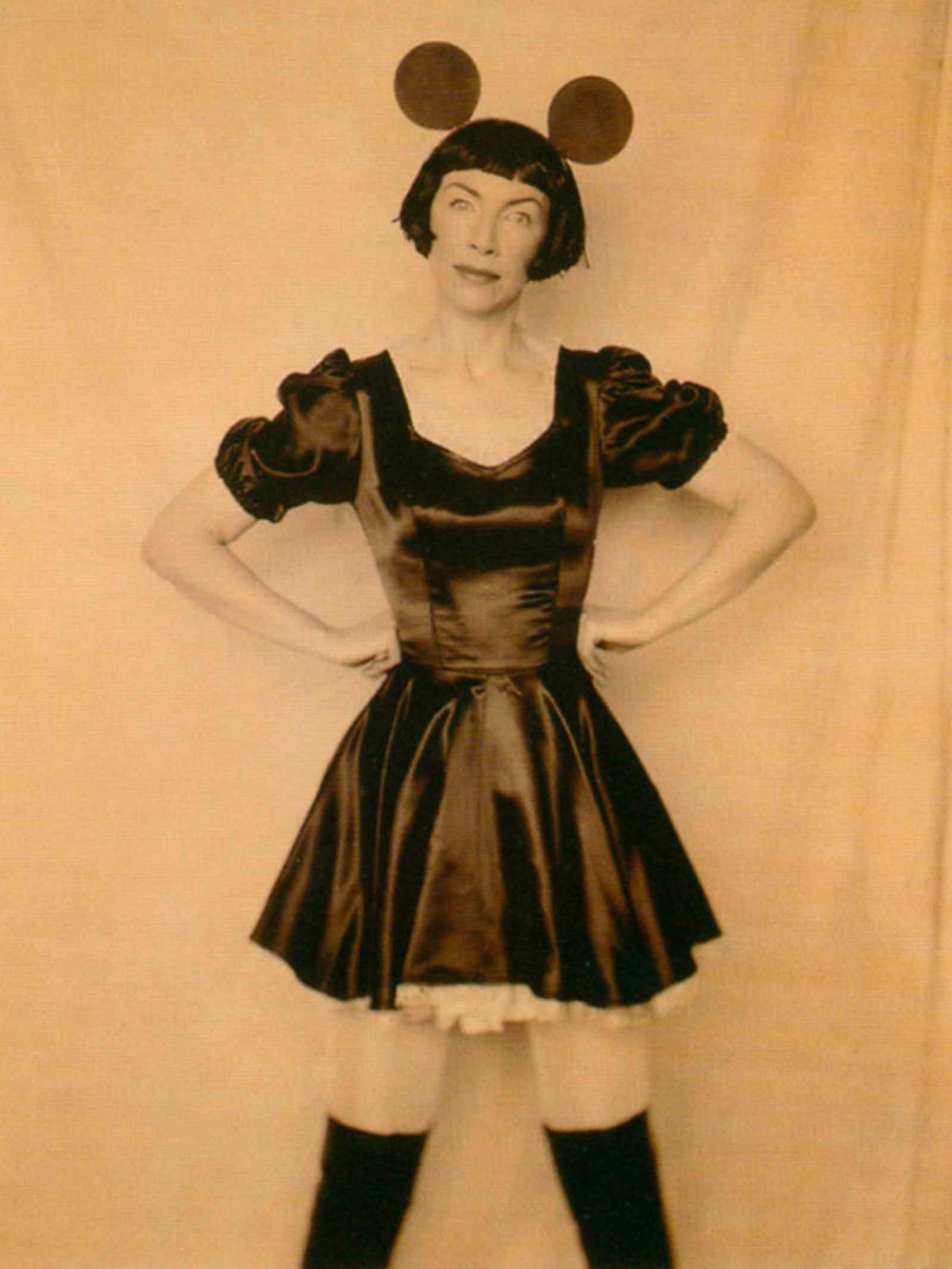
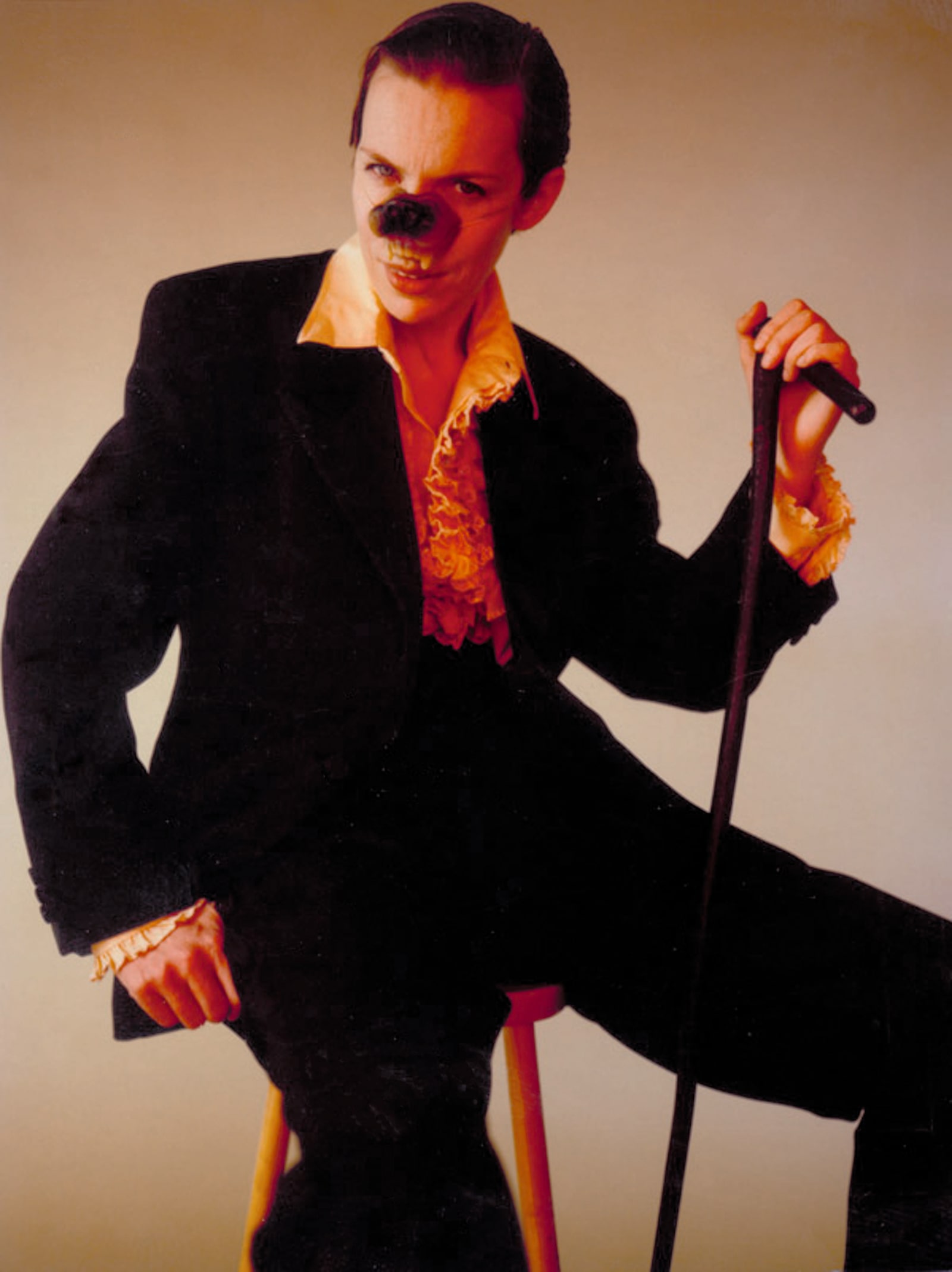
The sheer number of portraits prompts both pride and glee. Many times, she refers to her photos as acts of creation: “a privileged, shared declaration of art with profound people.” Those people include celebrated fashion photographers Richard Avedon and Ellen von Unwerth.
Her tone shifts when she returns to the petty thieves she mentioned earlier. “When you just look at someone like Princess Diana, who was hounded by paparazzi in such unpleasant ways that it led to her demise … it’s still so very disturbing,” she remarks. “I used to experience that kind of harassment when I was very visible, and it quickly turned into a violation of human rights. It feels like being mugged.”
Among the highly stylized photographs, Retrospective includes no paparazzi shots. Instead, Lennox sees her new book as a way to understand and curate her output, her way: “It’s extraordinary to present one’s life in a new context. It gives you a glimpse into the hard work before so many tech advances.”

Lennox and David Bowie perform at the Freddie Mercury Tribute Concert in 1992.Dave Benett/Supplied
Long before winning an Oscar, a Golden Globe and four Grammys, Lennox drew inspiration from revolutionary figures. She cites performance artists Gilbert and George and Lindsay Kemp – “baffling, magical and true subversives” – and singers Grace Jones (“a goddess”), Joni Mitchell (“a blueprint”) and David Bowie as early beacons.
A photo in Retrospective by Dave Benett captures Lennox and Bowie intensely embracing as they perform Under Pressure at the 1992 Freddie Mercury Tribute Concert. “I was so drawn to albums like Aladdin Sane and Ziggy Stardust because [Bowie] was a phenomenon – someone completely from another planet. In some ways, I felt the same.”
As a younger person, Lennox recalls, “I always ended up sitting with the child no one was talking to; I still love people who are different. They are the most interesting to me.”
Like Bowie, Lennox wrestled with convention and flirted with androgyny. In her 20s, she dropped out of London’s Royal Academy of Music, met Dave Stewart, fell in love, moved in and then joined two short-lived bands with him, including The Tourists, before finally forming Eurythmics.
Lennox and Stewart broke up before Sweet Dreams became a success. As artistic collaborators and friends, they went on to pioneer a sharper new wave sound – merging soul music with synthesizers. Together, they ensured videos were more than promotional pin-up flicks. Long before TikTok’s era of fleeting virality, they distilled politics and critique into sharp, short, biting visuals.
Lennox says their aesthetics were vital to their music, echoing the manifesto printed in the band’s last major world tour in 1989: “entertainment can still carry an edge that shocks, challenges and disturbs the status quo.”
Playing with envelope-pushing concepts became part of Eurythmics’ formula – and it followed into Lennox’s solo career. “Creating this book and looking back at all I’ve achieved has given me the confidence to start writing again,” she says, noting that a mysterious film and music project is waiting for her at home, on her desk (her last album of original pop songs was in 2007).

Lennox says Eurythmics' aesthetics were vital to their music.Lewis Ziolek/Supplied
She cites breaking new ground in pop’s “frustrating boys’ club” as one of her early accomplishments. When MTV first aired Eurythmics’ Love Is a Stranger, the video was pulled mid-broadcast after a scene in which Annie Lennox removes a blonde, Dynasty-style wig, transforming from fur-draped seductress to a sharp-suited British banker bro. In the 1980s, amid rising TV censorship led by religious groups such as Morality in Media, Lennox’s gender-puréeing was considered a threat to the nuclear family.
Yet her androgyny made her a lasting emblem of fearless self-expression.
Her influence took hold of the runways too: Designers drew on Lennox’s playful, boundary-crushing spirit in Louis Vuitton’s Fall 2007 men’s wear, Dolce & Gabbana’s Spring 2011 men’s wear and Jean Paul Gaultier’s Spring 2013 collections. Lennox herself remains ambivalent about the label of fashion muse: “I think being styled or having a stylist is like surrendering your identity. I usually brought my own suitcase of vintage clothing to sets,” she explains. “So many times, when you do a shoot, they want those credits beside your face and body – hair by, makeup by, jewellery by, clothes by.”
Armani asked her to be the face of the house numerous times; each instance, Lennox politely declined. “It was flattering but I had to defend my autonomy,” she says. “Madonna – who is a massive entity – started normalizing that trade-off. She was wearing Versace, but I didn’t want to be an entity like that, a sellable entity. I didn’t want to become a mannequin for the corporate industry.”
Cases in point: Retrospective’s concert photos, from Eurythmics’ 1986 Revenge tour. Dressed in black leather trenches and pants reminiscent of The Matrix movie, Lennox would rip off shirts mid-performance, singing Missionary Man and Thorn in My Side with visceral fury. “They wanted me to dress conventionally feminine, girly et cetera, but I was [giving] a finger up to the establishment,” she says, smirking. “I do believe what you wear gives you permission to become other than what you are. So I thought: You want to look at me as a sex object? I’m going to give it to you – but it’s on my terms.”

Scottish vocalist Annie Lennox of new wave duo Eurythmics performs in Paris in 1984.ISABELLE ALEXANDRE/Getty Images
Those terms took a provocative turn when Lennox teamed with music video director Sophie Muller to create a video album for Eurythmics’ Savage in 1987. Its aim was to turn the tables on a plethora of female archetypes. In Beethoven (I Love To Listen To), Lennox portrays a manic, provincial, OCD housewife, then transforms in I Need a Man into a flamboyant, lust-driven vamp – hitting the streets like a sexy menace in the suburbs. Wearing a big blonde wig, baby-blue sequin gown and white stilettos, Lennox described herself as “a woman dressed as a man, dressed as a woman,” driving home her message that gender – and power – should never be fixed.
“When I look at what we did, I think about Marilyn Monroe – the ultimate sex symbol, so fragile, messed up, but highly intelligent and never given her due as an artist,” she reflects. “The video to I Need a Man amplified the epitome of the femme sex goddess – [this] really [screwed] up bombshell but mixed with this kind of carnal Mick Jagger swagger – the two gender extremes. Savage came together when the descriptor of being gender fluid was not even invented yet.”
In light of Taylor Swift’s recent reinvention with The Life of a Showgirl, Lennox’s 1992 solo debut Diva has gained renewed attention. Lennox, unaware of the comparison, laughs off the parallel. Instead, she talks about the video for Why, in which she appears in Vegas chorus-line regalia – a feathered red headdress, thick makeup and a shimmering dress. Diva was her way of confronting “aging in show business,” she says. “I never called myself a diva; it is like my own private joke.”
In the video for Little Bird, shot when she was seven months pregnant with her first daughter Lola, she’s surrounded by drag performers, each dressed as one of her past personas, from Sweet Dreams to Diva. She is dressed as their ringleader in a Sally Bowles-ish, Cabaret-style costume, orchestrating the chaos. “Is it drag? Am I drag? What is drag?” she asks, looking at a photo of herself with her many doubles. “Who knows when it comes to this?” Leaving the question up for interpretation is her superpower.
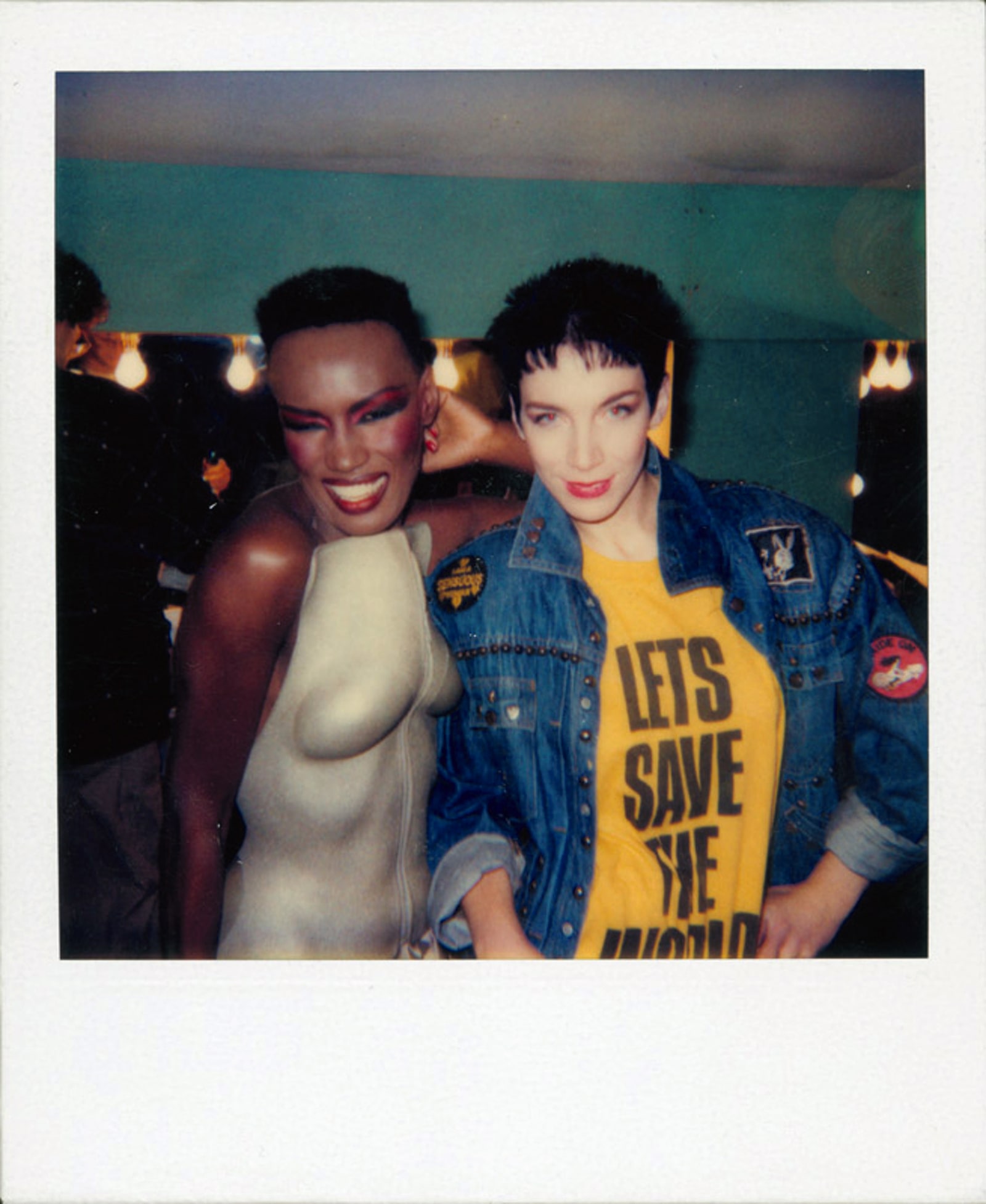
By the time Bare arrived in 2003, Lennox sought to strip away all the wigs and gloss. “I didn’t want to be Leibovitzed,” she says, referring to celeb snapper Annie Leibovitz. “I just didn’t want to be stamped with only that aesthetic, so I photographed myself.”
Her skin is covered in pale clay dust, her gaze steady, and around her neck is a tartan strip, indicating her Scottish background. “I’ve always been Scotland’s girl,” she says of the country that has claimed her as one of its greatest luminaries and exports. “While I’m proud of that, they don’t own me. I feel like I am a citizen of the world.”
Lennox, now 70, has spent decades expressing that sentiment and has long advocated for HIV/AIDS causes and women’s empowerment. She recently recorded Superlover, a duet calling for world peace, with Montreal-born singer/songwriter Allison Russell, a track which is currently being considered for two Grammys.
The final photograph in Retrospective shows her most recent self, lounging and beaming outside her Mallorca home. Taken by her youngest daughter, Tali, the image captures Lennox in a vibrant outfit covered in a print of large pineapples. Beside the image are the lyrics to a song she wrote called A Thousand Beautiful Things, a track she released in 2003 that sought to define her gratitude without sounding trite. “I got it on sale at a Mundaka department store – I thought: nobody wants to wear this, so I will,” she says. As the interview wraps up, she mirrors the song’s spirit: “For years I was looking for reasons to exist,” she says, tapping her tome. “I found so many – and some are right in here.”