Welcome to The Globe’s Recipe Lab, where food culture reporter Dakshana Bascaramurty explores what makes recipes work well.
If you are the person who always volunteers to make desserts for gatherings, you are probably a show-off who thrives on external validation. I know this because I am this person. At the dinner parties I attend, we clear the plates and bring out dessert with ceremony. The pressure is high, but so is the glory if you nail the execution.
Cookbook author Carla Lalli Music gets brutally honest about recipes
Every month for the past three years, I’ve gotten together with the same group of five friends at one of our homes and I always bring dessert. I’ve made tarts, pies, mousses and even a Baked Alaska. There have been goofs along the way, but my friends always obediently ooh and ahh. Each month presents an opportunity to challenge myself but, more importantly, to impress.
The objective
A show-stopping dessert that tastes like it came from a patisserie.

As a starting point, I thought of my favourite desserts. Many of them – Paris-Brest, profiteroles and éclairs – are made with choux pastry. You prepare choux by cooking milk, water, butter and flour on the stove and then later mixing in eggs. Then you pipe it out of a pastry bag and bake it.
I’d always been intimidated by the twice-cooked pastry and my piping skills are shaky at best, but then I learned about the Polish dessert karpatka. Instead of piping it, you bake the choux in two cake pans, sandwich cream between the choux discs and slice it like a cake.
I was drawn to a plum-and-mascarpone karpatka recipe found in London-based pastry chef Nicola Lamb’s cookbook Sift. The first half of the James Beard Award-winning Sift is very much a textbook, where Lamb explains concepts like starch gelatinization (which, in choux, is responsible for the beautiful puff that happens during baking). Knowing the science behind each step made me more willing to diligently follow the recipe.
“This is a great way that people can learn how to make choux stress-free,” she told me on Zoom call. “Everyone can spread choux in a tin.”
The process
The recipe says it will take 3 hours and 10 minutes (it took me an hour longer because I only had one pan that was the right size).
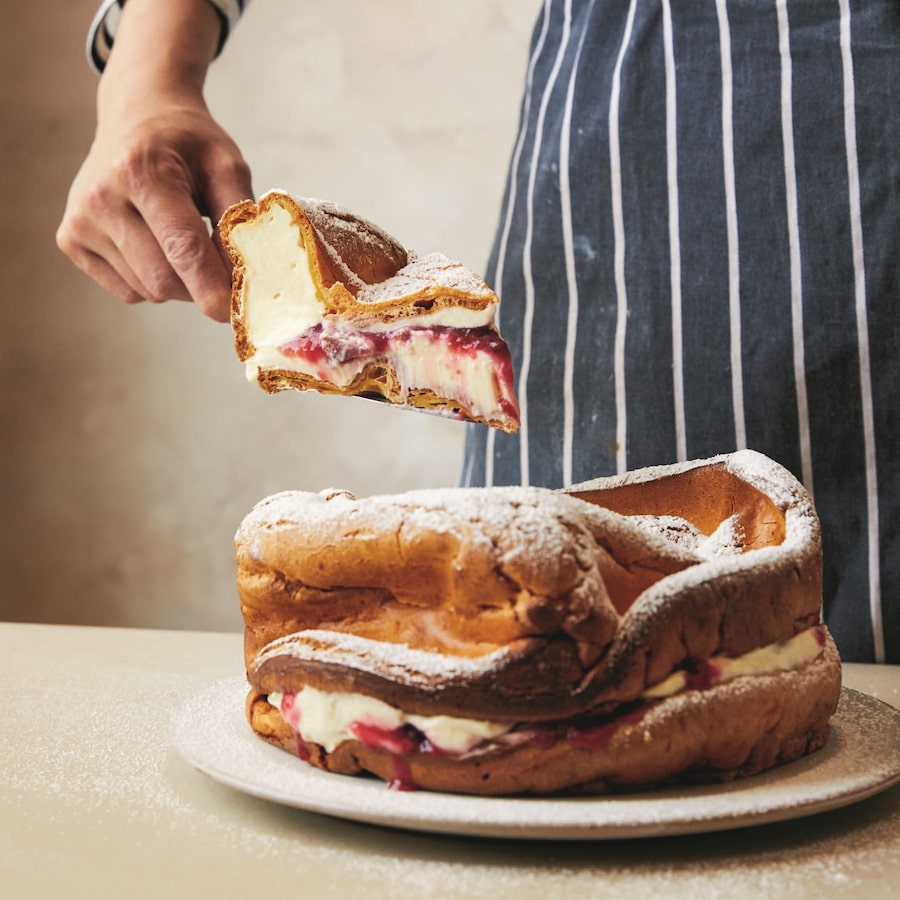
Choux: The recipe for the choux was detailed and I followed it to a T: sifting the flour multiple times, adding three instead of four eggs after weighing them, looking for the visual cues Lamb lists (I knew my choux was ready to bake when the glossy paste slowly dropped off my mixer’s paddle attachment). One of my finished discs had a single steep “hill” jutting from its centre, while the other had the more dramatic topography of Cape Breton Island. The unconventional addition of baking powder encourages extra lift and “a pleasingly irregular shape,” Lamb explains.
Filling: Karpatka is usually filled with crème mousseline – a velvety pastry cream that has softened butter whipped into it – but if you’re making it ahead, the butter hardens in the fridge, ruining the texture, and it won’t return to its original airy form unless you rewhip it. Lamb fills her karpatka with a mascarpone custard, which she described as her “tried and true number one babe,” both stiff and sliceable.
I’ve made custards that were too runny or got burnt on the bottom, but this one came out perfectly. I splurged on a higher-fat mascarpone from Italy, which gave the filling more thickness and structure. Rather than whipping by hand, I let my stand mixer aerate it.
Plums: As the plums cooked, their golden interiors released a light blush liquid that deepened into garnet after a few minutes. I probably should’ve separated the plums from their syrup before layering them into the tin, as the sweet, sticky liquid leaked out (I wisely put a plate under the springform pan to catch the leaks).
The result
That evening at my friend’s place, I dusted the karpatka with powdered sugar before serving.
“Do you hear that?” my friend Mary-Catherine asked, her eyes wide with delight, as I sliced into it. Though it had spent seven hours in the fridge, the top layer of choux had retained an audible crackle.
The delicate crispness of the choux gave way to a lighter, chewier layer underneath with a welcome saltiness thanks to my use of salted butter rather than the unsalted Lamb calls for (the only bit of freestyling I did). The mascarpone cream was cold and lush. The plums were jammy-sweet and a little tart.
Over all, it was beautiful and tasty but a bit messy on account of the plum syrup pooling on the serving plate.
Before I’d finished chewing my first bite, I noticed my friend Lindsay had already finished her slice. “Can I have another piece?” she asked, grinning. Is there any greater compliment?
Excerpted from Sift by Nicola Lamb, published by Penguin Random House