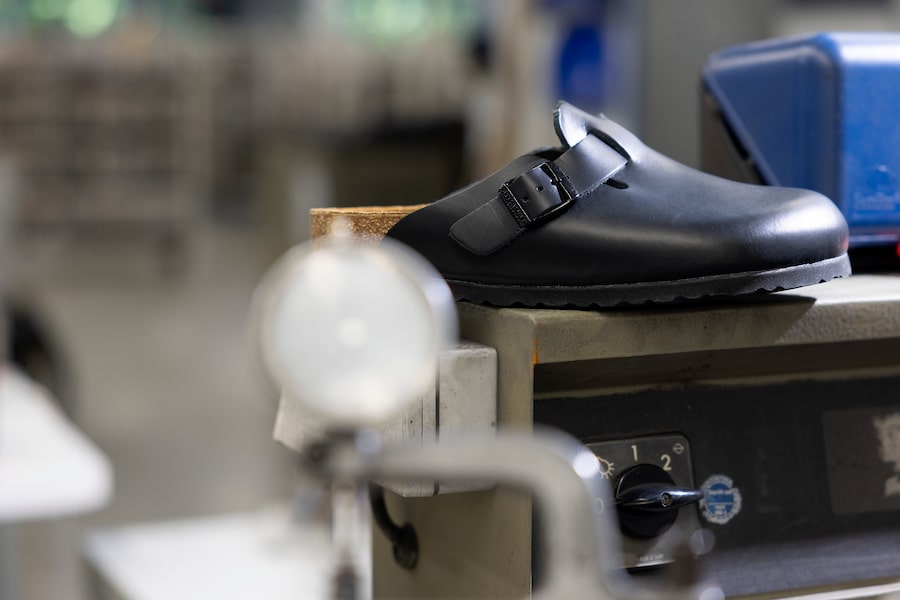
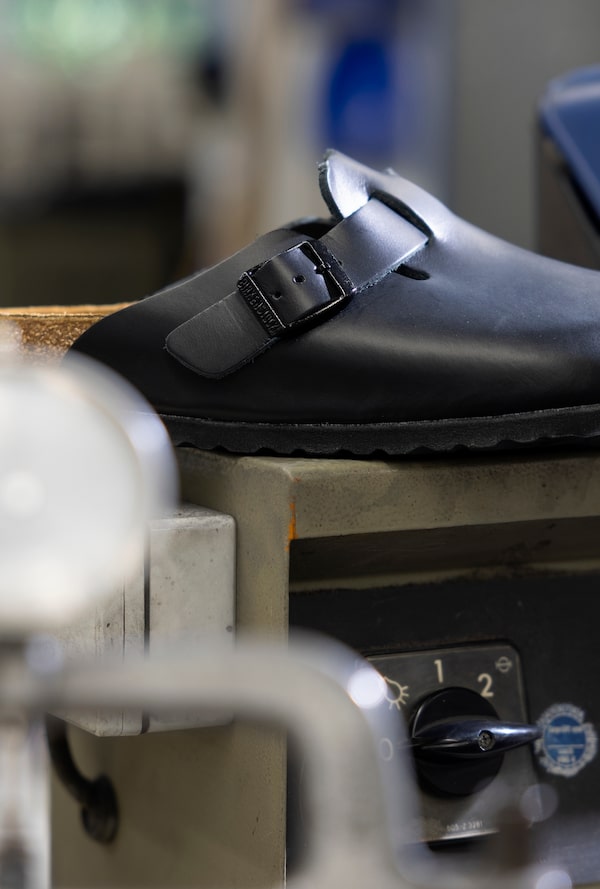
Not far from the historical centre of Görlitz, Germany, with its sleepy-eyed dormer windowed rooftops, is the factory where Birkenstock manufactures its famous cork footbeds.
A humming hub of activity, where the sustainably harvested material is compressed, cut and shaped, the facility is the focus of the brand’s local legacy and centuries of innovation in the realm of comfort-conscious footwear.
Lately, there’s also a lot of hometown pride for Birkenstock’s fashion collaborations with the likes of Manolo Blahnik and Rick Owens. For the brand, the goal of these designer moments is cultural relevance and placing their shoes in new, unexpected contexts.
Its chief product officer, Markus Baum, is quick to note that these styles are distinguishable from the glut of sartorial mash-ups that have become all too ubiquitous in the fashion industry over the past decade – partnerships that often feel more like cash grabs than genuine meetings of creative minds. “Fashion came to us,” he says.
The Boston, however, isn’t Birkenstock’s most popular offering. That honour goes to what’s perhaps its quickest-to-mind design, the dual-strapped Arizona. This hardy model, which has been around since the early 1970s, was long associated with the crunchy-granola set thanks to its humble, utilitarian look and the company’s comfort-centric raison d’être. But thanks to successful reimagining by labels including Staud and Proenza Schouler, the Arizona has evolved to be synonymous with an easy sort of chic.
Well-heeled architect, curator and artistic director of the DesignTO festival in Toronto Deborah Wang says she’s been wearing Birkenstocks since she was a teenager in the 1990s. Her love affair with the low-key flats began with a pair of trusty brown Arizonas, and she now owns a dozen pairs.

The dual-strapped Arizona, which has been around since the early 1970s, is Birkenstock's most popular model.Michael Probst/The Associated Press
Wang points to her innate practicality as a key motivator in turning to Birkenstock’s uncomplicated and ungendered styles day-to-day, noting that she has a pair to suit any need from an indoor slipper to dressy industry outings.
Those options include what’s been dubbed her “croissant shoes” – a layered-strap suede style called the Kyoto. Its intriguing texture and thoughtful, minimalist design fits Wang’s attention to every detail.
“There’s a simplicity and pragmatism that’s attractive to me,” she says. “I know I can stand at an event for hours. And as someone who has multiple jobs, having a streamlined wardrobe gives me more bandwidth, mentally.”
Elizabeth Semmelhack, senior curator at Toronto’s Bata Shoe Museum, points to Birkenstock’s unique ability to imply so many things at once. “Embodied within that one form of footwear is a great deal of cultural meaning,” she says. “The term ‘Birkenstock liberal’ was used in American politics to identify people who are too – quote, unquote – ‘left leaning.’”
Bata’s collection contains a more posh than political example of Birkenstock’s enduring appeal. “We acquired a pair of Manolo Blahnik’s Birkenstock collab for the museum years ago,” she says. “They’re a beautiful mix of a rich velvet upper and rhinestone-embellished buckle. They’re a Boston model, and [the brand] did the work of making it comfortable. It’s a good example of a high-fashion collab retaining a brand’s DNA.”
For Baum, that’s imperative when embarking on a collaboration. “People bring their ideas, we come with our ideas,” he says of the company’s calcified partnership process. “The final idea has to work in our own factories. It’s very down-to-earth, and we’re not trying too hard.”
The Globe and Mail Style Magazine travelled to Germany as a guest of Birkenstock. The company did not review or approve this article prior to publication.