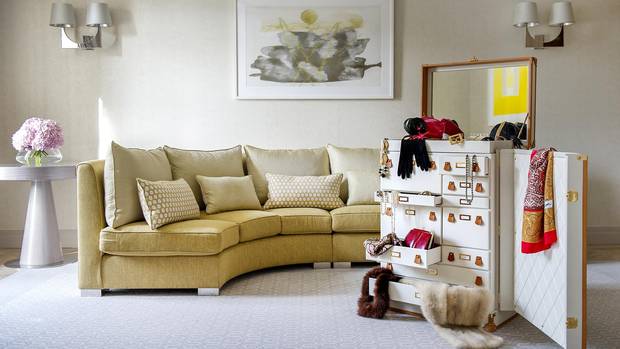
The new Grand Terrace Suite at the Berkeley Hotel in London's Knightsbridge is like a Richard Neutra bungalow reimagined for next month's Elle Decoration in voluptuous loungers and sleek teak. It catches the morning sun, so that the custom marble furnishings on the terrace positively gleam.
They can wait; another kind of glimmer has caught my attention. In the dressing room is a fine white-leather steamer trunk, its top lifted to reveal a suede tray arranged with vintage baubles. Beneath it, leather-pull drawers are labelled with European names few of us will have had the privilege of wearing: Chanel, Givenchy, Courrèges.
Draped over the mirror is a vintage Dior fox-fur scarf, which I wrap around my neck with hands cosseted by Hermès elbow gloves. In the closet is a tan Burberry trench coat. Now, I'm ready for that terrace.
I look nothing short of ridiculous, having thrown on all this expensive clobber, and some costume Chanel pearls to boot. All dressed up and nowhere to go, I feel eight years old again.
That's not quite the point of the Berkeley's Fashion Trunk program. And I'm not the target demographic for the 11 suites in which it is offered. Keeping a wardrobe of high-fashion accessories spun out of the perennial pressure felt by luxury hotels in an increasingly crowded and competitive industry.
A few years ago, the Berkeley's corporate head office sought out a deal with Vestiaire Collective, a consignment operation that stocks high-end, mint-condition pieces for fashion aficionados without the time or patience to trawl for treasures. (The raincoats were a more recent addition – and they're all brand new.) White-gloved attendants lay out everything in the handmade trunk, customized for the Berkeley by Norton MacCullough & Locke, with the invitation to go wild. Best of all, no money changes hands – although the $4,500-a-night cost of the Grand Terrace Suite should more than cover everyone's costs.
The partnership gave the Berkeley access to first-rate luxury one-offs in perhaps the world's most fertile market for designer vintage. Occupants of the suites can leave their precious possessions safely at home and still make a splash at the ball. And at the end of their stay, they may opt to buy something outright – the Chanel handbags are always the first to go. Advantage: Vestiaire.
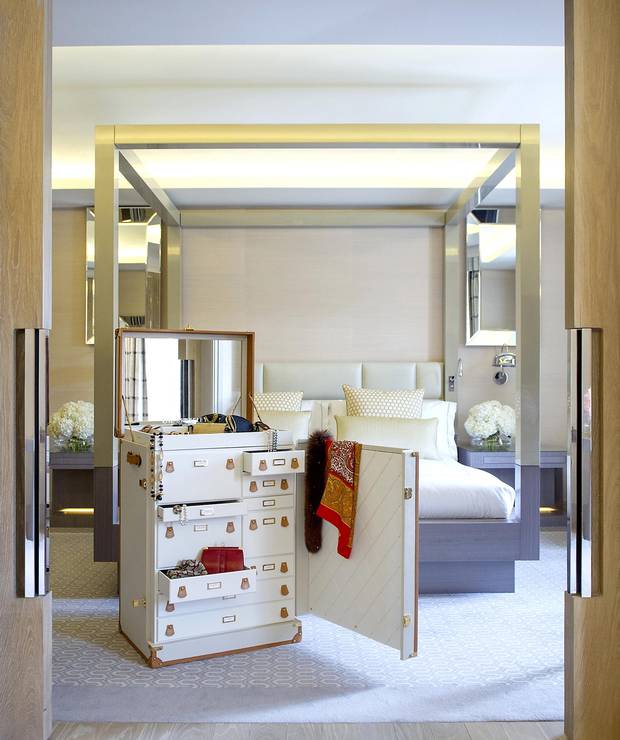
The Berkeley’s corporate head office sought out a deal with Vestiaire Collective, a consignment operation that stocks high-end, mint-condition pieces for fashion aficionados without the time or patience to trawl for treasures.
The idea is not so avant-garde. The Hotel Croydon in Miami Beach operates a loan program at the in-house concept store Wanderlista, a source for exotic metallic handbags and jewellery.
And the W Hotel in London's Leicester Square, which overlooks the city's primary theatre for red-carpet premieres, pushes a program called Walk-in Wardrobe, which invites guests of its five suites to select complimentary evening wear during their stay. The supplier, GirlMeetsDress.com, carries Marc Jacobs, Victoria Beckham, Lanvin and other designer labels; you preorder and the W has it waiting in the closet when you check in. No need to schlep unwieldy garment bags.
Yet, programs that deal with such personal commodities as clothing are difficult to sustain, even if they bring us all closer to the ideal of luggage-free travel – a freedom you'd think big-spending travellers would relish. Clothing-rental services tend to do well when directed at millennials, but only at home; hotels have yet to successfully harness that demand.
Three years ago, New York's James Hotel launched a designer accessories rental at its Tribeca location. Alas, it fielded more demand from the travel press than the general public. A spokesman for the James confirms the hotel discontinued its program last year.
Not even fashion-branded hotels such as Palazzo Versace and Armani Hotel in Dubai have floated the idea. Their Middle Eastern and Asian guests, generally, would sooner buy outright.
Brooklyn-based entrepreneurs Andrew Zahornacky and Aaron Liskov appeared on Season 8 of Shark Tank with a concept inspired by the beauty-box business Birchbox and the designer dress-rental operation Rent the Runway.
UnPack targeted high-frequency travellers with stylish suitcases packed with a well-curated wardrobe – including winter coats, umbrellas, formal wear, even phone chargers. A suitcase would be waiting at your hotel on arrival. "People don't want to ship their clothes," Zahornacky says. "It makes people nervous."
The company forged partnerships with top-quality brands and negotiated with boutique and larger-scale hotels in major centres such as New York and Boston before ultimately stepping away from the idea. The simple reason, according to Zahornacky: "It's hard to guess what people want to wear." As an example, he points to Trunk Club, a bespoke shopping service for men (the aforementioned "trunk" gets shipped to the client for perusal), which Nordstrom purchased for $350-million (U.S) before taking a $200-million writedown. "Those companies are finding it difficult."
But watch this space, Zahornacky says. "We will see bigger leaps in clothes renting," he adds. "It's something that's going to be done, even if it's not us."