More skiing: | Finding value at Switzerland's Verbier ski resort | Alpine fun at Poland’s Zakopane | A history lesson on the slopes of Austria
I stood atop a 15-metre-wide ridge, astonished by how the world fell away on either side. I gazed in awe at uninterrupted views of the French Alps before attaching my climbing skins to the bottom of my skis, running my hand from tip to tail to ensure my trek into the backcountry around the Sainte-Foy Tarentaise ski area wouldn’t be hindered by anything other than my own lack of fitness.
The chairlift that accessed the ridge, which rose from the Tarentaise Valley on the French-Italian border, remained empty. In North America, this would be a world-class resort. In France, this 2,620-metre slope is just another small hill.
And my group of eight had it all to ourselves.

Glide across the the border into neighbouring Italy.
On the way to Sainte-Foy Tarentaise in the heart of the French Alps, our driver explained that it’s his favourite ski area in the region because of the wooded terrain and backcountry access. He spoke passionately about the resort, revealing that his kids grew up skiing there and that his wife runs the ski school.
I travelled to Europe for the same reason many avid skiers do – for a shot at steep lines with untracked powder, a chance to explore unknown resorts that rival the best in North America and for a touch of an unfamiliar culture.
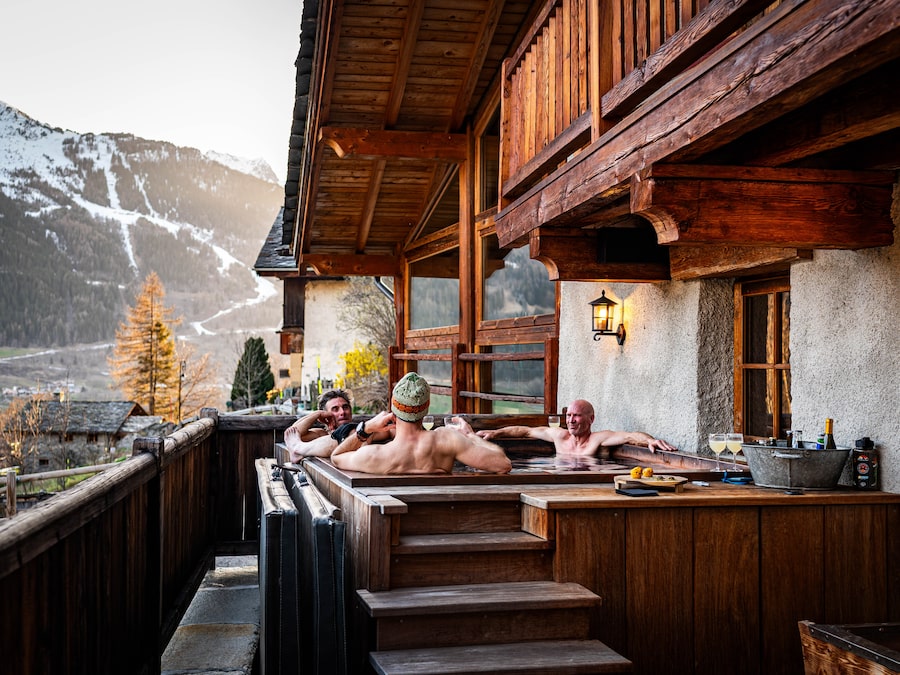
I couldn’t help but enjoy the other aspects that go hand-in-hand with a European ski trip: having an espresso between runs after gliding across the border into Italy, sipping cocktails on sun-drenched decks at mid-mountain restaurants, or admiring craggy peaks and endless valleys from the comfort of a steaming hot tub.

Chalet staff can arrange heli-skiing on nearby Italian slopes since it is not allowed in France.
An increasing number of skiers and riders are doing the same, fuelled in no small part by the high cost of skiing in North America. According to online booking platform Ski.com, 2025 European ski bookings increased by 33 per cent last year.
“We’re seeing a real ‘go farther for more’ mindset this season,” said Cat Iwanchuk, vice-president of business development at the travel company Ski.com. “The value equation is simply stronger abroad. When guests can stretch their budgets with inclusions like breakfast, walkable villages and, for many, use of Epic or Ikon passes, they’re willing to commit earlier and stay longer.”
The trend is expected to continue, with a large number of skiers flocking to Italy’s Dolomites (the entire region is virtually sold out in February) after watching the Winter Games.
But in southeastern France, the Tarentaise Valley, located just west of the Italian border, is home to several ski areas, making it a great option for those who want to avoid the Dolomites’ crowds this winter.

Cured meats and local cheeses are a staple of the French and Italian alps, and make for a perfect mid-day snack between runs.
Until the mid-20th century, the Tarentaise Valley’s economy was based mainly on the agriculture industry, with livestock grazing and cheese production.
“My family were always farmers,” said Jean-Noël Gaidet, who lives in Le Miroir and runs the mountain guide program in the Tarentaise Valley for the experiential travel company Eleven, that offers adventures and lodges.
Gaidet’s lineage in the valley dates back to the 16th century.
“Farming meant feeding your family. There was nothing else,” he said. “We still have farmers producing local cheese with goats and cows, but there are way fewer people doing it.”
As ski areas such as Tignes were established in the mid- to late-20th century, the valley gained recognition as a winter tourism destination – thanks to its terrain, snow conditions and countless high-end restaurants and hotels. Even with the exchange rate, it can offer a better bang for your buck than North America.

The valley, carved by the Isère River and stretching 180 kilometres from Albertville to the Iseran Pass, is dotted with small villages and hamlets that seem untouched by time. Like the sheer cliffs and glacier-capped peaks that surround them, they offer a glimpse into the past. Local restaurants and chalets pay homage to this, offering homemade cheeses and meats that often come from up the road. But, just beyond, ski areas such as Val d’Isère-Tignes, Les Trois Vallées and Les Arcs offer a stark contrast to these old villages.
Spending time skiing the backcountry terrain surrounding these resorts allowed us to seamlessly transition from the modern amenities and high-speed chairlifts to the charms of quiet villages. After partying at classic aprés bars like Cocorico at the base of Val d’Isère, where shoulder-to-shoulder crowds danced to covers of Taylor Swift and Oasis, we’d spend the following day slowing down, walking deep into the wilderness to ski under towering peaks, before popping out into small villages where we’d drink water piped directly from the glaciers above.
Our home base was Eleven Chalet Hibou in the quiet hamlet of Le Miroir. Perched high above the valley, this 200-year-old farmhouse was restored and converted into a luxury alpine lodge. When we weren’t dining or relaxing there, we’d wander the village’s sleepy streets, admiring the traditional stone and wood chalets, imagining what life in the Tarentaise Valley was like before the introduction of modern ski resorts and tourism.

Eleven Chalet Hibou's personal chef prepares steaks over an open flame at their nearby property, the Alpage, where guests can enjoy aprés and dinner.
One of our last days was spent in the backcountry around Sainte-Foy. After travelling nearly 15 kilometres, we collapsed onto plush leather sofas in front of a fire at Chalet Hibou. Its rustic wood ceilings and tables, terracotta floors and stone exterior create a comfortable, homey vibe. Old leather mountaineering boots and an ibex taxidermy mount hanging above the wood-burning fireplace complement the sweeping views of the Alps. But chef-prepared croque madame, served on homemade brioche, or cured meats and cheese made by a neighbour, serve as a reminder that this isn’t your run-of-the-mill ski lodge.
The Tarentaise Valley provided more than great skiing and crowdless slopes – it gave us an experience and friendships we won’t soon forget.
If you go
Fly into Geneva, Switzerland, which is just over an hour drive from Albertville, France – a gateway town to the Tarentaise Valley, and just over two hours from Le Miroir, where Eleven Chalet Hibou is located.
The Tarentaise Valley has several ski areas, many of which are interconnected through their piste and lift networks. Les Trois Vallées consists of seven ski resorts: Courchevel, Méribel, Brides-les-Bains, Les Menuires, Saint-Martin-de-Belleville, Val Thorens and Orelle. Epic Pass holders get seven consecutive days of skiing and riding at all of the interconnected resorts.

Eleven Chalet Pelerin and Eleven Chalet Hibou's rooms seamlessly blend luxury with the traditional feel of an alpine chalet.
Eleven Chalet Hibou, in the quiet hamlet of Le Miroir, is the perfect option for skiers or riders seeking an inclusive, curated experience. Itineraries are tailored for those who prefer to take a few laps on groomed pistes before aprés, to those who’d rather spend the day touring and skiing steep lines in the French backcountry or heli-skiing in the Italian backcountry.
The seven-room Chalet Hibou has specific dates that require a full-property buyout with a four-night minimum, but it also offers individual rooms starting at €1,700 ($2,700) a night. The price includes guided adventures at seven resorts, backcountry ski tours, all necessary gear, gourmet meals and aprés, ground transfers and prearrival planning. Heli-access skiing is not included in the base price. Eleven’s five-room Chalet Pelerin, located right next door, has an indoor pool but is available for buyouts only.
The writer was a guest of Eleven Chalet Hibou. It did not review or approve the story before publication.