Elizabeth Renzetti’s teenage son was born in the United States but raised in Canada and England. She whisks him off to Washington for a crash course in American history – and learns a thing or two herself
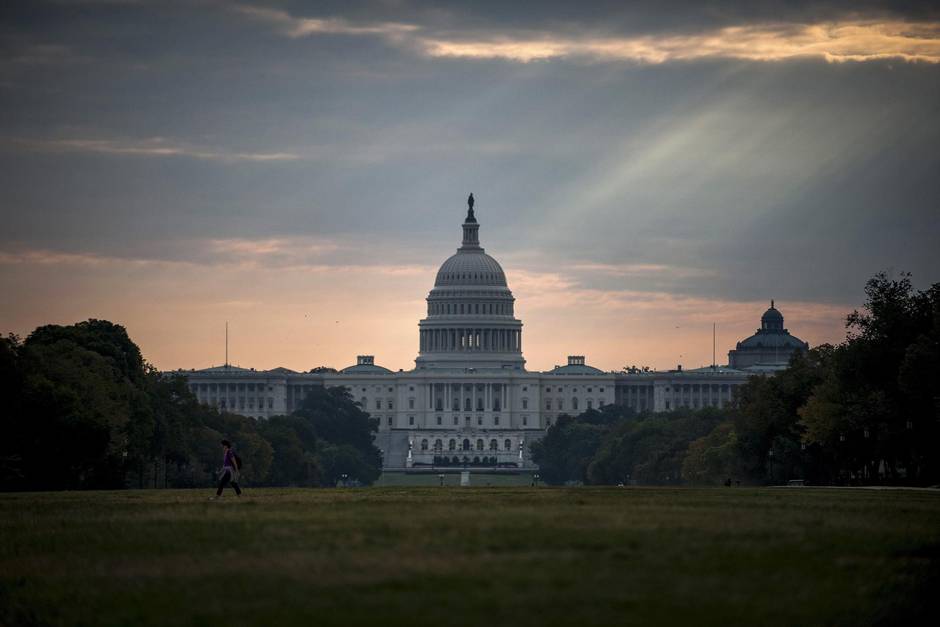
Donald Trump is haunting our trip to Washington, which is fair enough. He’s haunting most of America these days.
I’m reading an article in The Washington Post about stumping politicians’ visits to the Iowa State Fair, including a flying visit by the Republican front-runner in his “Trumpcopter.” Reading over my shoulder, my son Griff says, “Was he in the freak show? ‘Come on in and see the Orange Man!’”
Such disrespect! I have no idea where he gets it from. Then again, there is perhaps nothing in nature more given to disrespect than a 14-year-old boy. And Griff doesn’t even know about Mr. Trump’s particular antipathy toward people such as him: My son is, in the nasty parlance of the day, an “anchor baby.”
Fourteen years ago, Griff was born in Los Angeles while his father and I, non-Americans, were posted there. He is an American by birth, and a Canadian by citizenship, but he has spent most of his life living in Great Britain. It’s very confusing. Also, his understanding of his birthplace is shaped largely by Mad magazine, the Onion and the website People of Walmart. At least my childhood perceptions of America were forged in the intellectual fires of Creepy comic books and Saturday Night Live. And Mad magazine.

We have come to Washington to rectify the situation. Where better to learn about the history of this great land than here in its heart, the “malarious wasteland” once laced with open sewers that now encapsulates the best and worst of the country? A place of soaring monuments and a soaring murder rate. A place where the son of a single mother can fulfill the American dream by rising to the highest office in the land, yet which is still regarded as an open sewer by many of its citizens.
Over our four days I will attempt to answer Griff’s questions about America and its history, including: What do socialists believe? How do the presidential primaries work? Why is there no First World War monument in Washington? And so many questions of great import.
“When they build Ronald Reagan’s memorial, do you think it will be a giant jelly bean?” Griff whispers to me over the voice of our tour guide. We are on the National Mall, the city’s history-filled central park, looking up at the Washington Monument. I’m of the strong belief that you learn about a city only by walking around it, and D.C. offers many excellent walking tours. We have chosen “the Mall by twilight,” offered by an outfit called Free Tours by Foot. Partly I chose Free Tours based on its excellent reviews, and partly because its premise is so American: If you like the tour, you pay the guide what you think she deserves. If you don’t, you pay nothing.
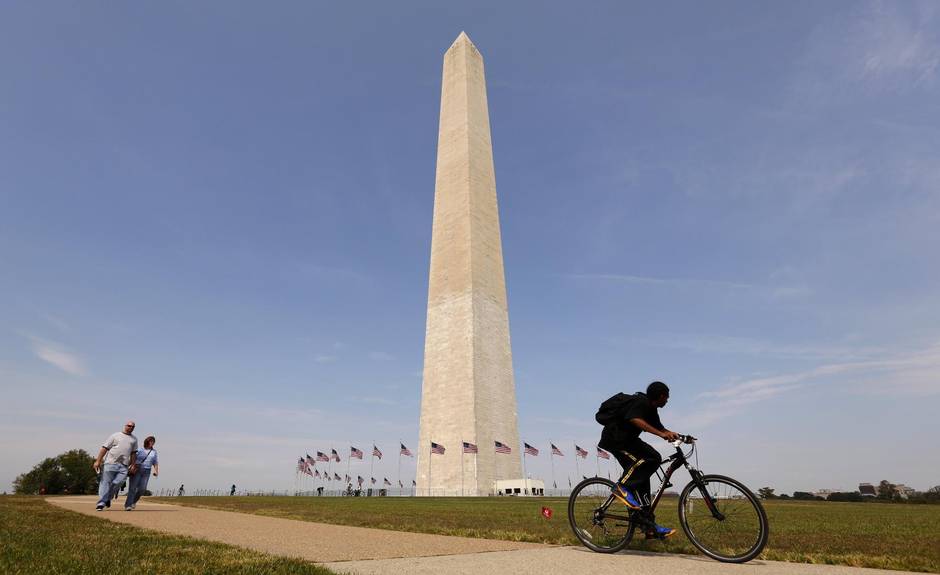
Our guide, Erin, is terrific, catering both to the more serious elements in the crowd and the ones, such as Griff and me, who are fascinated by the bizarre and macabre: For example, Washingtonians distinguish a presidential motorcade from more mundane motorcades by the ambulance that follows it. We stand at the base of the Washington Monument, looking east toward the beautiful, soon-to-open National Museum of African American History and Culture, and north toward the White House, which early Americans had once thought to call “the Presidential Palace.” (There was also a movement afoot to call George Washington “emperor,” a great error avoided, in hindsight.)
“When the new guy comes in,” Griff asks, gazing toward the White House, “will someone have to scrape the gum off the fancy desk?” The new guy might be a new gal, I remind him, and if it’s Obama’s gum, it’s probably Nicorette. That earns me a laugh. Score one for Mom.
We walk slowly past the Vietnam Veterans Memorial, which fascinates Griff (he has just seen Apocalypse Now). A full beer has been left as an offering to the dead soldiers. We listen as a man on our tour talks about how he narrowly escaped being drafted. The country’s history is alive here, among these people.
Ahead is the Lincoln Memorial, framed against the night sky, a sight so impressive it brings tears to my eyes. Here is the best of America: the spot where Martin Luther King Jr. told the world about his dream, where 75,000 people gathered to hear Marian Anderson sing in 1939 after she’d been denied a concert hall in the racially segregated city.

Even late at night the place is packed. I feel like Jimmy Stewart in Mr. Smith Goes to Washington as I stare at the words Lincoln spoke in Pennsylvania, now inscribed on the wall: “Four score and seven years ago our fathers brought forth on this continent, a new nation, conceived in liberty … ” Now I’m really crying, and Griff wanders away, possibly to find another mother.
The next day I’m reminded that the past lives in everyone we meet, and that reality is less a Frank Capra daydream than a Spike Lee nightmare. We are at Ford’s Theatre, where Lincoln was shot in 1865, listening to a talk by one of the U.S. National Park rangers who work here: “I didn’t even know about the Gettysburg Address until I came to Washington and saw it on the wall,” she says. She grew up in segregated Tennessee, where she was taught that Lincoln was a tyrant and that the “War Between the States” was an act of Northern aggression with a tragic end.
Downstairs, in the wonderful, tiny museum devoted to Lincoln’s life and death, Griff leans in to stare at John Wilkes Booth’s one-shot Deringer pistol, stored behind glass. The gun that changed history is tiny, much smaller than the ones he’s used to seeing in action movies. Later he learns that one of Lincoln’s sons threw apples off the roof of the White House at passersby – in other words, nothing has changed in 150 years. “He was the original Bart Simpson,” Griff whispers.
As we wander across Farragut Square, my eye is drawn to a statue with a square of brass underneath. “No, please, not another historic plaque,” my son moans. It’s too late, I’m busy reading. I tug him over, saying, “But this is the guy who said, ‘Damn the torpedoes!’” Griff’s eye roll can be felt on Neptune.
The city is, indeed, history-geekapalooza. The assortment of micro-museums is astonishing. The American Red Cross National HeadquartersVisitors’ Center? The International Spy Museum? The National Museum of American Jewish Military History? How about the IMF Center (“to heighten public awareness and understanding about the role of the International Monetary Fund”)? At the Bureau of Engraving and Printing you can watch money being printed, but you have to line up for tickets at 8 a.m., and we are not, to put it mildly, morning people.

Instead, we head to the Newseum, an astonishing, hands-on, high-tech temple to the noble art of newsgathering. “Noble art,” I murmur to Griff and he snorts, but he’s immediately entranced by a piece of actual Berlin Wall and its colourful graffiti. Upstairs is a huge gallery devoted to famous front pages through the years. Griff particularly loves the New York Post’s cheeky headlines “Tiger Admits: I’m a Cheetah” and “Headless Body in Topless Bar.” I tell him that Vincent Musetto, who wrote the latter headline, was a legendary editor who recently died. Punning headlines: Finally we have found a subject on which I have some expertise.
Our pun tour continues as we pass a restaurant called We the Pizza. If you haven’t got much dough, Washington is an exceptional place: Almost everything worth visiting is free. You can sit in on Supreme Court decisions when the court is in session and listen to free lectures when it’s not. The Library of Congress is worth a day alone. And, of course, there is the magnificent gift to the nation that is the Smithsonian complex – a universe of knowledge available completely free of charge.
We don’t have time to visit all 19 museums and parks under the Smithsonian umbrella, so we settle on two – the National Museum of American History and the National Museum of Natural History – and they’re both corkers. Unfortunately, our visit to the latter begins with an argument in the hall of taxidermied animals, underneath a giant stuffed polar bear rearing on its hind legs.
“Pretty soon all the polar bears are going to be in here,” Griff says.
I turn to him. “What is that supposed to mean?”
“You know they’re in trouble and there won’t be any left soon.”
As always when the subject turns to global warming, I become defensive and emotional. I try to excuse the inaction of my generation, and explain some of the advances in alternative energies that are under way around the world.
“You people,” he says – and I’m pretty sure he means “you old people” – “you’re always saying, ‘I’m going to start going to the gym tomorrow.’”
I don’t have an answer for that.
Things improve after a trip to the hot-dog truck and a quick walk next door to the Museum of American History. This may be my favourite place yet: Here you can see Julia Child’s kitchen, a terrifying vaccine gun from 1964 called the Ped-O-Jet, original Apple computers, school menus from the 1950s (“American chop suey”) and a gallery devoted to the presidency called “A Glorious Burden.” I might never have known otherwise that Johnny Cash played at Richard Nixon’s inaugural ball.
After four days, we’re exhausted. We have soaked up so much history that it’s coming out our pores, and Griff has seen what America strives to be at its best, and what it is capable of doing at its worst. On the way back to our hotel, we notice that someone has pasted to the bus shelter an attack on Donald Trump, comparing him to Senator Joseph McCarthy.
Griff turns to me. “Who’s Joseph McCarthy?”
And so it begins all over again.
If you go
Getting There
Porter Airlines flies direct to Dulles International from Toronto. Air Canada flies direct from Toronto, Ottawa and Montreal.
What to do
The Smithsonian Institution: The Smithsonian includes 19 museums and galleries plus the National Zoological Park in D.C. and Virginia. Entry is free, and museums are open every day except Christmas. si.edu
Newseum: A must-see for news junkies, the Newseum is fun, educational and, at times, deeply moving. Don’t miss the 9/11 exhibit, with its mangled piece of antenna from the North Tower of the World Trade Center and display of front pages from around the world. newseum.org
Ford’s Theatre: After visiting the site of Abraham Lincoln’s assassination (still a working theatre), cross the street to check out Petersen House, where the president died. fords.org
Library of Congress: To get the most out of the library, take a guided tour. But note that they run one hour: Younger guests might lose interest long before then. loc.gov
Free Tours by Foot: This name-your-price tour company runs a variety of tours in Washington, including evening ghost walks and a cupcake-and-dessert themed jaunt through Georgetown. freetoursbyfoot.com
For more information and to help plan your visit, visit washington.org.