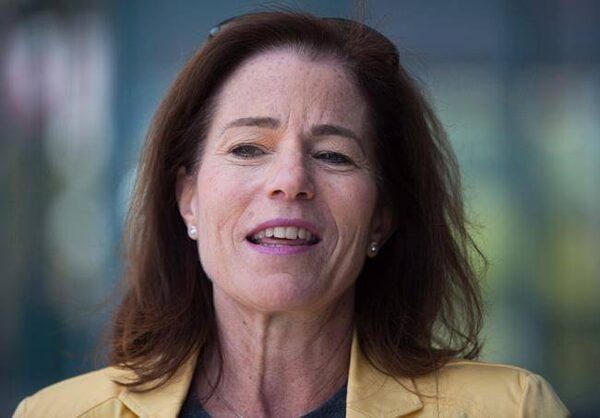
B.C. Municipal Affairs Minister Selina Robinson in Coquitlam, B.C., on May 7, 2017.Darryl Dyck/The Canadian Press
The news that corporate and union money will no longer be flowing into municipal elections has local politicians, advocacy groups and others cheering.
But they are also worried that there are still some loopholes in the proposed new legislation, announced Monday by Municipal Affairs Minister Selina Robinson, that will allow the millions of dollars now sloshing around civic campaigns to find new outlets.
"The experience in other jurisdictions has been that the stricter the limits (on campaign contributions), the more likely it is money from third parties will show up elsewhere," said Vancouver councillor Andrea Reimer, who lobbied for nearly a decade to get the rules changed.
She and Green Party councillor Adriane Carr both said they were concerned that limits on third-party advertising or campaign spending might not be enough to prevent determined funders from finding other ways to put money into campaigns for their preferred candidates.
"Where I'm concerned is there are very few limits, if any, on third-party advertising," said Ms. Carr. "So there's money that went into campaigns before that could go there."
The representative for a group that has lobbied intensively for changes to campaign finance said he doesn't see so much cause for concern about third-party restrictions as about other gaps.
"They may have opened a can of worms. Can you donate to every candidate [not in a political party] in every municipality in the Lower Mainland? We could easily see developers cutting $1,200 cheques to every candidate [in the suburbs]," said Dermod Travis of Integrity BC.
That's because the proposed legislation has a cap of $1,200 from any one donor to a political party (including all of its candidates). But, since the majority of suburban candidates don't run with a party, in theory a donor could give to each one and not violate the new rules.
That kind of change could end up, in fact, eroding the advantages of political parties and making people reconsider their worth.
"You wonder if government is trying to decapitate local parties," said Mr. Travis.
At the same time, a group in New Westminster that has launched a new civic political party says the new rules could help such grassroots organizations.
The people behind the new new party, the New Westminster Progressive Electors Coalition, say their goal is to take on the union-backed councillors who have dominated that city's politics. The city's mayor and councillors aren't in formal parties.
"When people sift through [the legislation] and realize what it does in communities like New Westminster and others, I think we will see the same thing in Burnaby, Surrey, Richmond," said Daniel Fontaine, who is among those putting together the new party.
Mr. Fontaine also said the new limits will still have a huge impact because not just cash will be limited, but also in-kind donations, which will mean that corporations or unions can't divert employees or members into unlimited campaign work.
Mr. Travis of Integrity BC said the provincial legislation should include a requirement for donors to list the name of their employers, as well as their name and address, to try to prevent what's known as "straw man" donations. That's when a company gets its employees to donate (sometimes with a secret reimbursement).
He, like others, was mostly enthusiastic about the new legislation.
Mr. Travis said he was surprised the province brought it in so early and will make it applicable to the 2018 election. The legislation is written to make all campaign finance subject to the new rules as of Oct. 31.
"Kudos to the government. We didn't expect that," he said.
Campaign finance has become a flashpoint for municipalities, as well as the province, because of the amount of money being spent in recent years on some campaigns.
In the 2014 Vancouver election, the two major parties, Vision Vancouver and the Non-Partisan Association, each spent about $2-million in the official campaign period. No one knows what might have been spent aside from that.
Since developers have always been the major donors to civic campaigns, that has led to accusations in Vancouver and elsewhere that councils are in the pockets of developers and that their decisions on controversial projects are influenced by that.
The legislation will also prohibit donations from other countries.
Vision Vancouver, the ruling party in Vancouver and, in the past, the biggest fundraiser, has its people looking over the legislation to see what it means.
But co-chair Maria Dobrinskaya said it's not surprising news and it will be good to have a level playing field for everyone.
"We've have been gearing up, frankly, with this in mind. We've been assessing operations within a dramatically transformed context."
She said it would likely change the culture of many political parties.
"The campaign next year will look very different," she said.