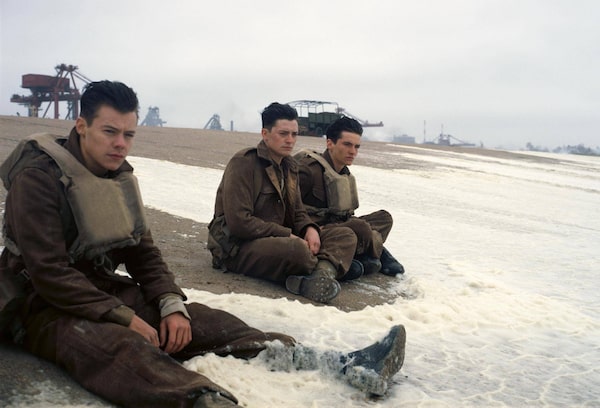
Watching Dunkirk is as close as you can get to war without being hurt.Warner Bros. Pictures/The Associated Press
It was quiet in the kitchen but with the normal whispering tick of the wall clock increased in volume to seemingly loud metronomic authority. I can't remember the day but it was some time in late May or early June, 1940. I can remember my mother sitting in her usual armchair at one end of the kitchen table; my father at the other puffing on his clay pipe, as nearby neighbour Walter (Wally) Emery apologized for his shabby clothes. And my mother reaching out to comfort-pat his arm as he tightened the string holding up his oversized army issue khaki pants and tried to tuck in what was left of his shirt.
Twenty-four hours earlier, Wally had been on the beach at Dunkirk trapped between the sea and an advancing German army along with close to 400,000 Allied army soldiers being swept across Europe by a then unstoppable "blitzkrieg." Wally had been part of that great retreat – still listed as one of the most crushing defeats ever suffered by British forces.
He was telling us how he and his army buddy would never have made it to the beach had they not stolen a horse to carry them the last desperate kilometres; and how frightening the beach was as he and his friend waited to be numbered among the 338,226 soldiers eventually rescued between May 27 and June 4, 1940.
Review: Dunkirk gives a visceral sense of the danger and desperation of war
Read more: Mark Rylance learning how to deal with fame as Dunkirk hits screens
As a 16-year-old on that far-off day, I was learning that an army in retreat can produce as many heroes as one capturing enemy strongholds. Wally was 20, maybe 21; hesitantly, modestly telling old friends of bombs and shells falling among the massed troops waiting for a boat ride to home and safety, how the first boat he boarded was small and overturned by a bomb explosion as they reached deep water.
My father sat silent. I think he was back 25 years on a beach where, in April, 1915, he lay wounded from dawn to dusk. It was called Gallipoli.
He understood when Wally, with the clock ticking louder than his voice, said: "That's when I lost my pants and boots. I was having trouble swimming weighted down so got rid of them and was able to swim to another boat and get home."
When he landed in England, he was handed an old pair of pants, a pair of running shoes, a few days leave pass and orders to then report to reoutfit and be reassigned.
What was Wally doing in my home when his own was just around the corner? Like hundreds, maybe thousands of others shipped by train or bus, Wally got home unannounced to find his dad at work and his mother out shopping.
His second home throughout childhood to young adulthood had been the home of his best friend Tom, my older brother. Wally, Tom and another neighbour Albert Panter were inseparable until 1937 when peritonitis claimed my brother and broke the link.
A year later, Albert joined the RAF, Wally the army – and the three families remained as close as they had always been. The day Wally came from Dunkirk looking for a cup of tea, a bite to eat and a place to wait until mum and dad came home was just "family" routine.
I made a minor pilgrimage for Wally a few days ago when my sons Nic, Andrew and Jonathan took me to see the movie Dunkirk. I think Wally (and my dad) would have given it a stamp of approval for authenticity. It was much as Wally had described and brutally honest.
Sentimentally, I looked for Wally on the beach and found him in a hundred different faces. And I shared with them old fears experienced by any person who has survived a heavy air attack.
As I watched in Imax comfort looking over the heads of massed soldiers waiting on the Dunkirk beach, a toy-sized twin-engine aircraft banked over the ocean to head in a direct line for the largest mass of troops. It stayed steadily on course growing larger on the screen by the second.
My "hostile aircraft recognition" skill – essential during the war – is not as reliable as it used to be, but I think it was a Heinkel He 111 bomber filling the screen as it released its bomb load of six – or was it eight? – high-explosive bombs to stride through the crowded soldiers with each step a killing ground, each gap between explosions a place of salvation.
I was never on the beach at Dunkirk, but was present on occasions later in the war, trembling as an airborne giant's bombs marched down a street or across roof tops killing or sparing without discrimination. I have lain prostrate, ears and head covered by outstretched arms, fingers vainly grasping at sidewalk concrete, tense with fear waiting, waiting, waiting and rejoicing to hear a final explosion and know I was still alive. In the Imax theatre, sitting directly in the path of the now giant Heinkel angel of death, my heart beat picked up. I held tight to my seat until I was absolutely sure I was beyond the reach of the last bomb in the stick. An old memory box had reopened; the relief was genuine.
If you have ever wondered what it would be like to be under fire, the movie Dunkirk is as close as you can get without being hurt. If you go, rejoice in the evacuation that saved more than 300,000 Wally Emery's. But remember, too, the 68,111 killed or wounded who never made it home or who carried the scars of the miracle at Dunkirk to their graves.
Seventy-seven years ago, my father finished his pipe; mother dispatched me to "go find Wally's mum on Abbey Street; she'll be at the Co-op store." I did. She was. The reunion was tears all round, much more tea and the "gopher" boy ordered to a nearby factory to "just tell his dad Wally's home, safe and well."