David Bathurst's journey toward Islam began with a quest for late-night pizza.
The 20-year-old and some buddies were out partying in Vancouver's historic Gastown neighbourhood when he struck up a conversation with a friendly busker, which led to him soon getting into contact with a local mystic who was giving free Arabic lessons.
Like many who experience a spiritual epiphany, a personal crisis precipitated his entry into a new religion.
Living in Burnaby, Mr. Bathurst was working for his dad's irrigation company while muddling through part-time studies at a local college. He had become a vegan and committed to taking cold showers in a genuine attempt to blunt his impact on climate change, but was struggling to forge his own identity during an era in human history, he characterizes as "a time of great confusion," where people are endlessly prodded to pursue empty pleasures instead of larger, spiritual truths.
Months before meeting the Arabic teacher, he had been in hospital briefly for a psychotic episode that, he says, was a result of isolating himself from friends and family, smoking too much cannabis and, ultimately, a crippling sense there was nothing he could do to improve the plight of humankind.
So, still in a deep malaise, he figured learning this ancient language, and more about the religion tied to it, could help break him out of his funk.
Before driving out for his first lesson, he phoned his friend and asked her to follow up if he didn't call her back in a couple of hours.
"I was really worried to go there, but I just felt I had to," he recalls.
Within minutes of entering the scholar's sanctuary, a modest two-storey home in nearby Surrey, he had taken shahada, the short ritual that officially makes one a Muslim.
"It felt like a table was on me and that table was lifted," he says of the experience.
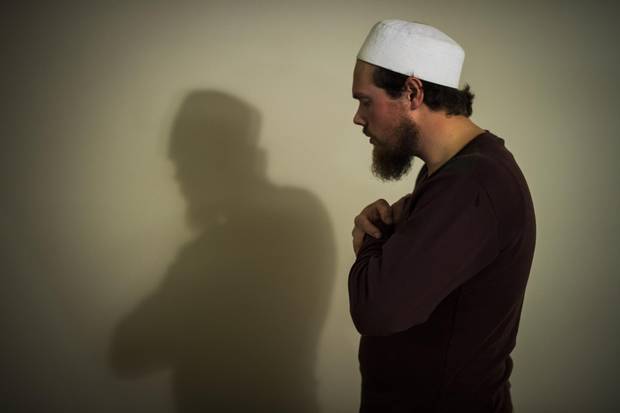
David Bathurst at his home in Burnaby in December, 2015, during prayers.
John Lehmann/The Globe and Mail
Over the next two years, he sublet a basement room from the man teaching him a new language as well as the core text and tenets of Islam, filtered through the lens of the esoteric tradition of Sufism. While working full-time with his dad in the family irrigation business, he and two other converts were living and praying in the home, an intense period that he credits with cementing his now-unshakeable faith.
A decade after converting, Mr. Bathurst and his wife, Kelly, an American-Canadian nurse of Taiwanese heritage, are raising their four children as Muslims. They say their story of Islam bringing them the structure and inner peace needed to lead a fulfilling life would be pedestrian if it weren't for the religion's public-perception problem in the West.
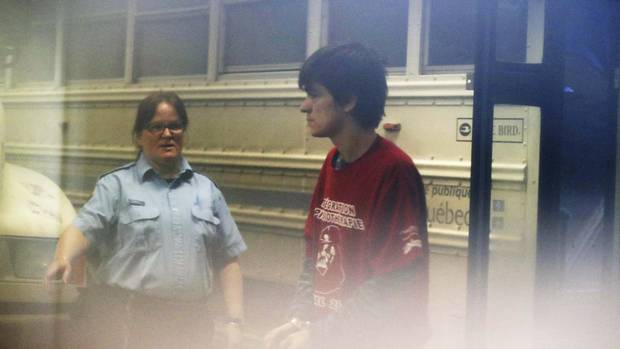
Still, Mr. Bathurst is aware of how easy it can be for newcomers to become radicalized after the initial rush of their conversion wanes. He saw that first-hand after learning a man he befriended at a local mosque, Michael Zehaf-Bibeau, killed a soldier at the War Memorial in Ottawa and then opened fire in Parliament.
No organization tracks how many converts are joining Canada's Muslim population of one million people, but studies show new members of the faith are more likely to embrace the militant strains of theology that lead them to do battle against perceived enemies at home or abroad.
The wider public's increasing mistrust of Islam has come in almost lockstep with a rise in the coverage of deadly jihadi terrorist attacks, with recent polls showing about half of all Canadians view the religion negatively.
Mr. Bathurst's father, John, is embarrassed to admit he once held the religion in low esteem.
"David and I've always had a pretty reasonable relationship and when he announced [his conversion] to me I said 'Dave that's all great, but the minute I smell gunpowder, I'm taking you into the RCMP for deprogramming,'" says the elder Mr. Bathurst over the phone, while his five-year-old grandson romped around his home in the same Burnaby housing co-op as his son's townhouse.
"He looked at me and said, 'Dad, that's like comparing Christianity to the Ku Klux Klan. If you check the numbers, dad, there are more acts of terrorism done in the name of Christianity than there is in the name of Islam.' And factually, that's the truth."
In this video, a young David Bathurst, seen at 2:00 wearing a white cap and green cloth over his right shoulder, chants with a group of fellow new Muslims in the Surrey home of their Sufi teacher.
If he's not wearing his traditional white prayer cap, David Bathurst's blond hair and blue-green eyes let him speak to many other Canadians without them ever guessing he is a Muslim. His scruffy beard helps him blend in even more thanks to the legions of hirsute hipsters across Metro Vancouver.
Over the years, several acquaintances that have badmouthed Islam in his presence quickly shut up as soon as he told them he was a convert.
As a white convert, he is shielded more than other Muslims from the Islamophobia now palpable in many Western countries, but he says he wishes that the newly emboldened xenophobes, whom comedian Aziz Ansari recently labelled the "lower-case KKK," would fade back into obscurity.
"There have been those bigots that thought 'Oh, we can come out of hiding now,'" he says, noting Donald Trump's controversial immigration ban, which critics argue was designed to target Muslims, seemed to create the most discord. "But there's also been so many beautiful people that are coming out and showing the best of humanity."
His wife, Kelly, who converted and began wearing a hijab eight years ago at 21, says she relishes her role as an ambassador to the religion and enjoys dispelling common misconceptions about the faith.
But having grown up in a post-9/11 world, even she has caught herself casting a suspicious eye toward fellow Muslims because, she says, "I'm scared of terrorists, too."
"I remember being on a plane in Taiwan and I saw four Pakistani guys get on in their garb," she recalls from a trip they took to see some family last year. "This is home to me, I know this beard, I know those clothes, but there were four men and I got nervous.
"Then they smiled at me and I felt better. I was conflicted inside."
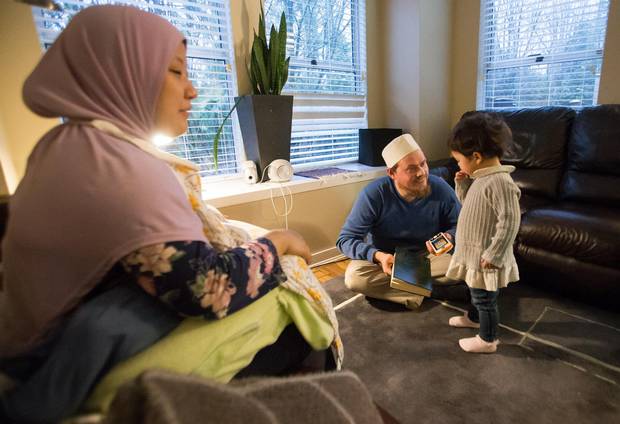
David Bathurst reads the Quran near his wife Kelly and his child Nura, 2, in their home in Burnaby.
Ben Nelms/For The Globe and Mail
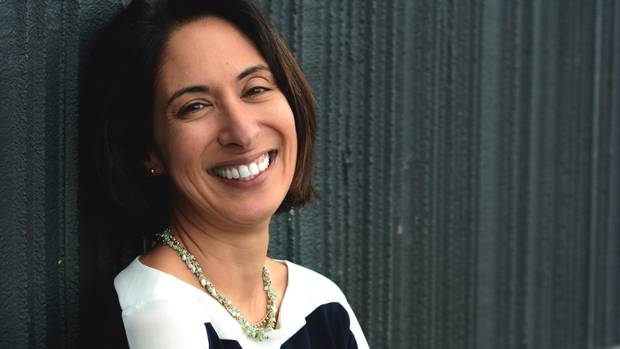
Amarnath Amarasingam, a research fellow at the UK-based Institute for Strategic Dialogue think tank who has interviewed dozens of jihadis in recent years, says research shows converts in North America and Europe tend to radicalize at a slightly higher percentage than other Muslims in those regions. But, overall, he says, only a tiny number of people ever embrace real violence.
"This idea that every peaceful Muslim is just on a conveyor belt to eventually becoming a terrorist is a problem," he says. "What Canadians need to understand is that violent individuals are of an entirely different sort and it takes more than just a bunch of ideas to push them into violence.
"It's the difference between an environmentalist and someone who bombs an oil pipeline, the difference between an animal-rights activist and one who blows up a Michigan State University laboratory."
The problem for researchers such as Mr. Amarasingam, who are trying to contact real jihadis, is that even among those openly espousing a hateful ideology, the vast majority don't ever take action.
"People who make threats on Twitter don't actually do anything," he says.
Mr. Bathurst remembers the last time he saw Mr. Zehaf-Bibeau, a year before the shootings in Ottawa. Mr. Bathurst says Mr. Zehaf-Bibeau told him he was planning to go to his father's ancestral homeland of Libya to study Islam.
"I said to him, 'Make sure that that's your intention.'"
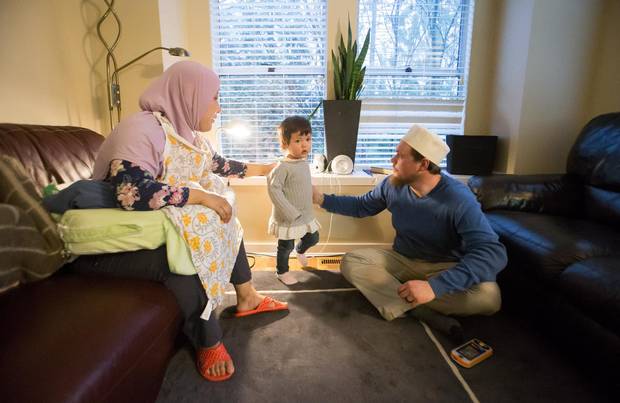
David Bathurst and his wife Kelly with their child Nura, 2.
Ben Nelms/For The Globe and Mail
He thought about calling the authorities to report another Canadian set to flee for a holy war abroad, but he says he genuinely believed the troubled man was seeking to deepen his understanding of a religion that helped give his vagabond life a semblance of structure, as well as cope with an ongoing addiction to crack cocaine.
Malcolm X famously remarked that Islam is the one religion capable of erasing the problem of race, but socializing can be awkward at mosques when people are welcomed from a myriad of different backgrounds.
Of the converts that become radicalized, many often do so after trying and failing to fit in at a mosque where most of the faithful share an ethnicity or culture, Mr. Amarasingam says.
"They might be celebrated on the first day or two that they've converted and entered the mosque, but then there is a kind of disunity that pops up later on," Mr. Amarasingam says. "They don't really fit into this community."
Very few mosques across the country have the resources to connect new converts with a mentor to help them through this disorienting process, he says, noting good work has been done on this issue in London and Montreal.
Mr. Bathurst says he is happy he spent his first few years as a convert studying the Koran with help from the Sufi mystic and support from a small circle of fellow new believers. He deliberately stayed away from attending a mosque, many of which, he says, are funded with Saudi money to espouse a more conservative version of Islam. Now, he prays every Friday at North Burnaby's Al-Salaam Mosque, a gleaming building where he greets Sunni Muslims from all different ethnic backgrounds by their first name and often unleashes his cheery cackle over small talk.
Those first months are an especially vulnerable time for new Muslims, who are lonely and could be facing serious criticism from family and friends over their decision, according to Ms. Bathurst. "It becomes hard when you go to the mosque and you realize your family isn't all with you," she says. "And then, when you fast by yourself, you're waking up before dawn, making a meal for just yourself, eating it and watching the weather channel.
"That was my lonely time."
This is also when jihadi recruiters can pounce, reaffirming to the convert that they need not fit in at the mosque to practise a pure version of Islam, Mr. Amarasingam says.
"[Extremists] don't generally think of ethnicity and culture as adding to your faith as a Muslim, but as the pollution of your identity," he says. "So there are some converts who naturally gravitate toward that because they enjoy that sense that they may not fit in and understand what's happening, but at least their commitment to the religion is seen as the primary thing to be cultivated."
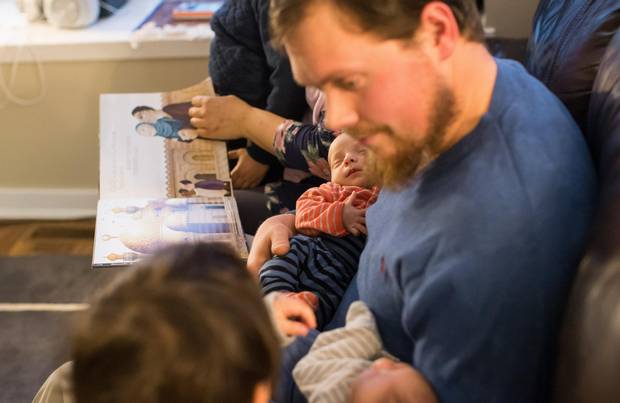
Parents Kelly and David Bathurst read to their children Yahya, 4, Nura, 2, and twins Ibrahim and Musa at their home in Burnaby.
Ben Nelms/For The Globe and Mail
Increasingly, this is happening online, where a brotherhood of fundamentalist Muslims makes it possible for someone in rural Canada or the United States who has never met a Muslim in real life to be able to convert by conducting a short ritual – or shahada – via a Skype session, he says.
"In Islam, the ease with which you can become a Muslim is considered to be a kind of gift from God," he says. "You don't have to go through any hard-core ideological training."
The converts who jump into the deep end could find themselves in trouble, he says, though the vast majority slowly enter the religion while studying its culture, history and traditions.
Scott Flowers, an Australian researcher with the University of Melbourne, is finishing his two-year government-funded study of Canadian converts and has found that most came to the religion before the age of 28, with about 35 per cent rejecting their Catholic background. His structured interviews with 157 Muslim converts found many were drawn into the religion in similar fashion to those joining the growing evangelical Christian movement.
"The reality is the data is showing that this is a very pedestrian, normalized process," Mr. Flowers says.
For years, the Bathursts have strengthened their faith through prayer sessions with friends, who were born into the religion in countries such as Sri Lanka and Afghanistan.
One Saturday on a drab December night two years ago, a small group of these friends form a semi-circle around Mr. Bathurst in his living room as he sings an intense passage, trying his best to disregard his eldest son Yahya pulling at his shirt. In between prayers, they chat and munch on a multicultural smorgasbord of pizza, naan, angel-hair pasta, chow mein, roast potatoes and Taiwanese pineapple cake. As the hum of the couple's large fish tanks fills the breaks in the group's melodious chants, his wife beams at the convert who is now becoming a spiritual resource for others.
Mr. Bathurst says they are committed to raising their daughter and three sons in the religion, even though Islamophobia could increase and directly impact their lives in the coming years.
"A moderate approach to Islam, a knowledge-based understanding of Islam, as opposed to a politically tainted or stained Islam will definitely set them up for success in this world and the next."
MORE FROM THE GLOBE AND MAIL: