Busy day? Here are five stories popular with Globe readers to help you catch up.
Tesla’s in-home battery pack coming to Canada
Canadians home dwellers will be able to get their hands on a Tesla Powerwall battery in early 2016.
The innovative in-home battery pack is being brought to Canada by Annette Verschuren, the former Home Depot Canada boss who now runs the energy storage company NRStor Inc., Richard Blackwell reports.
The Powerwall unit weighs about 100 kilograms and is designed to hang on a wall. It allows homeowners to store electricity generated by solar panels during the day, then use it at other times when the sun is not shining but electricity consumption is higher.
But that will not likely to be how it’s used in Canada because most solar electricity generated by Canadian homeowners’ rooftop panels is sold into the power grid through Ontario’s “feed-in tariff” system.
Instead, there are other applications where it would be useful here, including:
- Providing backup power during power outages
- Time-shifting so people can buy electricity at times of the day when it is cheap then use it at times when it is expensive.
The seven-kilowatt-hour model will be priced at $3,000 (U.S.); the 10-kwh unit will cost $3,500.
If you’re in the right tax bracket, Trudeau has a platform for you
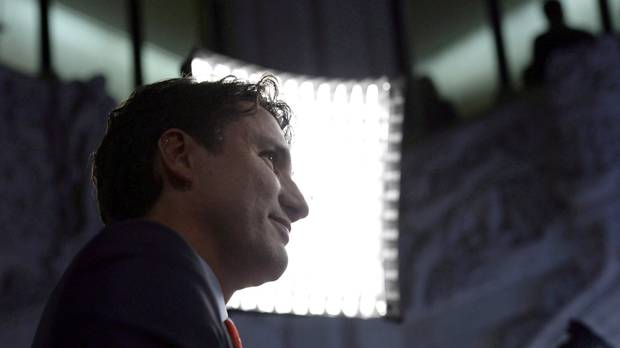
What is the middle class? For Justin Trudeau, it’s a tax bracket, John Ibbitson writes.
The Liberal Leader is dedicating himself, his party and his electoral prospects to making life easier for people earning between $44,700 and $89,401 a year. They would get a major tax cut and enhanced child-care benefits in the election-platform plank that Mr. Trudeau revealed Monday.
If you make less than that, and especially if you’re childless, Monday’s announcement offers you less. If you make more, the tax benefit diminishes proportionately as your income goes up. For the one-per-centers earning more than $200,000, there’s even a tax increase.
The new policy is simple, powerful and politically effective, Ibbitson argues. And if Trudeau can sell it, then he could win the Oct. 19 federal election.
But first he has to persuade people making between $44,700 and $89,401 that he believes in them, and not much else - there will be few dollars left for airports, sewers and highways, new programs or initiatives to combat global warming.
Three-year drought reshaping lush Beverly Hills
Nothing says Beverly Hills like movie stars lounging by their azure-coloured pools.
But with California in the grips of a three-year drought and its reservoirs going dry, that image is getting a serious makeover, Barrie McKenna reports.
This Los Angeles enclave of California’s biggest water hogs is a key target of the state’s first-ever mandatory water restrictions.
Last month, Governor Jerry Brown ordered communities to cut water use by 36 per cent. The city has since invoked its highest state of water emergency.
Water-saving measures include:
- Shutting off all fountains that don’t use recycled water
- A ban on filling new swimming pools
- A prohibition on restaurants giving patrons a glass of water (unless they ask).
- City council also approved fines of up to $1,000 (U.S.) and hefty water surcharges for abusers, while giving itself new powers to shut off the tap if residents balk.
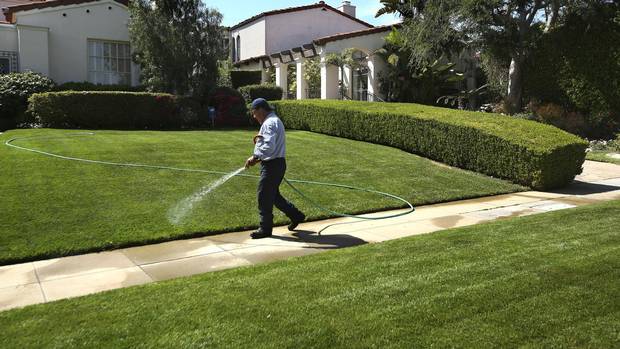
The Hills’ 42,000 residents currently consume 10 million gallons of water a day; As much as 70 per cent of that goes into landscapes – pools, lawns and the like.
The city has already let the grass turn yellow along the median of one its main downtown boulevards.
How Dave Goldberg died
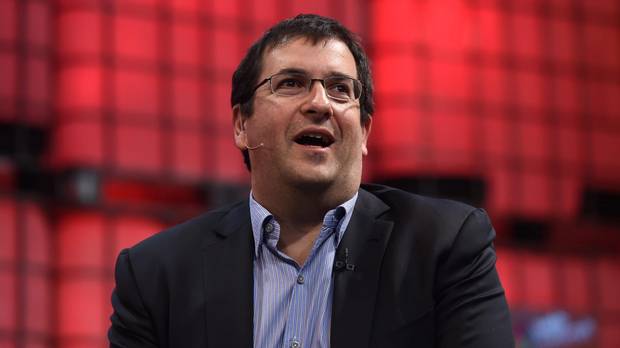
Dave Goldberg, the chief executive of SurveyMonkey and husband of Facebook’s Sheryl Sandberg, died of head trauma Friday night.
He collapsed while exercising at the gym at a private resort in Mexico, officials say.
Goldberg, 47, was on vacation with family and friends at a private beachfront villa near the Four Seasons Resort in Punta Mita.
His brother, Robert Goldberg, found him on the floor of a gym with blood around him. It appeared “he fell off the treadmill and cracked his head open,” said a spokesperson.
Dave Goldberg was well regarded as an entrepreneur and mentor and was the less famous half of one of Silicon Valley’s most prominent power couples.
Sandberg, the chief operating officer of Facebook, has made no public statements about her husband’s death.
Why it’s dangerous to still drive on your winter tires
Summertime and the driving is easy? Not necessarily, Andrew Clark writes.
Warm weather brings its own traps - the most frequent problem: treating your winter tires as if they’re all-seasons.
Some motorists try to save money by riding their winter wheels all summer. But it’s dangerous to assume a tire should have no problem dealing with warmth if it can handle tough winter conditions.
In fact:
- Once temperatures are steadily above 7C, winter tires (which are designed to stay soft in cold conditions) start to lose their grip and control.
- That means you need a lot more distance to come to a complete stop than you do with all-season or summer tires - one study found you need one-and-a-half to two car lengths more.
- The hotter the temperature, the worse the decline – more than 30 degrees and the rubber will start to marble, which causes it to form balls and spin under the wheel.
Driving on winter tires in the summer is a bit like buying an airplane and scrimping on the wings.
Follow Kat Sieniuc on Twitter: @katsieniuc