Busy day? Here are five stories popular with Globe readers to help you catch up.
Bank of Canada warns of housing market corrections
There could be a correction in three of the country’s largest housing markets, warns Canada’s central bank.
The warning comes as home values continue to soar in Toronto and Vancouver even as they fall across Alberta, Tamsin McMahon reports.
While the Bank of Canada has long called for a “soft landing” in the national housing market, this is the first time it has raised explicit concerns about the possibility of corrections in several key markets.
It’s also the first time the bank has expressed caution about the risks to the broader economy if regional housing market downturns were to spill across provincial borders.
And with prices showing double-digit gains in the most competitive markets but falling in others, there’s evidence that Canada’s housing market is dividing in two:
- Nearly all of the national price growth came from Vancouver and Toronto: Home sales have skyrocketed by more than 50 per cent over the past year in Vancouver and risen nearly 11 per cent in Toronto.
- But outside of those markets, prices grew an average of just 2.4 per cent compared to last March
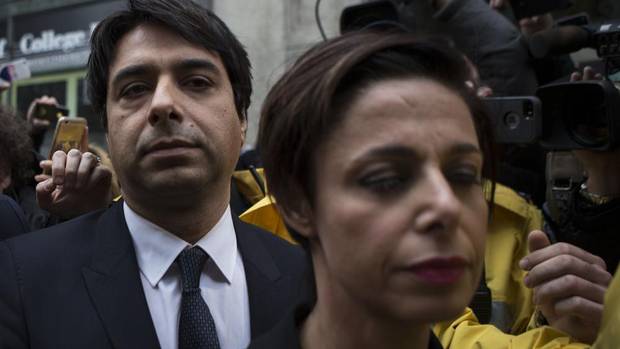
CBC executives lets go as Ghomeshi investigation released
The CBC has severed ties with two of its top executives connected to the Jian Ghomeshi controversy, Simon Houpt reports.
Chris Boyce, executive director of radio and audio, and Todd Spencer, executive director of Human Resources and Industrial Relations, had both been on leave since early January.
The news came just minutes before the public broadcaster released its report on the internal Ghomeshi investigation by the law firm Rubin Thomlinson.
Mr. Ghomeshi, who was fired as Q host in October, faces seven counts of sexual assault and one of overcoming resistance by choking.
The report draws on interviews with 99 people, though not Mr. Ghomeshi himself, and found that his actions “consistently breached the Behavourial Standard” of the CBC workplace.
It concludes that “management knew or ought to have known of this behaviour and conduct and failed to take steps required of it in accordance with its own policies.”
Some other key findings:
- The former Q host yelled, belittled, and humiliated those with whom he worked, and that “CBC management condoned this behaviour.”
- Most of Ghomeshi’s inappropriate behaviour was not sexualized in nature, but he was “overly familiar with a number of female employees and gave them back rubs and massages.”
- "Regrettably, it appears that Mr. Ghomeshi's managers were all too ready to believe his version of the truth"
The report makes nine recommendations to beef up CBC’s workplace protections, including the establishment of a confidential hotline.
Why Trudeau has more in common with Harper than Mulcair
Liberal Leader Justin Trudeau said Wednesday that he was “unequivocally opposed to any sort of coalition” with the NDP.
That makes perfect sense, John Ibbitson writes. Under Trudeau’s leadership, the Liberals on most major files have become virtually indistinguishable from Stephen Harper’s Conservatives.
An overview:
On taxes: the Liberals would retain all the Conservative measures, save for a minor income-splitting tax cut. The NDP, on the other hand, would raise corporate taxes.
On the environment: Trudeau appears content to allow the provinces to lead the fight against global warming, as does Harper. Mulcair is committed to compulsory national standards to reduce carbon emissions.
On natural resources: Trudeau backs the proposed Keystone XL pipeline and supports oil sands development, while Mulcair opposes Keystone and talks of a “Dutch disease” of oil dependency.
On national security: the Liberals support Bill C-51, the Conservative anti-terrorism legislation that the NDP opposes. The Liberals are also behind the Canadian military training mission in Ukraine, which the NDP insists must first be approved by Parliament.
More Arctic sea ice in Canada or less?
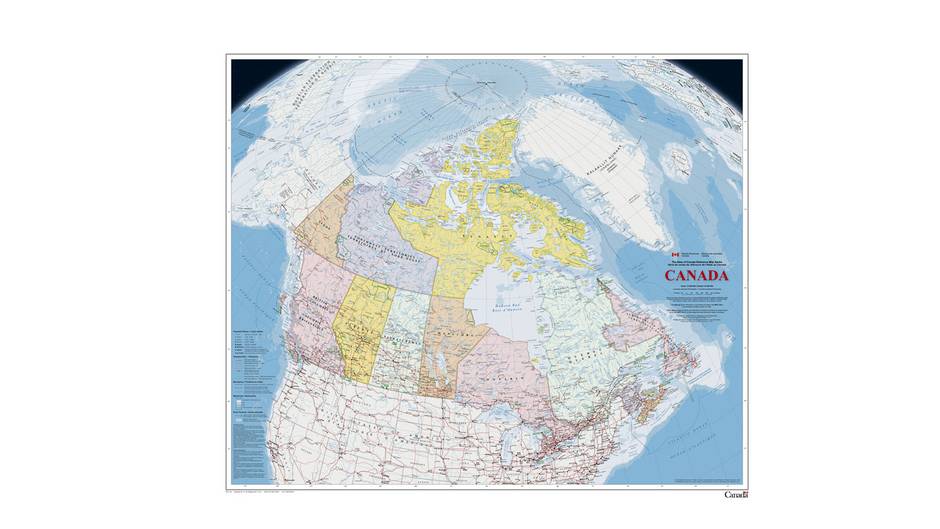
Canada’s new map has a lot more white space.
That’s because, Ivan Semeniuk writes, the way Arctic sea ice is represented relative to the previous version of the map makes it seem like there’s more ice now than there was in 2006 (when the previous map was published).
In reality, we know climate change has been gnawing away at the planet’s permanent polar ice cap and it is projected to continue doing so.
But whereas the older version of the map showed only that part of the sea ice that permanently covered Arctic waters year round at that time, the new edition uses a 30-year median of September sea-ice extent from 1981 through 2010. (It’s worth noting September sea ice hit a record low in 2012 and is projected to decline further).
While both maps are correct, it`s a subtle way to change the perspective on the way something is viewed, says one geographer.
For comparison, the older, less icy, version can be found here.

Raccoon drops in on Toronto crane operator - more than 210 metres up
Toronto’s trying to outsmart raccoons with tougher and taller green bins. But apparently, construction cranes are still within their grasp, Evan Annett reports.
Crane operator Robert MacFarlane got a visit from a climbing raccoon this morning on a crane at Yonge Street and the Esplanade - at about 700 feet in the air.
It came up the ladder to the counter jib, a part of the crane that balances the load to keep it from falling over.
The animal was “totally fearless and unintimidated by me,” Mr. MacFarlane said on Twitter, but he managed to shoo it down after a “hissing match.”
Follow Kat Sieniuc on Twitter: @katsieniuc