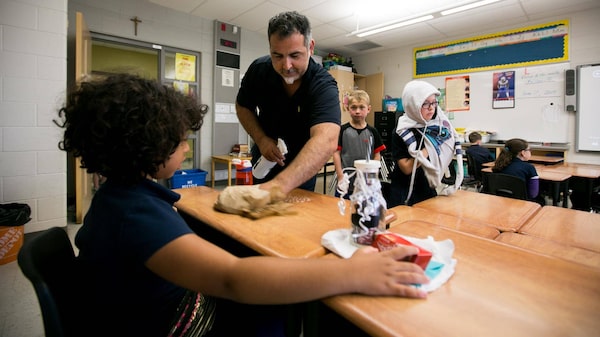
School custodian Alex Sessa wipes down surfaces in and around several classrooms three times daily, at Holy Name of Jesus Catholic Elementary School in Hamilton where students have food allergy issue .Glenn Lowson/The Globe and Mail
It's part of the job for Alex Sessa, the head caretaker at Holy Name of Jesus Catholic Elementary School in Hamilton, to wipe down the desks, chairs and door handles in select classrooms three times a day. It can make for a busy day when there are calls coming from other rooms, but "this is a priority."
If he misses even a trace of dairy or eggs in student Elodie Glover's classroom, her life is in danger.
Mr. Sessa's cleaning is part of the school's response to a settlement reached with Elodie's family after an Ontario human-rights complaint related to children and serious food allergies. It raises a complex question: How far should schools be required to go to steer clear of dietary dangers?
The U.S. Centers for Disease Control and Prevention found the prevalence of food allergies in children climbed by 50 per cent between 1997 and 2011. Certain foods cause adverse effects in about one in 13 Canadians.
Related: Food fight: How a hot-lunch plan divided a Toronto school
For schools, that means a continuing struggle with requests to ban or limit some foods, and a growing debate among parents and school officials over how to handle it. Quebec's largest school board made headlines in the spring when it sent a note home saying school staff do not ban or confiscate any foods at lunch, including peanuts and other allergens, because it creates a false sense of security. Elsewhere, schools strongly encourage parents not to send peanuts and nuts with their kids, but what protective measures are in place for children who are allergic to wheat, dairy, eggs or certain fruits?
"I think, like anything that affects children, this can be a challenge for schools," said Beatrice Povolo, a spokeswoman for Food Allergy Canada. "I think it comes down to ensuring all children are taken care of. It comes down to balancing the expectations of parents and students with food allergies and those without."
At Holy Name of Jesus, if a child is allergic to a certain food, it is restricted in his or her classroom. Mr. Sessa then cleans that room after snack time and lunch.
The class-by-class acccommodation measures came into place after Lynne Glover filed a human-rights complaint that the school was discriminating in the way it handled her daughter Elodie's potentially life-threatening allergies to eggs and dairy products. In kindergarten, Elodie was isolated in her classroom while her classmates ate lunch and snacks elsewhere. She would still break out in hives when they returned, Ms. Glover said. She kept her daughter out of school for much of Grade 1, fearing for Elodie's safety while fighting for the girl to be accommodated.
Elodie, 10, has had three allergic reactions at school. Her reactions vary in severity. Some were delayed. Others were instant, in which her eyes went glossy, her face swelled and she fought to breathe. A settlement reached when Elodie was in Grade 2 (she is entering Grade 5 this fall) banned dairy and eggs from her classrooms. Her classmates' lunch bags are checked each morning, and food that contains dairy or eggs is replaced with something comparable. Food cannot be consumed in the halls or the gymnasium. Signs on the main doors of the school read: "Holy Name of Jesus is an allergen aware school."
"They look after her," Ms. Glover said. "They do. So I have no hesitation sending her to school. Part of it was finding a way for fair and equal treatment to ensure that all students could attend school in a barrier-free, safe and inclusive environment. And that's what we ended up with."
The changes did not sit well with all parents. When a letter was sent home asking parents to refrain from sending foods with common allergens – such as peanuts, nuts, dairy and eggs – to school, two online petitions surfaced asking Ms. Glover and the school board to find another way to accommodate Elodie. "We all care about the safety of the kids, but taking a food group away is too much," one person wrote on the website Change.org.
"This is outrageous!" another wrote. "If your child has an extreme dairy product allergy then keep them home for lunch. But do not make every child suffer."
Ms. Glover said there was no school-wide ban, even though some parents interpreted the letter that way (the school has specific food restrictions in classrooms where children have allergies). While many parents have come to understand her daughter's allergies, she still hears negative remarks.
Toni Kovach, a superintendent of education at the Hamilton-Wentworth Catholic District School Board, said the district has a policy that lays out specific expectations, such as anaphylaxis training, and schools can also determine strategies for students with allergies.
"We're talking about life and death," she said, describing Elodie's situation at Holy Name of Jesus. "Am I an advocate for banning? Absolutely not. I'm a real advocate for education. But when it involves such a serious risk to a child, I'm a strong proponent for putting in measures that will ensure the safety of that child."
Several provinces, including British Columbia and Manitoba, require school districts to develop anaphylaxis policies. In 2005, Ontario became the first to introduce legislation that forced schools to have an allergy policy that includes training for school staff and individual safety plans for students who are at risk.
Quebec lets school boards develop their own protocols.
The Commission scolaire de Montréal (CSDM), the largest board in Quebec, caused a stir among parents when it sent a note home earlier this year saying it was not policing lunches. Spokesman Alain Perron said the school district's policy had not changed; it was simply reminding parents of its approach.
Mr. Perron said the list of allergy-causing foods is growing so extensive that it would "never end" if schools tried to ban the foods. The board believes in making parents responsible for what their children bring to eat.
"Parents shouldn't send their children to school believing there are no allergy risks," he said. "We don't want to give them a false sense of security."
In turn, CSDM believes parents should be making their children responsible by telling them not to share their food with other kids, and encourages students to wash their hands. Mr. Perron said all students with allergies are known, and school staff are educated on the precautions needed.
David Fischer, president of the Canadian Society of Allergy and Clinical Immunology, said banning foods is not effective because accidents happen. Studies do not show a significant reduction in reaction rates at schools that have bans, he said.
"If you're removing bans and doing nothing else, that's terrible. But if they actually are implementing [measures to protect children with allergies], that's much more acceptable," he said.
Still, the Montreal school board's policy makes parents such as Annie Boisvert nervous. Ms. Boisvert, who lives just outside of Montreal, has a six-year-old son with more than 20 food allergies, from peanuts and nuts to strawberries and kiwis. She and her school board's nurse devised a plan when Thomas started school that included sending a note home to parents, having children in his classroom wash their hands after meals, not sharing food, and separating her son from those who packed foods containing allergens.
"It kind of feels weird that such a huge growing health issue is pushed in the corner like that," she said. "It's almost like they don't want to acknowledge it any more, they don't want to deal with it any more."
The children in Elodie's classroom in Hamilton understand the new rules and are protective of their classmate. During lunchtime in late June, one girl said she had brought in a food item that contained one of Elodie's allergens. "I felt bad for bringing in something with dairy considering [Elodie] could have gone to the hospital," she said.
Another said she did not mind the food bans: "It means having my best friend in the classroom."
Elodie said it makes her happy when her classmates leave dairy and eggs at home.
She carries her medication in a pouch around her waist just in case.
- With a report from Ingrid Peritz in Montreal