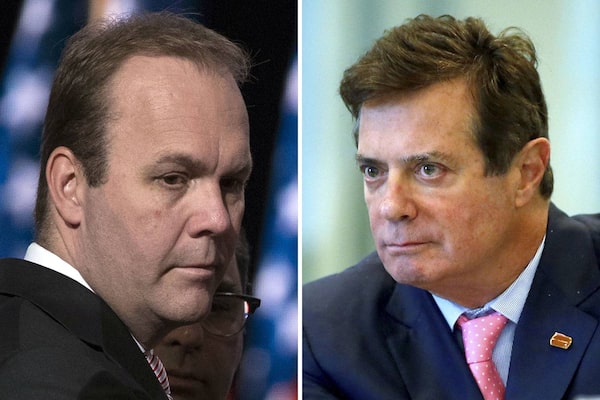
Rick Gates and Paul Manafort.
Good morning,
These are the top stories:
Breaking down the charges filed in the Trump-Russia investigation
Special counsel Robert Mueller's probe of possible ties between U.S. President Donald Trump's campaign and Russia has intensified with a slew of charges against three former aides. The indictments call into question the President's assertion that there was no collusion between his team and the Russians in the lead-up to last year's election.
George Papadopoulos: In a deal, the former Trump campaign foreign-policy adviser pleaded guilty to making false statements to the FBI. Papadopoulos met with Russian intermediaries to try to arrange meetings between campaign officials and Russian politicians, including President Vladimir Putin. In one meeting, he was told Russia had "thousands of e-mails" that contained "dirt" on Hillary Clinton. Papodopoulos updated other campaign officials on his efforts, documents show.
Paul Manafort and Rick Gates: The former Trump campaign chair and his business partner pleaded not guilty to 12 charges including conspiracy against the United States (that dates back to 2006-07). They're also accused of not registering as agents of Ukraine's former Russian-backed government (2008-14). The pair have also been charged with making false statements as recently as February of this year. Manafort and Gates face up to 80 and 70 years in prison, respectively.
What's next: Mueller still has to decide whether he thinks criminal conduct took place to assist Russia with its efforts to influence the election. Monday's charges will serve as a warning to others to "be worried," said Solomon Wisenberg, who worked on the independent counsel that investigated former president Bill Clinton. The moves also make it hard for Trump to pardon anyone or fire Mueller, he added.
Here's our commentary on the latest news:
Sarah Kendzior: "The wheels of justice may finally be turning, but they grind slowly like the initial trek up a roller coaster, and Americans should expect a stomach-turning plunge as the Trump administration retaliates and whiplash as the investigation proceeds."
Globe editorial: "...on Monday, we learned nothing new about the Trump administration or its Russian connections. The political case against Trump as President was strong prior to the election, and every day it gets stronger. The legal case? It's still evolving."
Lawrence Martin: "...the idea that it's all fake news or a witch hunt, as Trump has claimed, took a good thrashing. Special counsel Robert Mueller demonstrated that he is building a case, that he is hot on the trail."
This is the daily Morning Update newsletter. If you're reading this on the web, or if someone forwarded this e-mail to you, you can sign up for Morning Update and all Globe newsletters here.
If you like this newsletter, you might want to subscribe to our Evening Update newsletter. It's a roundup of the important stories of the day that will be delivered to your inbox every weekday around 5 p.m. ET.
Justin Trudeau is refusing to reveal which ministers used a financial loophole
A handful of cabinet ministers kept personal investments in a holding company or similar mechanism instead of selling their stakes or placing them in a blind trust. Earlier this month Finance Minister Bill Morneau was found to have used this loophole, but this week it was revealed that he's not the only one. Opposition Leader Andrew Scheer called on Trudeau to reveal their names: "It is a very simple question. Who are they?" But Trudeau refused to answer. "The conflict of interest and ethics commissioner is there to ensure that, above all of these petty personal attacks, Canadians can be confident that people follow the rules," he said. (In a column, Campbell Clark argues that the ordeal has damaged the ethics watchdog's responsibility to do just that.)
Ottawa's plans to lower drug prices could be 'crippling,' pharma companies say
Canada's prescription-drug prices are among the highest in the world and the federal government has proposed changes to reduce costs. Now, the head of the organization that represents more than 45 pharmaceutical companies says the move could limit their ability to invest in Canada. "I'm really concerned about the balance here," Innovative Medicines Canada president Pamela Fralick said. But it's long been unclear how much Big Pharma actually invests in Canada. Drug companies are supposed to be putting the equivalent of 10 per cent of revenue toward research and development, but there is no penalty for failing to meet the target. And the federal review board's latest annual report asserts that IMC members are contributing 4.9 per cent.
IN CASE YOU MISSED IT
The Liberals aren't always appointing the top recommended judges
The Liberals brought back a ranking system that identifies judicial candidates as either "highly recommended," "recommended" and "unable to recommend." There are 129 "highly recommended" candidates, but the government's 74 appointments so far have included some on the "recommended" list. The 74 picks have been split 50-50 between men and women. The Liberals' selection process raises questions about possible partisan political considerations.
MORNING MARKETS
Global markets are mixed Tuesday, and the Canadian dollar is below 78 cents (U.S.). Tokyo's Nikkei ended flat, while Hong Kong's Hang Seng lost 0.3 per cent, and the Shanghai composite gained 0.1 per cent. In Europe, stocks are on the rise, with London's FTSE 100, Germany's DAX and the Paris CAC 40 up by between 0.1 and 0.4 per cent by about 5:35 a.m. ET. New York futures were also up. Markets await the Federal Reserve, which begins a two-day meeting that will climax with a Wednesday rate decision, though no change is expected. Oil prices eased after a week of gains as the prospect of increasing U.S. exports dampened bullish sentiment that has driven Brent to more than two-year highs above $60 per barrel.
NEW - We've launched a new Top Business: Evening Edition newsletter providing a summary of the biggest business headlines of the day. You can sign up for it here.
WHAT EVERYONE'S TALKING ABOUT
The faulty premise of racial 'colour-blindness' at Halloween (or ever)
"Here comes Halloween, with its inevitable, painful conversations around costumes, cultural appropriation and my favourite word (insert sarcasm font here): 'colour-blindness.' You know what I mean – the annual protestation that it didn't occur to parents that dressing their child as an 'Indian Chief' or blackening their face to be a 'rapper' was troublesome because they 'don't see colour.' … Teaching our children to be 'colour-blind' is a mistake, one that tells young people to see differences as negative things to ignore or erase. It taints children's innate ability to recognize that human variances don't have any kind of intrinsic value or place in a hierarchy." – Bee Quammie
Who's afraid of new Alberta UCP leader Jason Kenney?
"In the eyes of many, Kenney is a brilliant politician. … So why do so many people loathe him? Mostly it's because he is a middle-aged, slightly pudgy white man who is also a devout (Catholic) Christian with deeply held personal beliefs. In other words, he belongs to the most reviled demographic in Canada. Many people simply don't accept that he can keep his personal beliefs out of politics. He's vilified on social media, where his quite reasonable position that parents should generally know what's going on with their kids at school gets boiled down to 'Jason wants to out little kids.'" – Margaret Wente
HEALTH PRIMER
Protein for men – how much of a good thing is too much?
You can usually get all the protein you need from a balanced diet. In other words, most people don't need to turn to protein supplements. Going overboard could put stress on your kidneys and liver because your body can't process that much protein.
MOMENT IN TIME
Princess Margaret calls off her controversial engagement
Oct. 31, 1955: The path to true love never did run smooth for Princess Margaret. The younger sister of Queen Elizabeth was still a teen when she first met Group Captain Peter Townsend, a decorated RAF fighter pilot already married with two children. The romance simmered but everything changed when Margaret's father, George VI, died and Elizabeth ascended to the throne. For the next few years, the British press had a field day covering the scandalous romance between the Princess and her dashing divorcee flyboy, but British parliament made clear it would never sanction the union. The end of the affair became official on this day when BBC radio read a statement from Margaret announcing her decision not to marry Townsend. Citing the "church's teachings" and her duty to the Commonwealth, "I have resolved to put these considerations before others." Five years later, Margaret would marry Antony Armstrong-Jones, 1st Earl of Snowden, which ended in divorce in 1978. – Andrew Ryan
Morning Update is written by Arik Ligeti.
If you'd like to receive this newsletter by e-mail every weekday morning, go here to sign up. If you have any feedback, send us a note.