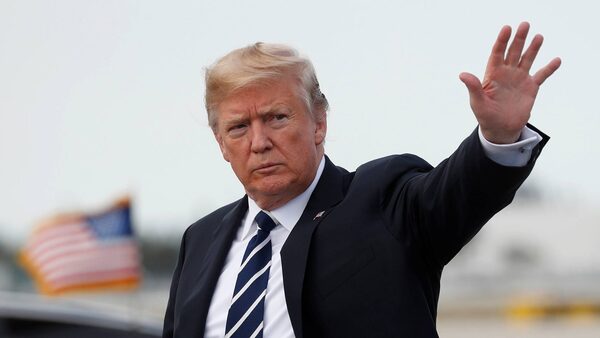
Donald Trump plans steep tariffs on foreign imports of steel and aluminum.Kevin Lamarque
Good morning, These are the top stories:
Trump waves threat of steel tariffs over NAFTA talks
U.S. President Donald Trump is threatening to hit Canada and Mexico with hefty tariffs on steel and aluminum until the two countries agree to a renegotiated NAFTA, rolling two looming trade battles into a single protectionist attack. Canada and Mexico are pushing back on the latest escalation in trade talks, arguing that the two should not be linked. The countries concluded the seventh round of North American free-trade agreement talks on Monday, but sources say a deal looks far off. (for subscribers)
As Campbell Clark writes, the essence of Trump's trade policy is that the U.S. is bigger and will get what it wants. But it might also get a trade war of attrition. (for subscribers)
Feeling behind on the trade talks? Read our explainer on NAFTA renegotiations and what it could mean for you.
This is the daily Morning Update newsletter. If you're reading this on the web, or if someone forwarded this e-mail to you, you can sign up for Morning Update and all Globe newsletters here.
Heads up: We have a new weekly newsletter called Amplify that will inspire and challenge our readers while highlighting the voices, opinions and insights of women at The Globe and Mail. Amplify will have a different guest editor each week – a woman who works at The Globe – highlighting a topic of the author's choice. Sign up today.
Rising seas and climate change: Everything you need to know
In a new Globe and Mail series, Matthew McClearn examines how Canada's most vulnerable coastal communities are preparing for potential catastrophe on their future shores. Here's a primer on the science behind it and here's the first of the series, which examines how the deluges Nova Scotians faced during 2003's Hurricane Juan could be commonplace within decades and how the provincial capital has barely begun to prepare for potential future disaster.
Sixties Scoop deal in jeopardy as more potential claimants object
A proposed deal struck by the federal government to compensate First Nations and Inuit people who were taken from their homes as children and adopted into non-Indigenous families may be in jeopardy as victims of the Sixties Scoop step forward to say the terms are unacceptable. Some Sixties Scoop victims say the payments, which will not exceed $50,000 and will come from a $750-million fund to be divided among all qualified claimants, are inadequate. If there are 80,000 successful claims, they argue, each claimant will receive less than $10,000. Some say the terms of the deal are too narrow. But mostly, the dissenters say, they are angry that they were not fully consulted about the terms of the deal before it was reached.
Ontario's professors are retiring later, study finds
Seventy-one is the new 65 for a growing number of professors at Ontario's universities who are staying in the classroom past the traditional retirement since mandatory retirement ended for the province in 2006. According to the report, the proportion of faculty over 65 has grown to almost 9 per cent from close to zero. The report calculates that approximately 2,000 full-time professorial jobs would have been created over the past decade if the salary costs of the entire over-65 faculty cohort was applied toward hiring new PhD graduates into permanent positions.
Got a news tip that you'd like us to look into? E-mail us at tips@globeandmail.com. Need to share documents securely? Reach out via SecureDrop.
IN CASE YOU MISSED IT
Toronto police recover seventh set of McArthur-linked remains; release photo of new potential victim
Investigators working on the case of alleged serial killer Bruce McArthur released a photo of a dead man Monday, in hopes that it will help identify someone they believe to be another victim of the 66-year-old landscaper facing six murder charges. The photo – a headshot of a bearded middle-aged man with his eyes partly shut – was released at a news conference where the lead detective announced police had found the remains of a seventh individual linked to McArthur.
MORNING MARKETS
Stocks recover
Stock markets in Asia and Europe regained ground on Tuesday after U.S. President Donald Trump faced growing pressure from political allies to pull back from proposed steel and aluminum tariffs and a potential global trade war. Tokyo's Nikkei gained 1.8 per cent, Hong Kong's Hang Seng 2.1 per cent, and the Shanghai composite 1 per cent. In Europe, London's FTSE 100, Germany's DAX and the Paris CAC 40 were up by between 0.7 and 1 per cent by about 6:10 a.m. ET. New York futures were also up. The Canadian dollar slipped as low as 76.95 US cents, and moved as high as 77.14 US cents. Oil was broadly unchanged, as a recovery from last week's lows fizzled out.
FYI: The Globe now provides all users access to real-time stock quotes for both Canadian and U.S. markets. Go here to find out about the major changes to our Globe Investor site.
WHAT EVERYONE'S TALKING ABOUT
Trudeau is an insult to feminism – and to seriousness
"Pandering is what Mr. Trudeau does best. He wants to be more feminist than the feminists and more Bollywood than Shah Rukh Khan. The trouble is that he's trying way too hard. So he just comes off as opportunistic and condescending. Both the India trip and the budget − both of which should be routine affairs – have exposed the worst defects of Mr. Trudeau and his team. They are all politics and no policy; all play-acting and no substance. Just last year the international media were styling Mr. Trudeau as 'the free world's best hope,' as Rolling Stone breathlessly put it. Now, he's Mr. Dressup. The scornful headlines from the global media were nothing short of epic. 'Trudeau's India trip is a total disaster – and he has only himself to blame,' went one headline in The Washington Post."– Margaret Wente
Canadian sovereignty depends on public-private cybercollaboration
"Domestic capability in cyber is a key precondition for countries remaining safe and sovereign in the age of digital threats. If we are not suppliers of cyber solutions, Canada is wholly reliant on external actors – vendors and countries which have no public accountability to Canadian citizens – to design the systems that protect us. Furthermore, the technology our government uses to keep its citizens safe should reflect our Canadian values of data privacy and protecting civil liberties. Technology is reflective of the values of the society that develops it, so if Canada is left to procure from countries that, for example, are more comfortable with constant surveillance on their own citizens, we need a different approach." – Patrick Searle
Canada should not get drawn into Trump's trade war
"There is reason to believe that Mr. Trump's case will fall apart under scrutiny, and that his tariffs don't meet the specific standards that allow a President to act unilaterally. For instance, his assertion that the tariffs are needed as an emergency measure has already been contradicted by his statement that he won't apply them to Canada and Mexico if they sign a new free-trade deal that is to his tastes. Is there an emergency, or isn't there? With so much opposition to the tariffs in the U.S. and internationally, and with so little forethought to buttress them, Canada should avoid firing a retaliatory shot and getting drawn into Mr. Trump's mindless trade war. We are better off relying on mechanisms like the WTO that were invented to prevent bigger countries from riding herd over their smaller trading partners. Just like an eye for an eye leaves the whole world blind, a tariff for a tariff leaves the whole world poorer." – Globe Editorial
HEALTH PRIMER
Growing effort seeks to change commonly held view of mammograms
Although mammography is recommended for all women age 50 and older, hundreds of thousands of Canadian women do not undergo this exam, which requires compressing the patient's breasts to obtain an adequate image. But there is a growing effort to encourage women to get the exam by making them more comfortable. For example, the breast-imaging team at St. Joseph's Health Care London has been offering a new screening environment, which includes video monitors in the exam room that play nature clips with bird sounds, patients' gowns are designed to make it for easy for them to expose their breasts and the mammography machines are quiet and ergonomically friendly.
MOMENT IN TIME
JFK assassination footage first airs on network TV
March 6, 1975: When Dallas dressmaker Abe Zapruder took his Bell & Howell Zoomatic home-movie camera to the city's Dealey Plaza one November day in 1963, he was hoping to catch a bit of history – the swift passing of a presidential motorcade – but caught much more of it than he bargained for. Standing on a concrete abutment, Zapruder switched on his 8mm camera just before John F. Kennedy's open limousine swung into view and it whirred for just 26.6 seconds, but in that span captured the shooting of the President. Life magazine quickly bought the rights and the brief film served as key evidence for the Warren Commission investigating the assassination; it still fuels countless conspiracy theories. Yet, because of its graphic imagery, it wasn't broadcast in full on network television for more than a decade, until Geraldo Rivera aired it on ABC's Good Night America in March, 1975 – to audible gasps from the studio audience. Even today, and despite its extreme familiarity, Zapruder's silent, grainy colour footage is endlessly shocking: cheerful crowds, bright sunshine, smiling President, then odd motion in the rear seat followed by a ghastly puff of matter from JFK's head – as Camelot dies, yet again, before our eyes. – Christopher Harris
Morning Update was written by Kiran Rana. If you'd like to receive this newsletter by e-mail every weekday morning, go here to sign up. If you have any feedback, send us a note.