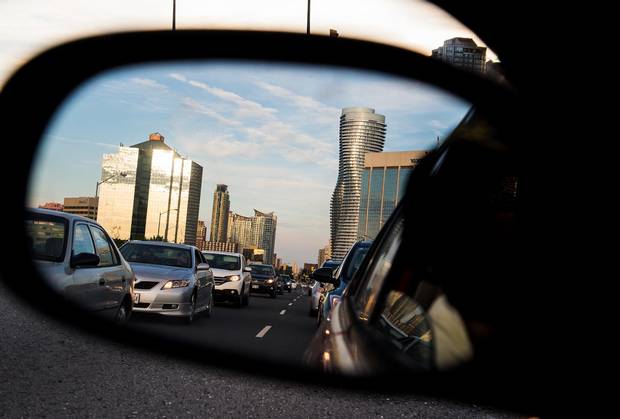
Watch: Meet the voters of Mississauga Centre
3:07
Because Joab, 4, and Zeervia, 2, managed to get more of their dinner on them than in them, their father, Elvis Malcolm, cleans up as he explains why he plans to vote for Stephen Harper.
Other party leaders "say a lot, but don't deliver," Mr. Malcolm, a personal-fitness trainer, tells a reporter who is interrupting the family's evening meal. He values the child-care benefit that arrives each month courtesy of the Harper government. He believes the Conservatives have managed the economy well.
"They've moved the country forward."
Just a few doors down the street, Judy MacDonald is finally getting home after her 90-minute rush-hour commute from downtown Toronto, where she works as a dental assistant. Mr. Harper will never, ever have her vote, especially now that the Conservatives have introduced an income-splitting tax benefit.
"I'm a single mother, so I don't have anyone to split the income with," Ms. McDonald explains. She is still trying to make up her mind whether to vote for the New Democratic Party's Thomas Mulcair or Liberal Leader Justin Trudeau.
Mr. Malcolm and Ms. MacDonald may not agree on much, but with Canada's 42nd federal election campaign well under way, the two have one thing in common: They live in a riding like no other, one that is a microcosm of modern Canada, located in a region with a tradition of backing whichever party forms the government.
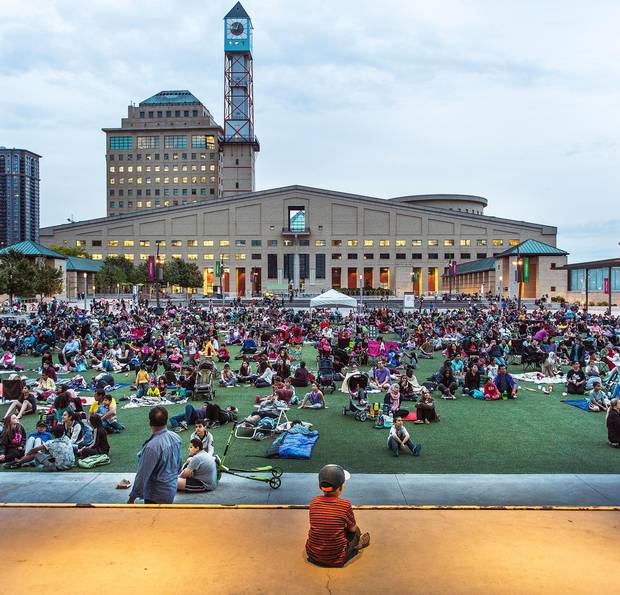
Families gather on a summer evening for an outdoor film screening in Mississauga’s Celebration Square. The suburban belts outside of Toronto and Vancouver are historically where federal elections are won and lost.
Aaron Vincent Elkaim for The Globe and Mail
It has been three weeks since Mr. Harper – soon after Mr. Malcolm and millions of parents like him had received back payments for increased child benefits (a $3-billion handout that critics called blatant vote-buying) – asked Governor-General David Johnston to dissolve Parliament and call an election for Oct. 19.
At 78 days, the campaign will be the longest in 143 years, likely the costliest ever and, for the first time in this country's history, a three-way race for power that is too close to call.
Mr. Harper is bidding to become the first party leader since Wilfrid Laurier to win four consecutive mandates. Thomas Mulcair is hoping to be the first New Democrat ever to lead the nation. And Justin Trudeau wants to restore the Liberal Party to its historic place at the top of the greasy political pole; that would require a herculean feat (the Liberals flirted with extinction after the last election), but the polls suggest that any of the three leaders could succeed.
This election falls in the midst of uncertain times. In July, Canadians learned that, with oil prices still down, the economy had shrunk for the fifth month in a row and may already be in recession. The military is battling radical insurgent Islamists in the Middle East amid a heated debate over how much power security forces should be given to detect and prevent attacks on the home front. Pressure is becoming so great to have Ottawa seriously tackle the challenge of climate change that the Conservatives find themselves on the defensive as environmental laggards.
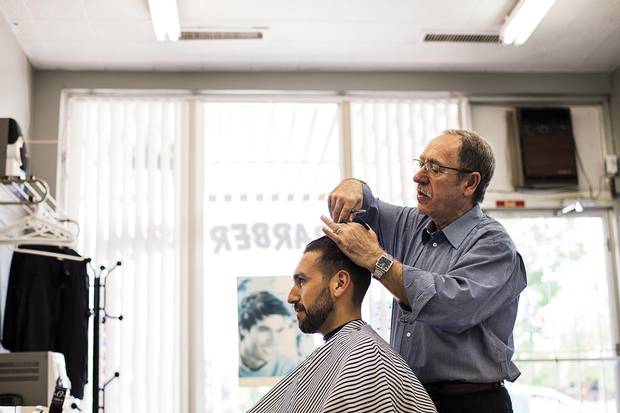
Joe Barillari gives Dan Ahumada a trim at his barber shop, which was built more than 65 years ago and is one of the oldest in Mississauga.
Aaron Vincent Elkaim for The Globe and Mail
Just three months ago, Mr. Harper's home province cast aside almost a half-century of Progressive Conservative rule to embrace, astonishingly, the NDP. Across the country, incumbents have been ousted in four of the last six provincial elections, and a conservative party hasn't won since doing so in Saskatchewan in November, 2011, six months after Mr. Harper's last victory.
As a result, the prospect of federal change is now in the air with the polls so close – the latest weekly tracking poll from Nanos Research puts the three major parties in a virtual tie – that the contest has been heated since the moment it was called. All three are battling to defend the ridings they have, and to seize any they can from their rivals.
If there is one riding equipped to foreshadow how close the outcome of this perplexing election may be, it is Mississauga Centre. Although its name may be familiar – the old Mississauga Centre disappeared in a redistribution more than a decade ago – it is new for this election, made of turf poached from four of its neighbours.
And it is a bellwether at birth.
New seats, in swing territory
Of course, every riding counts in an election. But in Canada, different regions have a tendency to cancel each other out.
Quebec is volatile, but for the past quarter-century has supported whichever party forms the opposition (first the Bloc Québécois, then the NDP). The Liberals are traditionally strong in Atlantic Canada and in most city centres across the country, where they battle the NDP for dominance. The Conservatives own the Prairies and rural Southern Ontario.
But Canada is no longer either urban or rural: It is a suburban nation. According to a 2014 study headed by David Gordon, director of the School of Urban and Regional Planning at Queen's University, two-thirds of all Canadians live in suburbs.
The two regions where large numbers of ridings swing from one party to another – deciding elections in the process – are both suburban: the belts wrapped around Vancouver and Toronto. Of the two, the latter – known collectively as the 905, for its area code – is more important only because it has almost twice as many seats (22 or so, depending on how you count) as the former.
How significant is the 905? In almost every election since 1968, the majority of the ridings from Oshawa in the east, north to the shore of Lake Simcoe and west to Burlington have gone to the party that formed the government.
In a rare exception, most of the 905 stayed Liberal in 2006, when Mr. Harper first came to power with a weak minority government. Five years later, when he finally secured a majority, almost every riding in the 905 went Tory blue. The progress of Conservative power is told in the party's increasing success in Greater Toronto.
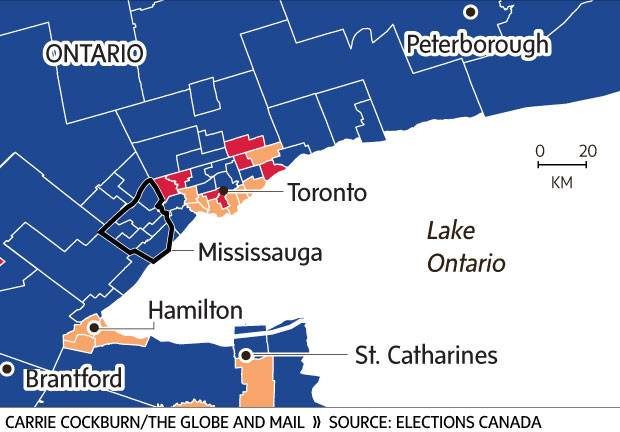
Mississauga Centre was part of a sea of Tory blue in the 2011 election, compared to a smattering of seats that went to the Liberals (shown in red) and the NDP (in orange).
Now there is an opportunity for even more 905 blue – the result of a historic expansion of the House of Commons. For decades, suburban populations were underrepresented in the Commons. Constitutional guarantees and ancient bias in favour of preserving the country's rural roots meant that places like Prince Edward Island were allocated four seats, while single ridings in places such as greater Toronto or Vancouver had almost as many voters as the entire Island.
To remedy the injustice, the Harper government introduced legislation that will grow the House by 30 seats in this election. Ontario gets 15 new seats, nine of them in the 905, including the new Mississauga Centre.
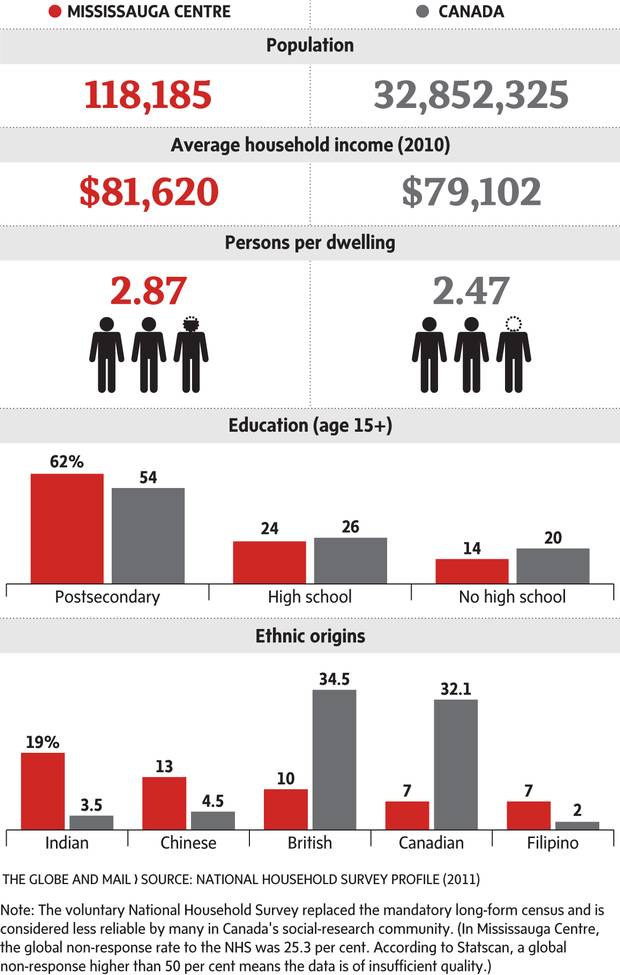
But Mississauga Centre is special, even if at first glance it seems anything but. With a population of just over 118,000 (still almost as many voters as in all of PEI), it is the heart of a community that, perhaps more than any other, exemplifies modern Canada.
Old suburb, new suburb
Mississauga's civic motto begins "Pride in our past." The city is named for the indigenous people who once lived along the Credit River. No longer able to resist the tide of European settlement, the Mississaugas moved to a new home (provided by the Six Nations Confederacy) near Brantford. In the early 1800s, the land they left behind became the Township of Toronto, not that long before a city with the same name was incorporated a few miles to the east.
For a century the township was largely farmland punctuated by such quiet villages as Erindale, Malton, Clarkson, Port Credit and Streetsville. After the Second World War, however, the farms began to disappear, and then the villages, replaced by what downtowners sniffily call suburban sprawl. With the influx of commuters, several communities combined in 1968 to create the Town of Mississauga, which expanded into a city six years later. By 1976 it had a population of 250,000, consisting mostly of vast tracts of bungalows, strip malls and supermarkets, with wide streets to accommodate all the commuters' cars.
Now, four decades later, that older developed area anchors the southern portion of the city, but the population has tripled to 750,000: multicultural, double-income, mobile, wired, suburban and middle-class. And the heart of the community lies a bit to the north, in Mississauga Centre.
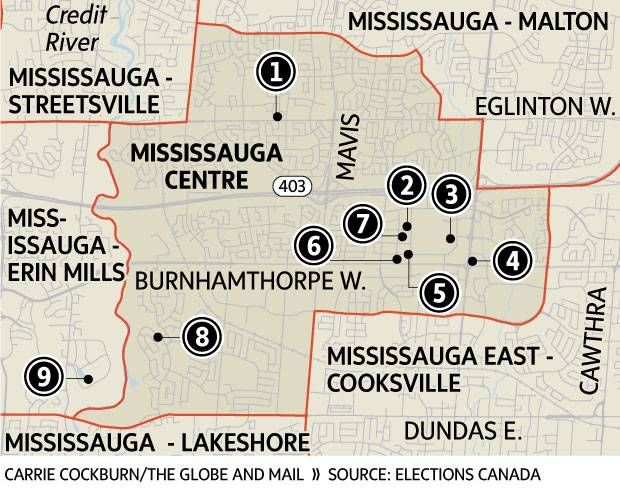
- Masjid al-Farooq Mosque
- Sheridan College Hazel McCallion Campus
- Square One shopping centre
- Absolute Condos (‘Marilyn Monroes’)
- Mississauga Civic Centre
- Mississauga Central Library
- Living Arts Centre
- Credit Woodlands
- University of Toronto Mississauga Campus
The riding begins just east of Square One, one of the country's biggest shopping malls; runs west to the Credit River, the last bastion of the Mississaugas; and is divided in half horizontally by the perpetually humming Highway 403. And it contains the downtown that Mississauga has long been said to lack: a complex jump-started by the local government near Square One that includes a civic centre (with a postmodern city hall, municipal art gallery and wedding chapel), as well as a central library and a performing-arts centre, all ringed by built-yesterday condominiums dominated by two beautiful, curvaceous glass towers nicknamed "the Marilyn Monroes."
Nearby is the Hazel McCallion campus of Sheridan College, named after the iconic mayor who retired last fall after 36 years in office. North and west of the new downtown, the homes are generally newer, larger and more substantial than those to the south: brick houses with oversized garages, and new semis.
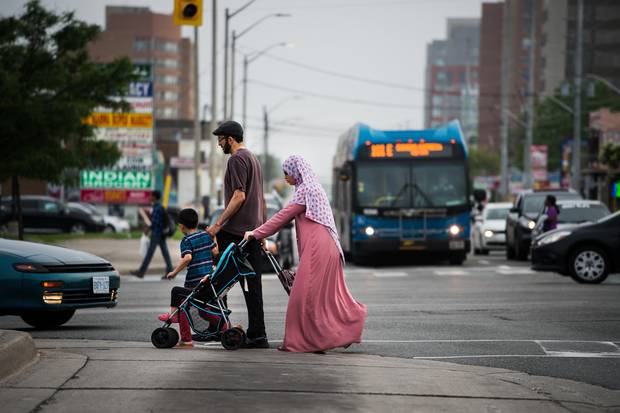
A family crosses Dundas Street at Hurontario Street.
Aaron Vincent Elkaim for The Globe and Mail
A lost 'sense of tightness'
Who actually lives in these homes? As it turns out, we have a very good idea. By combining census data, other publicly available information databases and social-values surveys, even building permits and satellite images, market-research firm Environics Analytics has sliced up the Canadian population by postal code into no fewer than 68 categories, from "cosmopolitan elite" and "country acres" to "aging in suburbia." (You can find their assessment of your postal code at www.environicsanalytics.ca/prizm5.)
Environics also assesses how these people feel, and found that Mississauga Centrans embrace such values as concern for the environment and enthusiasm for new technology, as well as empathy, tolerance and racial diversity. The last of those makes sense, since, like the rest of the 905, the riding has a very large immigrant population. Sixty-one per cent of Mississauga Centre's residents were born outside Canada, and what Statscan calls "visible minority" residents make up a slightly larger portion – 67 per cent – of the population. They are part of the 21 per cent of Canadians, almost seven million souls, who were born elsewhere.
The roughly 250,000 immigrants a year that Canada has been bringing in for more than two decades – the equivalent, over that period, of two Torontos – are almost all from developing countries, and, like most Canadians, they gravitate to the suburbs.
But their attitudes are anything but uniform, observes Rupen Seoni, a vice-president at Environics Analytics. "There is diversity there – but there is diversity within diversity."
Environics says Mississauga Centre is dominated by eight of the 68 groups, most of them composed of middle-class immigrants, though with plenty of variation from lower- to upper-middle class, depending on the neighbourhood. There are new arrivals, who are well-educated but have modest incomes and are just starting to climb up the social ladder; "sophisticated singles" and upscale couples; and established families, again often affluent, whether newcomers or native-born.
About a quarter of the riding's population is South Asian (principally from India, Pakistan and Sri Lanka), about 12 per cent of the population is of Chinese descent, and about 7 per cent Filipino. Another 7 per cent are from Arabic countries.
The fact that Mississauga is such a true melting pot continually amazes even Gurpreet Malhotra, executive director of India Rainbow Community Services of Peel, which offers settlement and other services to the immigrant community. "I can never get past how a Korean bakery will be next door to a Jamaican grocery store beside a Pakistani jeweller, and on and on and on it goes, from all sorts of backgrounds," he says. "I've not seen a mix like this even in Toronto or Vancouver."
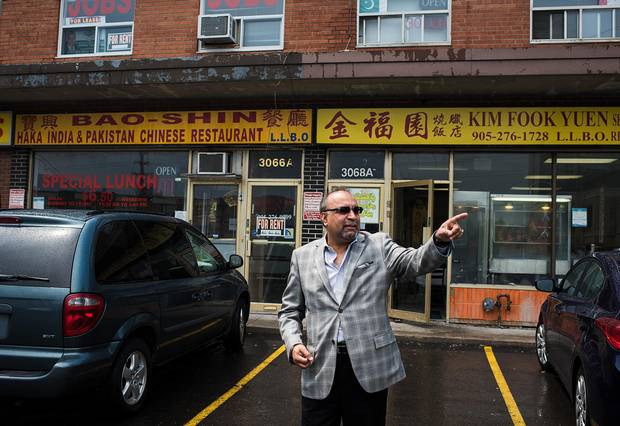
Gurpreet Malhotra, executive director of India Rainbow Community Services, points out some of his favourite local stores.
Aaron Vincent Elkaim for The Globe and Mail
For more than four decades, from behind his barber's chair, Joe Barillari has watched Mississauga evolve: the booming new arrivals from Toronto, the kids growing up and moving out, the parents moving on. For the past 17 years, his shop has been in Credit Woodlands, a neighbourhood near the river in the southwest part of the riding. Now, at 65, he should retire, but says he'd miss the company.
"When people get their hair cut, they talk," he says. They talk sports, they talk lottery dreams, they talk about what's going on back in the old country. They talked during the recession about the hell everything seemed to be going to in a handbasket.
Abdullah Al Hamlawi has noticed the city changing as well. Although just 18, he feels nostalgia for a time when Mississauga was "more of a family thing," the nursing student explains during a shopping trip to Square One. "It's lost that sense of tightness."
But as Mississauga just gets bigger and bigger, so does its political clout.
A mix of values
Nowhere is the progress of the federal Conservatives better represented. During the reigns of Jean Chrétien and Paul Martin, every riding in the city went Liberal red, often by huge margins. In the 1997 and 2000 elections, Carolyn Parrish took the old Mississauga Centre for the party with 65 per cent of the vote.
When the riding was broken up in 2004, she ran in Mississauga-Erindale and defeated her Conservative opponent by 12,000 votes, only to be expelled from the caucus for making controversial anti-American remarks. Her successor held the riding in 2006, when Mr. Harper came to power, but two years later lost it narrowly (by fewer than 400 votes) and then was beaten handily (by more than 8,000 votes) attempting a comeback amid the 2011 Conservative sweep.
Polling data from that election for the areas that now make up Mississauga Centre reveal that the Conservatives would have won the new riding as well, although by only 2,000 votes. They would have taken 42 per cent of the vote, versus 37 per cent for the Liberals and a respectable 19 per cent for the NDP.
What will happen this time?
According to the Environics research, the eight groups that dominate the riding generally place a high emphasis on social cohesion and the need to save money. These are values associated with the Conservatives, whose ability to connect with these middle-class, suburban newcomers is why they currently hold every riding in Mississauga.
The magnitude of that accomplishment shouldn't be underestimated. Around the developed world, conservative parties are generally seen as anti-immigrant. And in Canada, for generation after generation, immigrants, mostly from Europe – fleeing war and poverty, arriving with the proverbial five dollars in their pocket – supported the Liberal Party, which encouraged them to come here, helped them get settled, and gratefully accepted their vote. As late as 2000, according to one election study, 70 per cent of all immigrant voters supported the Liberal Party.
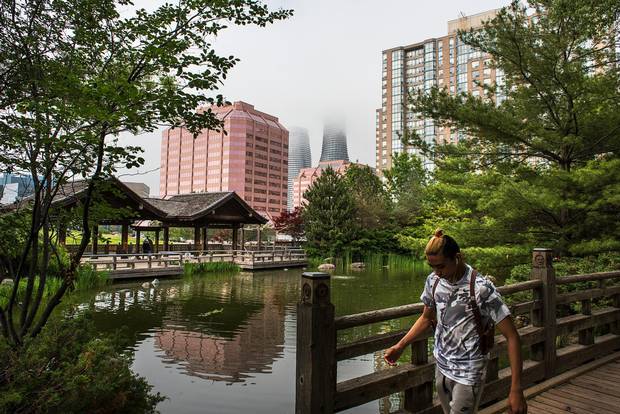
Mississauga’s Keryia Park. The heart of Mississauga Centre contains less sprawl than one might normally associate with the suburbs.
Aaron Vincent Elkaim for The Globe and Mail
But today, most new Canadians come from Asia and the Pacific (India, China and the Philippines are the three largest source countries). The selection process ensures that they have a good education and decent job prospects. Polling data suggest that their economic and social values (low taxes, law and order) align closely with those of the party – a synergy that tilts Mississauga Centre in Stephen Harper's favour.
But there are also buttons the progressive parties could push.
Tihang Tran, who arrived from Vietnam 10 years ago, works as an administrative assistant in an office building, and dreams of escaping the condominium where she and her husband are raising a nine-month-old son – "They don't let children run around" – and owning a home.
Her biggest concern? "It is very hard to find daycare." And because she wants the very best for her son, she says politicians should "spend on the future of education." Ms. Tran is tailor-made to vote for the Liberals or the NDP, which has pledged to bring in subsidized daycare. But the truth is, she knows little about Justin Trudeau or Thomas Mulcair – she just doesn't follow politics.
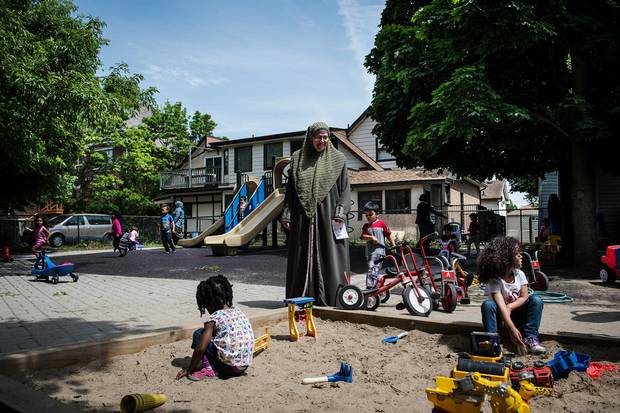
Mariam Ali watches over the kids at the Creditview Childcare Centre, which she manages. Some voters in Mississauga see the scarcity of daycare as an obstacle to upward mobility.
Aaron Vincent Elkaim for The Globe and Mail
Legions of new Canadians like Ms. Tran should flock to one opposition party or the other, but don't. Postelection surveys in 2011 showed that, the longer they have been here, and the more affluent they have become, the more likely they are to cast a ballot – and the more likely that ballot will be for a Conservative.
To take Mississauga Centre, the NDP or Liberals either must win back these voters, or persuade more of the others to get involved on their behalf. One problem: Many so-called "landing-pad" immigrants live in apartment buildings or condo towers. That makes it much harder for candidates to reach them through the traditional method of door-knocking – which, in turn, makes advertising and, increasingly, contact through social media even more crucial to their success.
The combatants
Omar Alghabra is back. The 45-year-old Saudi-born mechanical engineer who inherited Mississauga-Erindale from Ms. Parrish in 2006 is contending for the Liberals for the fourth consecutive election – fighting for a riding in part fashioned from the one he lost.
Now teaching at Toronto's Ryerson University, he believes the election is about the economy: "Even those who have a job have a sense of anxiety about their jobs."
There are other issues, of course. As he spends a pleasant morning canvassing the northern part of the riding – new semi-detached, two-storey brick houses with prominent garages – concerns at the door range from property taxes, speed bumps, the new provincial sex-education curriculum and exorbitant rates for car insurance to the evils of gay marriage and godlessness in general.
But over and over again, conversations circle back to jobs and taxes. The economy has been a defining issue in politics ever since the recession of 2008-09. It's what matters most to Arcadio Parinas – the sort of voter Mr. Alghabra simply must win over.
He is a 32-year-old information-technology professional whose wife works in health care. They plan on having children some day, but right now they and their friends "are just focused on our careers." Mr. Parinas came to Canada from the Philippines when he was 5, voted Conservative in the last election, and inclines that way again.
To win, Mr. Alghabra must get him to switch – and the millennial professional is intrigued by the Liberal proposal to cut taxes on middle-income earners like himself, while raising them on high incomes. Echoing Mr. Alghabra, he says, "We just want government to keep our jobs secure and our taxes low." And he, too, wants to hear how the parties are going to help with daycare costs, when the time comes.
The New Democrats are represented by Farheen Khan, who gets a good response when she door-knocks on a rainy evening in Credit Woodlands, seeking names for a petition in support of her party's daycare pledge. The 34-year-old has managed a women's shelter, and already won recognition for her work advocating for women's rights. But her team is demonstrably less well-organized than their Liberal counterpart. The NDP campaigners use clipboards; the Liberals have iPads.
In fact, until recently, the NDP considered Mississauga less than crucial to its electoral prospects. The best hope for a New Democratic government, strategists speaking on background maintained, would come not from the 905, but by marrying the party's Quebec base to major gains in British Columbia's Lower Mainland.
That may be because, until now, the battle in the 905 has been red versus blue. But with the NDP now tied with or, in some polls, even ahead of the Conservatives and Liberals, the party has shifted its focus. Mr. Mulcair campaigned in the 905 in late July and will be holding a rally in Mississauga on Monday. There, he will be introduced by Ms. Khan. Mississauga Centre, and ridings like it, are now squarely in the party's crosshairs.
The Conservatives are represented by Julius Tiangson, a financial consultant who, like Mr. Parinas, was born in the Philippines. He declined repeated requests for an interview, but according to his campaign website, Mr. Tiangson arrived in Canada in 1985, and has devoted many years to working with, and advocating for, fellow newcomers.
According to a profile in Munting Nayon, an online Filipino news site, he is "a practising Christian and a former church minister" who originally settled in Saskatchewan before moving to Ontario, where he founded the Gateway Centre for New Canadians in Mississauga, which offers settlement and support services.
According to Mr. Tiangson's website, he and his family "believe in serving God, serving people and serving our community together."
The fight for Canada's soul
Politically active or not, the people of Mississauga Centre agree that their community is a splendid place in which to live and work – a great incubator where starter homes are relatively affordable, a launch pad for anyone determined to make it, a uniquely Canadian cosmopolitan community.
"Just tell them Mississauga is beautiful," Joy Mag, yet another Philippine-born resident, calls over her shoulder as she hurries to pick up her children from swimming lessons. "Everyone should live here."
But for Mr. Malhotra, of India Rainbow, one of the challenges of Mississauga Centre is that many "haven't had the opportunity to be fully a part of the Canadian conversation.
"Whether it concerns sexual orientation or mental health or a number of things, people say, 'No, no – we don't have that, we don't do that, we don't go there.'" Such social conservatism may put them at odds with the native-born population. "I don't think it's terribly healthy," he worries.
Even so, newcomers also worry about the cost of daycare, and education, and the environment and global warming. The policies that brought them or their parents here are part of Canada's progressive, not conservative, tradition. If Justin Trudeau and Thomas Mulcair want to win, they must convince these voters of the need for change without disturbing their ambitions and their socially conservative core.
Mr. Hamlawi, the young nursing student, will probably vote NDP, since he detests what he sees as the authoritarian and inequitable policies of the Harper government; and he is appalled that the Trudeau Liberals backed Bill C-51, the Conservatives' anti-terrorism legislation.
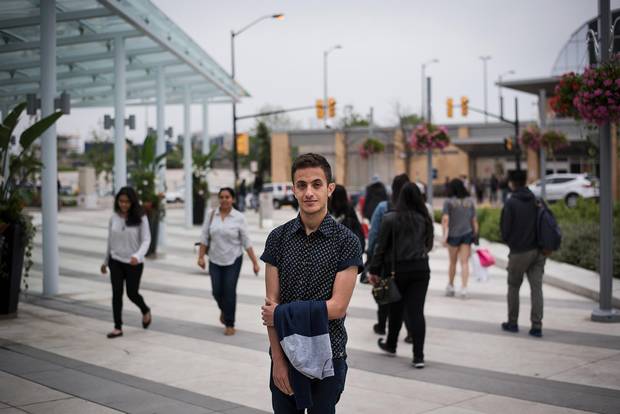
Even at age 18, Abdullah Al Hamlawi is nostalgic for a more family-oriented Mississauga.
Aaron Vincent Elkaim for The Globe and Mail
His friend, Ryan de Silva, is less exercised by politics, although he, too, is unlikely to back the Conservatives, "because they have been in power for so long. If the Liberals had been in power for that long, I probably wouldn't vote for them either."
But Stephen Harper has Tanveer Farooqi's vote. He came to Canada from Pakistan in 2001 and believes only the Conservatives can be trusted to keep criminals and terrorists at bay. "It was hell there and, if we're not careful, it will be hell here, too," he warns, heading to his car in a grocery-store parking lot.
This bedrock desire for stability is expressed over and over again in Mississauga Centre, and is the Conservative advantage. But that advantage may not be sufficient. Polls show that, after a decade of Conservative government, voters are growing weary of Mr. Harper's face. There is a great desire for change in the electorate, and that desire could overwhelm all other considerations.
Joe Barillari says he sees the clash between conservative values and a desire for change in his barber shop. The men who sit in his chair, he says, give the Prime Minister credit for getting the country through tough times, but they're also intrigued by the Liberal leader, even if they have doubts.
Like other postwar immigrants, Mr. Barillari worshipped Mr. Trudeau's father (he arrived in Canada in 1968, the year Pierre Trudeau came to power) for promoting multiculturalism. But his customers wonder whether Justin "is not ready for prime time," as Mr. Barillari puts in – echoing the Tories' relentless attack ads.
Does this mean Mr. Harper will keep voters here loyal one more time? Will Mr. Trudeau manage to change their minds and return them to the fold? He certainly seems determined to do so; his first Ontario appearance after the election call was to unveil the Liberal campaign bus – in Mississauga. Or perhaps Mr. Mulcair, newly engaged with the 905, will persuade Mississauga Centrans to reject the past and follow Alberta's lead.
Mr. Barillari shrugs. "We have to see what happens."
Whatever does happen in Mississauga Centre and across the 905 will matter hugely on election night when, if past is prediction, the suburban heart of the nation casts the deciding vote.
John Ibbitson is writer at large for The Globe and Mail