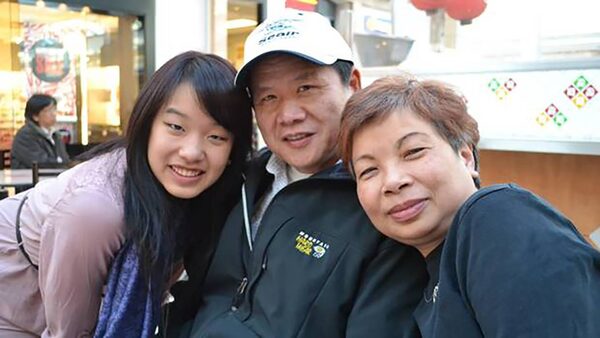
Amy Chang, seen with her parents John Chang and Allison Lu,
The daughter of two Canadians detained in China over a customs dispute is keeping a vigil in Ottawa this week, waiting for Prime Minister Justin Trudeau to respond to her request for a meeting on the plight of her parents.
Signs are emerging, meanwhile, that the Trudeau government has stepped up its efforts on behalf of John Chang and Allison Lu, Canadian winery owners trapped in Shanghai since March, 2016, when the Chinese government accused them of failing to pay sufficient duties on wine shipments to China.
The case has raised new questions about Canada's pursuit of a trade deal with China after the couple's daughter, Amy Chang, petitioned Ottawa for help. Lawyers for the couple say their clients have been victimized by a country where commercial disputes can catapult the unwary into an abuse-prone criminal justice system controlled by the ruling Communist Party.
Mr. Chang and Ms. Lu faced a criminal trial in Shanghai last week, accused of smuggling wine into China at cut-rate prices. No verdict has yet been rendered, but China's legal system has a conviction rate of 99.6 per cent.
Chinese authorities say the couple owes Beijing nearly $20-million and have seized 267,000 bottles of their wine; the maximum punishment for smuggling is life in prison and a fine up to five times the amount owed.
Ms. Chang has travelled to Ottawa this week, still waiting to see Mr. Trudeau, who returns from a lengthy trip to Europe on Wednesday. It has been nearly a week since she formally asked the Prime Minister for a meeting to explain the case and why Canada must intervene. She has received no response.
She said Canadians should not be jailed over a commercial dispute. "This is a trade issue. I would like him to turn his attention to this file because my parents … shouldn't be detained overseas," Ms. Chang said. "I am hopeful he will give me 10 minutes of his time to meet with me on this."
Mr. Chang and Ms. Lu were born in Taiwan but obtained Canadian citizenship after moving here. They live in Richmond, B.C., and over the years Mr. Chang had built a name for himself and his winery business in Canada. He regularly accompanied Canadian government officials on trade missions to China, and during the 2010 Winter Olympics in Vancouver, the premises of one of their businesses, Lulu Island Winery, were designated as "China House," the place where Chinese athletes, coaches and officials could unwind after competition.
In 2015, Mr. Chang was named an RBC Top 25 Canadian Immigrant award winner.
The Trudeau government appears to have been galvanized into action. Canada's new ambassador to China, former Trudeau cabinet minister John McCallum, flew to Shanghai, where Ms. Lu currently resides. Chinese authorities have taken her Canadian passport and she is forbidden to leave the country.
Mr. McCallum told Ms. Lu, according to her daughter, that he has written a letter on the couple's behalf to the Chinese government. He did not provide her a copy because, he said, it was government-to-government communication.
Canadian officials also informed Ms. Lu that Canada's International Trade Minister, Francois-Philippe Champagne, recently discussed the matter at length with his Chinese counterpart. They told Ms. Lu that half the conversation was devoted to the case.
The department of Global Affairs declined to discuss the matter. "We are closely following the case of Mr. Chang and Ms. Lu. We have raised our concerns at a high level with Chinese authorities. Canadian officials are in contact with the relevant Chinese authorities, and are providing consular assistance to Mr. Chang, Ms. Lu, and their family," a Global Affairs spokeswoman said.
The Prime Minster's Office has repeatedly declined to say whether Mr. Trudeau will meet with Ms. Chang.
At the trial last week in Shanghai, Chinese authorities enlisted the testimony of a former employee of Lulu Island Winery, who told the court he warned his bosses years ago that they needed to raise the price they were declaring to Chinese customs. Chinese authorities alleged that while Lulu Island sold its wine for $69 to $95 in Canada, it declared its value to Chinese customs for much less, in some cases well below $10. The winery says the Canadian prices are in-store retail prices while the import value declared in China was in line with how other foreign importers were pricing their wine for customs.
Lulu Island said the employee had been fired for stealing wine and Mr. Chang said he had placed his trust in Chinese expertise to navigate a customs system he did not know well.