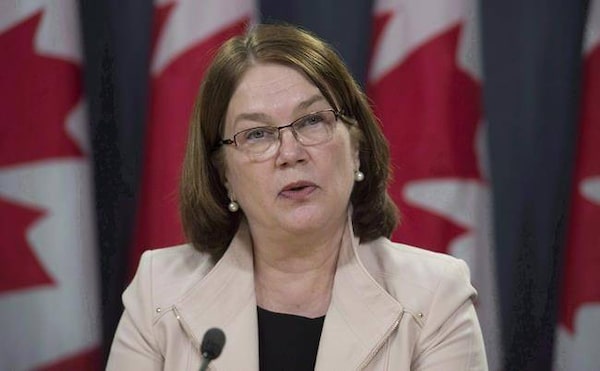
Jane Philpott speaks during a news conference in Ottawa, Thursday April 13, 2017.Adrian Wyld/The Canadian Press
Jane Philpott learned early in her medical career that the world is a very unfair place. Now, she sees it as her job to help fix it.
Working in Niger, West Africa, the family physician saw how dreams and talent did not necessarily lead to opportunity. In 1991, she experienced her own personal tragedy, when her first-born child, Emily, died suddenly at the age of 2 1/2 of meningococcemia, an illness rarely seen in North America.
"Having lived through that pain, it, I believe, helped me to be able to understand what it's like for others," Dr. Philpott, now 56, said in an interview.
André Picard: Philpott may be the right person to improve Indigenous health delivery
It is a personal perspective the former health minister brings to her new, historic portfolio: Minister of Indigenous Services.
Dr. Philpott, who will work in co-ordination with Minister of Crown-Indigenous Relations Carolyn Bennett, will focus on a variety of issues affecting Indigenous people, including child and family services, health care, infrastructure, education and housing.
The position developed from an understanding that this country, too, can be very unfair to some.
"I am increasingly taken with the reality that in Canada, there's a tremendous amount of inequity and injustice," Dr. Philpott told The Globe and Mail.
"And there are certain groups in the country that have been particularly discriminated against and we have an absolute obligation to make amends for that and to do better in the future."
Dr. Philpott comes to the file with the reputation of being a calm, thoughtful presence at Prime Minister Justin Trudeau's cabinet table. She is also known for getting difficult jobs done. The first-term Toronto MP negotiated health-care funding agreements with the provinces and territories, helped steer the government's contentious legislation on physician-assisted dying through Parliament and chaired an initial cabinet committee in charge of resettling 25,000 Syrian refugees.
When Mr. Trudeau asked Dr. Philpott last week to take on the new ministry, he told her he appreciated her work on the refugee file. "And then told me that he wanted me to work harder," Dr. Philpott said.
Her work in health will continue to inform her new role, she said, citing issues such as substance abuse in Indigenous communities.
"We know that First Nations, for example, are disproportionately represented in those who die of overdose. Clearly, those issues will continue to be priorities," she told reporters after the cabinet shuffle.
Justice Minister Jody Wilson-Raybould said Dr. Philpott, with whom she worked closely on the assisted-dying file, brings an "even keel" and thoughtfulness to her work.
"She approaches difficult situations by ensuring … she's done her research, that she's read everything that she can about the issue," Ms. Wilson-Raybould said.
The Justice Minister has nicknamed Dr. Philpott, now her good friend, the #motherofthecountry for her ability to instill confidence in those around her.
"She's a real person, and she doesn't purport to know the answers to everything," Ms. Wilson-Raybould told The Globe. "But she wants to find the answers in a really collaborative way, which I think is a hugely strong and necessary characteristic for this ministry."
Ms. Wilson-Raybould also chairs a working group of ministers reviewing laws and policies related to Indigenous people, of which both Dr. Philpott and Dr. Bennett are a part. Ms. Wilson-Raybould said the goal is ultimately to eliminate the Indigenous Services ministry altogether "because Indigenous peoples have determined how they're going to govern themselves."
Indigenous advocates hope Dr. Philpott can make significant improvements. Cindy Blackstock, executive director of the First Nations Child and Family Caring Society, said she hopes the federal government finally complies with a Canadian Human Rights Tribunal ruling that found it discriminates against First Nations children by failing to provide the same level of social and health services that are available to other Canadian youth.
"So far there's lot of symbolism and not a lot of action," Ms. Blackstock said.
She said Dr. Philpott can make a difference only if she has bureaucratic support. "My experience of her is that she's very open to hearing feedback," Ms. Blackstock said.
Dr. Philpott said the government has to "close those gaps" in First Nations funding, be it education, child services or health care.
"This is systemic discrimination, and it's wrong," she said.
Despite her personal loss, Dr. Philpott said she recognizes that she has lived a life of privilege. And she is hoping to use her time in government to level the playing field as much as possible.
"You get one life to live, so I'm going to use whatever energy I've got to try to address some of those issues."