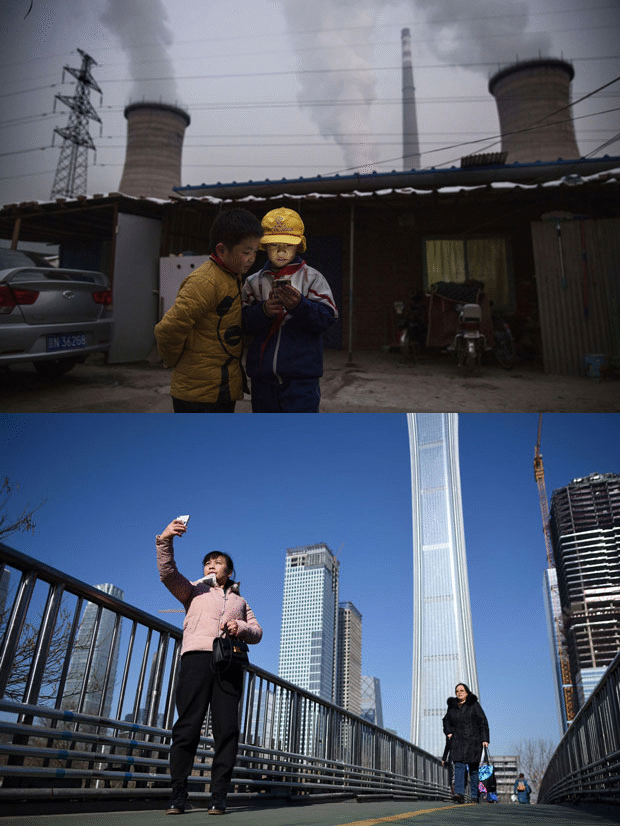
The sight of sharp horizons and cerulean skies in the Chinese capital was, not so long ago, rare enough that it merited special designation.
There was "APEC Blue," around the time Beijing hosted world leaders in 2014. There was "Parade Blue" for a 2015 military march past Tiananmen Square. There were multiple instances of "Two Sessions Blue" around annual political meetings – each permutation of blue the temporary result of government fiat. Once the parades, the foreign dignitaries and the politicians dispersed, the redolence of burnt coal returned.
But in the past few months, Beijingers have been toying with a less-familiar idea: Could blue skies be here to stay? Or has China's ability to manufacture blue skies just grown more skilled, producing clean air around Beijing but leaving others mired in a toxic atmosphere? Both, it seems, are true.
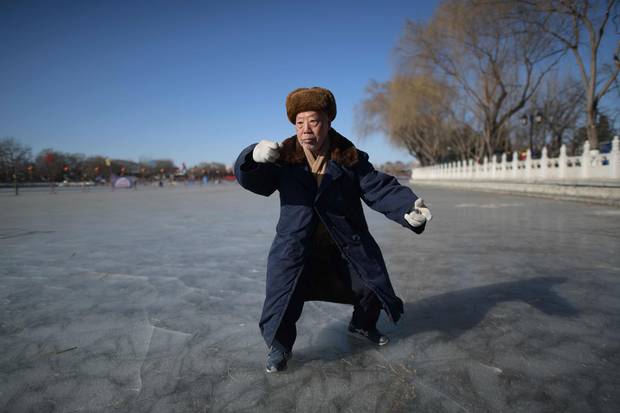
Jan. 23, 2018: In Beijing, under clear blue skies, an elderly man practices tai chi on the frozen lake of Hou Hai.
NICOLAS ASFOURI/AFP/GETTY IMAGES
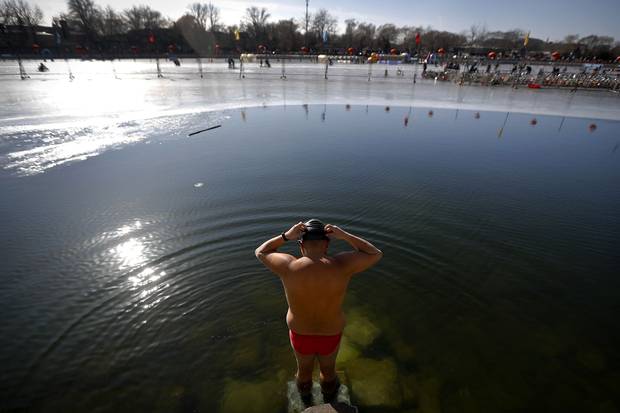
Jan. 24, 2018: A man prepares to swim in the half-frozen waters at the Shichahai Lake in Beijing. According to some of Beijing’s local residents, swimming in the freezing water is good for their health.
ANDY WONG/ASSOCIATED PRESS
Winter has typically brought the thickest smog to northern China, as coal-fired heating furnaces belch out particulate matter. During the worst episodes, flights are cancelled, schools are closed and people are afflicted with a dread that each breath is filling their lungs with carcinogens.
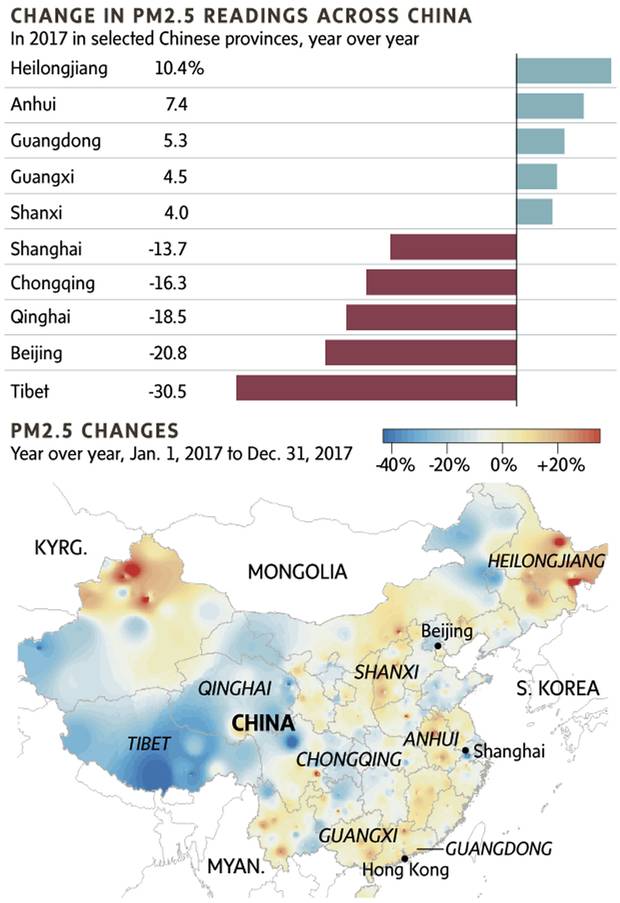
Some parts of China have remained true to form, with 2017 air pollution levels rising in eight Chinese provinces. Other areas have suffered icy chills, as buildings went cold without coal to heat them, the product of overambitious mandates to use natural-gas heating, even when gas lines had yet to be installed.
But nationwide, pollution fell 6.5 per cent last year, the Chinese government says – and nowhere has been better than Beijing, where nearby mountains have been visible in crisp relief, the snap of winter's cold unsullied by floating soot.
It has been a windy winter, to be sure, and gusty conditions have always brought clearer skies to Beijing. Roughly half the improvement this year came from weather, according to Greenpeace research.
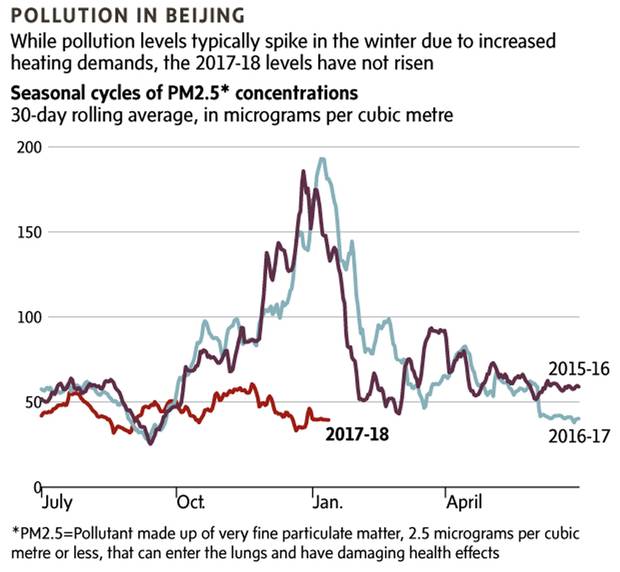
Even so, the change this winter has been staggering. It was less than three years ago that Chinese Premier Li Keqiang called for a national "war" on pollution. In the fourth quarter of 2017, Beijing's levels of fine carcinogenic particulates called PM2.5 dropped by 54 per cent relative to the same period in 2016, an analysis by Greenpeace determined.
JOHN SOPINSKI/THE GLOBE AND MAIL (SOURCES: REUTERS (VIA BEIJING AIR QUALITY MONITOR); GREENPEACE; THEATLAS.COM; CONFERENCE BOARD OF CANADA
Beijing's air was actually worse for much of 2017, but the late-year drop was so substantial that its annual average improved by a fifth. In December, Beijing was ninth among China's major cities for air quality.
"It's beyond imagination to see Beijing listed in the top 10 in December during the smog season in the past year, a delightful surprise," prominent environmentalist Ma Jun told the China Daily.
Elsewhere, though, delight has been harder to come by, as progress in Beijing raises suspicions that the city has merely exported the smog elsewhere.
JOHN SOPINSKI/THE GLOBE AND MAIL (SOURCES: REUTERS (VIA BEIJING AIR QUALITY MONITOR); GREENPEACE; THEATLAS.COM; CONFERENCE BOARD OF CANADA
For years now, heavy industry has been pushed away from the capital region. About 1,200 plants had been banished from the city by the end of 2016, according to Pengfei Xie, deputy regional director for East Asia at the C40 Cities Climate Leadership Group.
So when rising commodity prices prompted an industrial surge – China's raw coal output rose 3.2 per cent last year, while 2017 steel production hit an all-time record, with November steel-mill profits touching a 20-year high – the resulting smog billowed up far from Beijing.
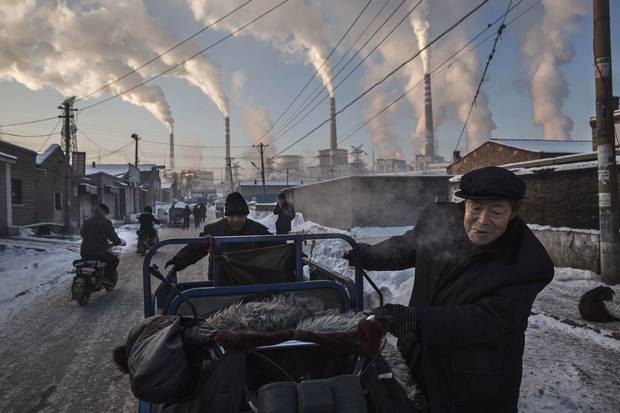
Nov. 26, 2015: Smoke billows from stacks as Chinese men pull a tricycle in a neighborhood next to a coal-fired power plant in Shanxi, China.
KEVIN FRAYER/GETTY IMAGES
In northeastern China's Heilongjiang, air pollution was up 10.4 per cent last year. In Guangdong, it rose 5.3 per cent. The unequal results in fighting air pollution have bred resentment.
"It's smoggy every day in Harbin. And it's the same in other cities in this province," said Hou Jie, who recently graduated from land resource management studies at Northeast Agricultural University. Harbin is the capital of Heilongjiang.
Smog has caused the closing of freeways to Harbin and a government-mandated slowing of high-speed trains in the area, he said.
Beijing "is the capital city, right? So naturally, it receives more attention," Mr. Hou said. In Heilongjiang, meanwhile, "I have to say, there is no obvious progress."
In Guangdong province, meanwhile, worsening air has afflicted a population less accustomed to defending against the outdoors.
"Most of us aren't in the habit of wearing masks or using an air purifier," said Jackson Li, who works in finance in the industrial city of Dongguan. The bad air leaves him feeling depressed, he said.
"We hope the central government can stop placing all of its attention on Beijing and spare some effort for environmental protection in other cities."
But the problem may lie closer to home.
Song Guojun, a professor of environment at Renmin University, is skeptical of the idea that Beijing's pollution has merely been exported. The biggest gains in the capital region have come from strict compliance, including checks on "loose, messy and polluting enterprises and factories," he said – cracking down on companies with outmoded technology or improper smog controls.
In December, Liu Changgen, head of China's environmental inspection, told the state-run Xinhua news agency that, over the course of two years, more than 18,000 government and party officials were held accountable for environmental offences.
Still, even Beijing remains far from vanquishing smog. It averaged 58 micrograms per cubic metre of PM2.5 in 2017, nearly six times the World Health Organization recommended level.
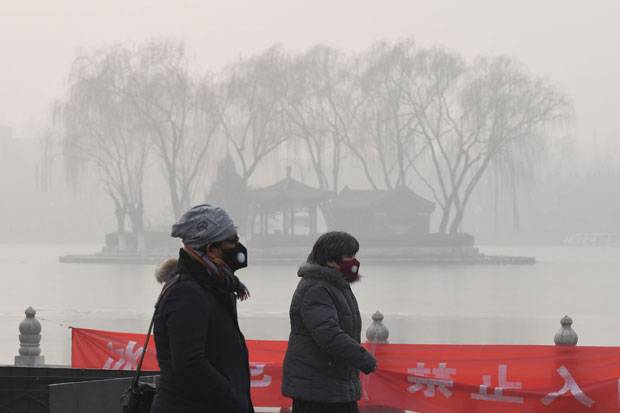
Beijing has nonetheless shown that a concerted government effort can make a difference – its more than 500 environmental inspectors have investigated and punished thousands of companies in the past four years, Reuters reported. The city has also promised a new police force dedicated to environmental protection.
Elsewhere, however, enforcement has been less strict, Prof. Song said, pointing to problems with local protectionism. Even if industry has been pushed away from Beijing, it is up to local leaders to ensure companies don't foul the air, he said – and that's largely a question of ensuring rules are followed.
"What we've already seen has proven that it's not wise to let local departments take care of all their own business," he said. "This needs to be reformed."
With reporting by Alexandra Li
THE GLOBE IN CHINA: MORE FROM NATHAN VANDERKLIPPE