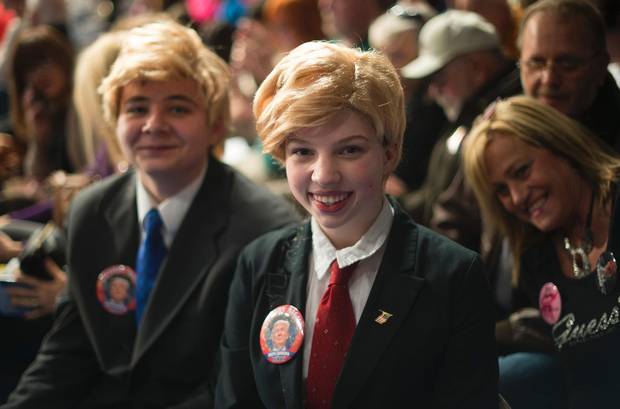
Sitting in front of his dishevelled desk, Myrtle Beach Mayor John Rhodes looked bewildered by Donald Trump's likely victory in Saturday's South Carolina primary.
"This is a comedy show," he said with deadpan scorn. "The debate last weekend was better than Saturday Night Live."
Like many mainstream Republicans who oppose the billionaire upstart, Mr. Rhodes tries to put on a good face, but people who don't like Mr. Trump are no longer amused by the King of Zing's success. They're surprised, angry or both. Usually, South Carolina is where insurgency campaigns such as Mr. Trump's come to die. This is an establishment-friendly state with a long, brutal history of weeding out windy parvenues and woolly radicals.
The third state contest that's also called the "first in the South," the South Carolina primary follows Iowa and New Hampshire.
For Republican strategists, the first two races are novel, quirky and give the country a sense of which candidates have early buzz. But that's it. South Carolina, on the other hand, is a primary of major symbolism and serious consequence, with a population far more representative of the nation at large. Its primaries are almost designed to favour an establishment candidate who will win the nomination, and perhaps take the White House.
Except for the 2012 election, its voters have correctly predicted every GOP nominee since Ronald Reagan in 1980. For almost two generations, the state has served as a giant sinkhole for outlier candidates who have wheeled into the first Southern contest thinking they had a sense of momentum, only to wind up trapped in the deep muck of South Carolina politics.
Remember the campaign of that other Nativist television fixture, Pat Buchanan, the angry Grand Old Party troll who won the New Hampshire primary in 1996. Moderate Bob Dole beat him here and later became the party nominee for president.
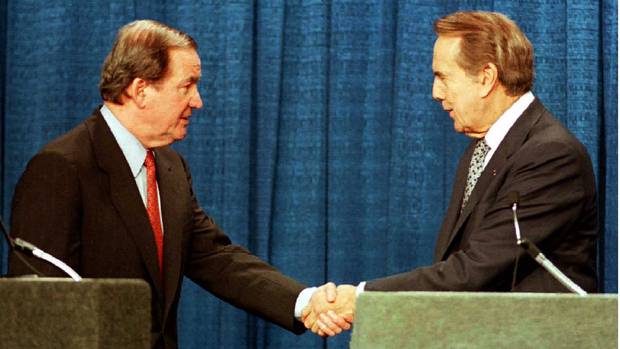
Republican presidential candidate Pat Buchanan (left) shakes hands with rival candidate and U.S. Senate Majority Leader Bob Dole at the start of a debate in Columbia, South Carolina, ahead of the primary in that state in 1996.
REUTERS
While mainstream candidates such as Mr. Dole don't always make it to the White House, winning early in South Carolina has allowed the party to rally behind a front-runner who can then refocus his energy on attacking the Democrats.
Ideally, the early victory gives the chosen candidate a head start.
This is why South Carolina is called the Firewall State. It protects the establishment's favourite son and gives him a safety zone in which to operate. That's the plan, at least. But in recent years, there has been slippage. Its ability to zap party upstarts was first challenged in 2012, when Newt Gingrich slipped under the firewall and defeated the so-called establishment candidate, former governor Mitt Romney.
But the firewall has met its match in Mr. Trump, who is noisily clanging at it like no other candidate before him. It's a showdown between one of the country's most impenetrable trip-wires and Mr. Trump, the Jason Bourne of political-code cracking.
In the meantime, the local establishment seems either helpless or absent.
"We don't have a very disciplined party here," said David Woodard, a leading political consultant in the state and a political science professor at Clemson University. "If Trump is nominated, though, it may be a disaster."
The vote has become something of a referendum on the GOP establishment's connection to its voters. If Mr. Trump's polling percentages turn out to be accurate on voting day – nearly twice those of so-called establishment candidate Marco Rubio the day before the contest, and with the other anti-establishment figure, Ted Cruz, running second – they will indicate significant daylight between the party leadership and voters of a critical state.
That will also leave the leadership in uncharted waters, having to rally behind a likely nominee with whom it has rancorous relations. The party would not be able to take advantage of a head start against the Democrats, who themselves are distracted with a powerful, populist insurgency from Vermont Senator Bernie Sanders, challenging their own establishment favourite, former secretary of state Hillary Clinton.
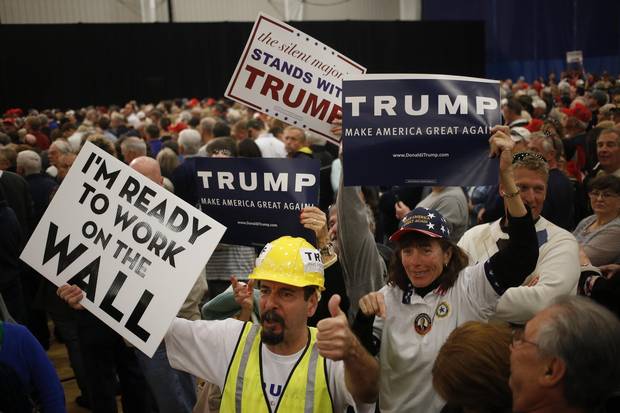
Attendees of a rally hosted by Donald Trump hold signs while waiting for Trump’s remarks to begin at the Myrtle Beach Sports Center in Myrtle Beach, South Carolina.
LUKE SHARRETT/Bloomberg
Whatever the outcome of Saturday's contest, South Carolina has long been considered to be conservative America writ smaller, a bellwether of the national Republican landscape.
The Lowcountry, home to Charleston and Myrtle Beach, is a coastal area where there are fiscally conservative retirees, as well as ex-military servicemen who want a more muscular defence program and tougher foreign policy.
The Upcountry is largely rural, religious and pro-gun. (It's also home to Gaffney, whose fictitious native son is Frank Underwood, the jugular-seeking president on the hit political series, House of Cards).
The Midlands is where the government and big business is mostly located. It was also the backyard to Lee Atwater, the late and controversial strategist who came up with the firewall strategy to help out George H.W. Bush in his successful 1988 campaign.
While popular in the Upcountry, Mr. Trump also has fans in the more moderate Lowcountry, who like his financial independence and tough talk. "He's not beholden to anyone but the people who brought him here," said state representative Mike Ryhal, who endorsed Mr. Trump. "He is questioning how we can change the political system. Doing the same thing over and over again the wrong way is called insanity."
In the meantime, others in the Lowcountry are wondering how this happened and where it will go. Mr. Rhodes said he could foresee Mr. Rubio trying an independent run, maybe taking some like-minded people with him to start a coalition. Others see a reprise of the 1912 election, in which four parties ran, including Theodore Roosevelt's Progressive Party, nicknamed the Bull Moose Party.
Still others say it's time to write the obituary for the firewall.
"Almost no one is understanding this," said conservative pollster and lawyer Matt Towery.
"The firewall has ended. There is no firewall."
One woman, who didn't want her name used because it sounded like she was swearing, may have summed up the chaos most succinctly: "It's a mell of a hess."
Visions and dirty tricks
Back in the late 1970s, when upstart Ronald Reagan was challenging the Republican establishment, South Carolina strategist Mr. Atwater and others sought to make the state more pivotal in the national nomination process. He saw seismic shifts in conservative power.
The South and West had become critical bases of support. Yankee, WASPy powerbrokers were a creaky, dying breed. Lunch-pail Democrats had become fickle, up for grabs. Key Republicans persuaded the GOP to make their state third in the primary season. Along with others, Mr. Atwater grasped that his traditional state had such an entrenched institutional bent that its voters would likely rally behind the establishment's choice. Unlike the populist contests in Iowa and New Hampshire, the South Carolina primary would stop any rebellion in its tracks.
In the 1980 election, South Carolina became the third state to host a contest. "It was visionary," said John Napier, a former Republican congressman and federal judge who knew Mr. Atwater. "The idea was to give the South as much influence as possible."
One of Mr. Atwater's mentors, Harry Dent, favoured candidate George H.W. Bush. (Mr. Dent was also the architect of Richard Nixon's Southern strategy.) South Carolina's long-standing senator Strom Thurmond endorsed former Texas governor John Connally. Mr. Atwater, on the other hand, supported Mr. Reagan, who ironically might not have made it through the firewall that Mr. Atwater later constructed.
South Carolina is renowned for its refined manners, but also notorious for its history of low-down, race-baiting politics. To bolster his candidate, Mr. Atwater leaked a rumour that Mr. Connally was trying to buy black votes. "And that was how the South Carolina Republican primary was born," wrote Charles Pierce in a recent Esquire article on Mr. Atwater's legacy, "in carefully calculating realpolitik and in dirty tricks."
For several years, Mr. Atwater served President Reagan, and by the time George H.W. Bush was in the running for president for the 1988 election, Mr. Atwater's notoriety had surpassed his mentor. "He eclipsed Harry," Mr. Napier said in an interview in Myrtle Beach. "He had a vision that was more national. He also had a better idea of who would succeed."
And how he would succeed. During that contest, Mr. Atwater coined the phrase Firewall State for his new candidate, Mr. Bush Sr. It was a way of articulating the protective zone they'd create around the heir apparent.
Mr. Bush already had lost to Bob Dole in Iowa, and eked out a victory in New Hampshire, not far from his home state of Connecticut. Sensing trouble, Mr. Atwater converted the patrician moderate into a man of piety, hectored the state's own establishment and the Christian coalition to back his man, and lit up television screens with nasty ad campaigns.
In 1991, two years after becoming chairman of the Republican National Committee, Mr. Atwater died. But his strategy didn't go with him. One of his close friends and protégés was Karl Rove, who bailed out the sinking campaign of George W. Bush in 2000.
The establishment choice, Mr. Bush was whacked by the John McCain Straight Talk Express in New Hampshire, routed by nearly 20 points. An outspoken Senate veteran and war hero, Mr. McCain was not seen as a machine candidate at the time. Popular with media, he had a winning kind of candour that seized the national imagination. That was until some nasty tricks tripped him up, including anonymous phone calls that asked South Carolina voters if they would be "more likely or less likely to vote for John McCain for president if [they] knew he had fathered an illegitimate black child." Mr. Bush won.
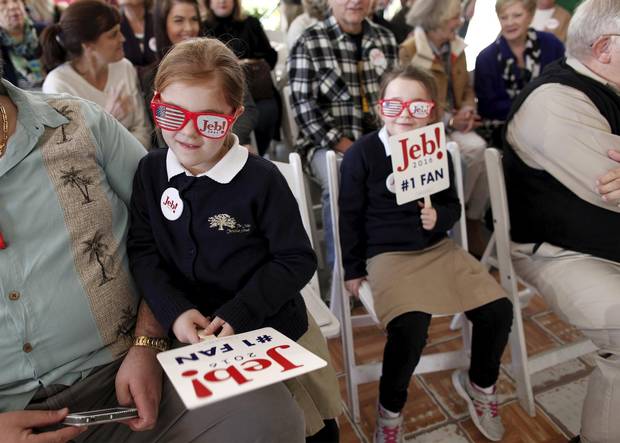
Twin sisters, Riley (left) and Reagan Gregg of Summerville, play with campaign fans before a campaign stop by U.S. Republican presidential candidate Jeb Bush at the Summerville Country Club in Summerville, South Carolina.
RANDALL HILL/REUTERS
To this day, the Bush family remains popular in the Palmetto State, where the approval ratings for George W.'s presidency sit at 84 per cent. Two administrations later, former Florida governor Jeb Bush is hoping to follow his brother to the White House.
At a local hotel for a town hall earlier this week, he gave a commanding speech about the perils of divisiveness and the merits of compassion and self-sufficiency. Much more authoritative and energetic than Mr. Trump would depict him, he is a very nuanced speaker with a vocabulary that compared with Mr. Trump is Churchillian. "What is that expression?" he wondered at one point. "Hoisted on his own petard?"
I asked Mr. Napier, Mr. Bush's co-campaign chair in South Carolina, if Mr. Bush is the right candidate at the wrong time. Surely there is too much clamorous resentment for voters to stop and listen to his fully formed thoughts. Mr. Napier disagreed. The country needs him more than ever, he said; Mr. Bush is measured, experienced, thoughtful. The polling numbers for this establishment candidate, however, indicate different sentiments. In this state, he is barely in the double-digits.
Last week, there was the sulphuric whiff of the firewall at the now-notorious debate in which Mr. Trump was soundly and repeatedly booed. Mr. Trump alleged that the local machine of the Republican National Committee stacked the audience with anti-Trump donors, who presumably would be out to ridicule him on national television.
Much of the state's establishment has in fact teed up against Mr. Trump. Indo-American Governor Nikki Haley, seen as an up-and-coming star in the GOP, has made veiled criticisms at Mr. Trump and endorsed the Cuban-American Mr. Rubio, another politician who gives the party a more diverse brand. Senator Lindsey Graham, a failed candidate whom Mr. Trump recently called "one of the dumbest human beings," is stumping with Jeb Bush.
Most party officials dismiss the claim of a rigged audience. Some local media reports back it up, however; one leading state organizer also verified it to The Globe and Mail, and she is not a Trump supporter. She said she recognized a lot of party members.
Maybe there is a wall or maybe there isn't. Either way, there sure is a lot of fire.
Follow me on Twitter @Craigoffman
Republicans and the South Carolina primary
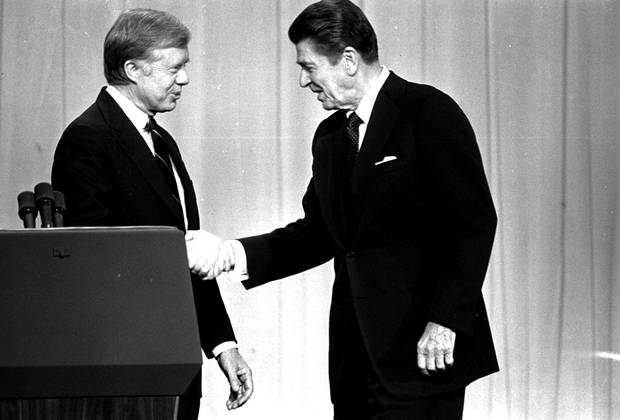
President Jimmy Carter, left, and Republican presidential candidate Ronald Reagan, shake hands before nationwide televised debate in Oct. 1980 in Cleveland, Ohio.
AP
The first Republican primary in South Carolina took place in 1980. Ronald Reagan defeated former Texas governor John Connally by winning 55 per cent of the vote.
"It was a key victory for Reagan who had to get the only southern candidate out of the race early so that he could win a series of big victories in the south," writes Donald Fowler, a long-time political operative, in a piece for the Brookings Institution.
"From that victory, Reagan went on to win the nomination and defeat the Democratic incumbent, President Jimmy Carter," he added.

Vice President George Bush during a presidential campaign address to the 70th annual convention of the American Legion in Sept. 1988 in Louisville, Kentucky.
J. SCOTT APPLEWHITE/Associated Press
Vice President George H.W. Bush was defeated in the Iowa caucuses in 1988 – finishing third behind Christian evangelical leader Pat Robertson and Iowa winner Bob Dole.
He won the New Hampshire primary but struggled to fend off challengers.
His resounding South Carolina victory proved a turning point – and Mr. Bush eventually secured the Republican presidential nomination and won the 1988 election.
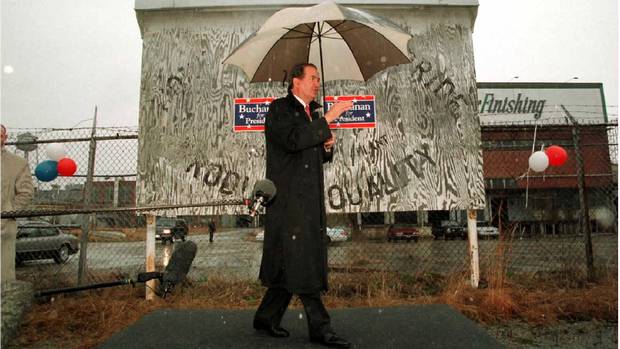
Republican U.S. presidential candidate Pat Buchanan stands alone in the rain on a small stage as he addresses a crowd at a campaign rally at the Clearwater Finishing Plant in Clearwater, South Carolina in Feb. 1996 ahead of the South Carolina primary.
WIN MCNAMEE/REUTERS
Conservative firebrand Pat Buchanan, who served as an aide to Richard Nixon and communications director in the Reagan White House, ran a populist and insurgent campaign against the Republican establishment in 1996.
His triumph in New Hampshire put pressure on front-runner Bob Dole. But Mr. Buchanan was not able to keep up the momentum in following contests. A solid win in the South Carolina primary by Mr. Dole put him on the path to the Republican party's presidential nomination.
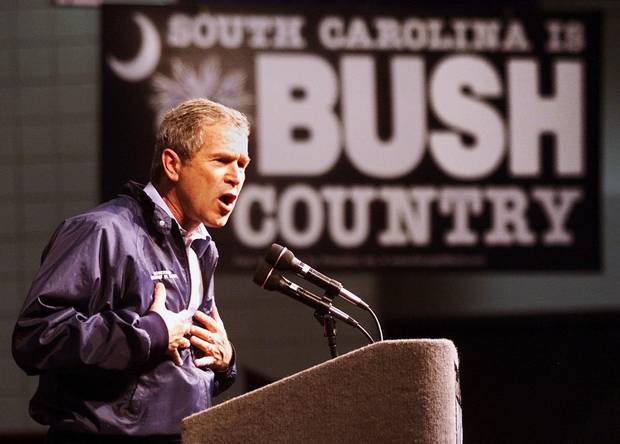
Republican presidential hopeful Texas Governor George W. Bush addresses the crowd during a community barbecue at the Florence Civic Center in Florence, South Carolina ahead of the primary in that state in 2000.
TIMOTHY A. CLARY/AFP
Texas Governor George W. Bush won the Iowa caucuses in 2000 and then lost the New Hampshire primary to Sen. John McCain. Looking for a win in South Carolina, both candidates campaigned hard.
As the story goes, a smear campaign against Mr. McCain, including allegations that he fathered an illegitimate black child and that his wife struggled with drug addiction, turned the South Carolina in Mr. Bush's favour.
The Texas governor went to win the party's nomination and defeat Al Gore in a highly contested general election.
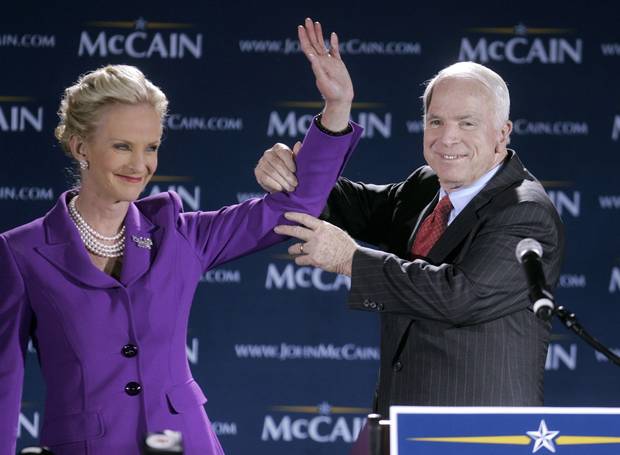
Republican presidential hopeful Sen. John McCain lifts his wife’s arm up as the two take the stage at an election night watch party at The Citadel, in Charleston, South Carolina in Jan. 2008 following primary voting in South Carolina.
STEVEN SENNE/AP
John McCain's bid to become president in the 2008 election started with a loss in the Iowa caucuses to former Arkansas governor Mike Huckabee. Mr. McCain bounced back with a win in New Hampshire – where his main opponent was Mitt Romney.
The South Carolina primary, a state where Mr. Huckabee hoped to regain the magic of Iowa and some momentum, did not materialize. The Huckabee campaign faded, as did the Romney candidacy – and Mr. McCain went on to face Barack Obama in the 2008 presidential election.
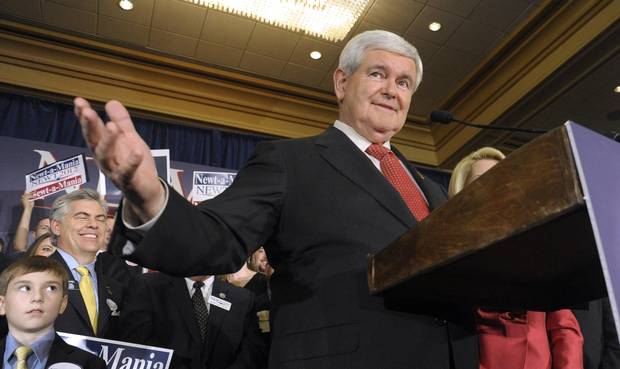
U.S. Republican presidential candidate Newt Gingrich addresses supporters after polls closed in Georgia. He won his home state, but lost in eight other states during the Super Tuesday contests in March 2012.
JOHN AMIS/REUTERS
Newt Gingrich finished in fourth place following the Iowa caucuses, and his showing in New Hampshire was equally poor. But the former speaker of the U.S. House of Representatives made a powerful statement by winning the South Carolina primary. That would be the high-water mark of his campaign.
Mr. Gingrich lost the Florida primary because of poor debate performances against Mitt Romney – and a widely ridiculed idea to put a human colony on the moon. Mitt Romney won the party's nomination and lost to President Barack Obama.
– Affan Chowdhry