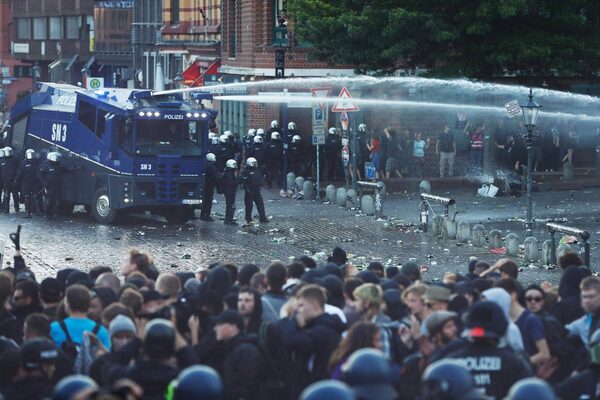
Riot police use water cannon during the ‘Welcome to Hell’ rally against the G20 summit in Hamburg, northern Germany, on July 6, 2017.ODD ANDERSEN/AFP / Getty Images
The Group of 20 summit is opening under a dark cloud with violent protests in the streets and some leaders sniping at each other.
As Prime Minister Justin Trudeau and the other leaders arrived on Thursday, tens of thousands of demonstrators held a giant rally dubbed "Welcome to Hell." By the evening, the protesters had clashed with hundreds of riot police, leaving many injured and reports that several cars had been set on fire.
As the clashes spread across other parts of the city, U.S. President Donald Trump was lambasting Russian President Vladimir Putin over his country's aggression in Ukraine, causing the Russians to bite back. Meanwhile, some delegates to the summit wondered if the final communiqué should simply turn into a G19 document, with Mr. Trump excluded because of his stance on trade and climate change.
Globe editorial: A guide to the G20, and the importance of nice socks
Opinion: Why G20 unity is crucial to Canada
Trump vs. Merkel: Whose trade vision will triumph at the G20?
It all left the summit's host, German Chancellor Angela Merkel, scrambling to keep everyone onside and hoping to find some common ground. "You can imagine that there will be discussions that will not be easy," she said on Thursday. "Globalization can be a win-win situation. It must not always be that there are winners and losers."
These will be a difficult two days for Ms. Merkel and the other leaders when they begin formal meetings on Friday at a downtown conference centre. Several experts don't expect much to be accomplished at the summit and there are fears among some that this could be first G20 that fails completely, with no consensus reached on how to tackle major issues, such as climate change and open trade.
That has made some people like Greta Winkler wonder if G20 meetings are worth it. "They are not going to think about the really important things that are touching our everyday life," said Ms. Winkler, a student from Italy who came to Hamburg to join the rally. "There is a lot of anger … I'm 23 years old and I have grown up hearing that no matter what I study, or what I do, I will have no job and no opportunity."
She joined the protesters as they began to march toward the G20 meeting site in central Hamburg. The group represented a wide selection of issues, from gay rights to environmental protection, anti-globalization and worker protection. And while Mr. Trump was the focus of much of the anger, many were also virulently opposed to Mr. Putin and Turkish President Recep Tayyip Erdogan.
"They are anti-democratic," said Maximilian Hermannsen, a 20-year old electrician. "Trump is not as bad as Putin or Erdogan. [Turkey and Russia] are not real democratic countries and America is and it will stay democratic with or without Trump."
As the marchers headed out, they inflated a giant "black block," the informal name of their loose coalition, and waved flags and banners. But they only got a few hundred metres before being stopped by hundreds of police in riot gear. Some protesters began throwing rocks and bottles, and the police retaliated with water cannons and pepper spray. Many people could be seen lying on the grass as ambulance workers tended to the injuries.
By nightfall, the protest had broken up and spread to other areas around the city, leading to running battles with police. Still more protests are expected on Friday and Saturday, as organizers estimate that around 100,000 people have come to Hamburg to voice their concerns about the G20.
While the marchers gathered, Mr. Trump was in Poland on a brief stop before landing in Hamburg Thursday afternoon. During a speech in Warsaw, the President took Mr. Putin to task over Russia's involvement in Ukraine.
"We urge Russia to cease its destabilizing activities in Ukraine and elsewhere, and its support for hostile regimes including Syria and Iran, and to join the community of responsible nations in our fight against common enemies and in defence of civilization itself," Mr. Trump said. The Kremlin quickly rejected the assertions, setting up what could be a tricky first meeting between Mr. Trump and Mr. Putin in Hamburg on Friday.
Mr. Trump met for about an hour with Ms. Merkel after landing on Thursday, and the two discussed a range of issues including North Korea, the Middle East and eastern Ukraine. Before the meeting, Ms. Merkel said she held out hope she can find common ground on the issues she wanted to pursue during the summit, including the importance of the Paris accord on climate change which Mr. Trump has rejected.
Ms. Merkel said she will make her case but added: "On the other hand, as hosts we – and I – will do all we can to find compromises." That included finding some kind of agreement on climate change. "There are various options, which can be discussed. We know that the United States have withdrawn. All others … or as far as I know, many, many others stand by this agreement," she said.
Mr. Trudeau took a different approach on Thursday, landing in the early afternoon and attending a glittering Global Citizen concert in the city's 16,000-seat Barclaycard Arena. In keeping with his own celebrity status here, Mr. Trudeau took the stage to introduce Coldplay and Shakira, telling the crowd that he hoped to push the other G20 leaders on issues concerning women. That issue "underscores something that we all know," he said, "given equal opportunities, women and girls can change the world."
Mr. Trudeau took the opportunity during the show to hold meetings with Norwegian Prime Minister Erna Solberg, Argentine President Mauricio Macri and World Bank President Jim Yong Kim, who gushed that Canadians were "all so lucky to have this man as prime minister."
Mr. Trudeau plans to hold more one-on-ones with French President Emmanuel Macron, Ms. Merkel, Mexican President Enrique Pena Nieto and India's Prime Minister Narendra Modi. Mr. Trump also plans to meet his Mexican counterpart, meaning the G20 could include the North American free-trade agreement in its trade deliberations.
But as the leaders arrived and their motorcades blocked off roads, delayed public transit and caused general havoc across this city, many Hamburg residents felt frustrated at the mayhem and the G20 in general.
"Why did they have to hold it here?" asked an exasperated Michael Tasche as he watched thousands of protesters take over the city's famous fish market district. "I don't know why [Ms. Merkel] did it."