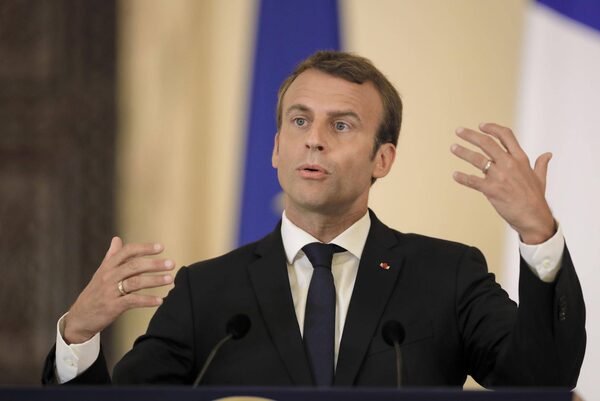
French President Emmanuel Macron speaks during a news conference in Bucharest, Romania, on Aug. 24, 2017.Vadim Ghirda/The Associated Press
When Emmanuel Macron swept to power as France's youngest President in May, he was seen as a great reformer who promised a new style of leadership and vowed to overhaul the country's sagging economy.
But now, three months into office, Mr. Macron has seen his popular support crumble amid a series of scandals, a host of political missteps and growing discontent over his leadership. Recent opinion polls put support for him at around 36 per cent, far lower than any of his three immediate predecessors had at the same stage in their presidencies. It's also a far cry from last May, when Mr. Macron won 66 per cent of the vote in defeating the National Front's Marine Le Pen.
"It's been kind of rough," said Nicole Bacharan, a political scientist who lectures at Sciences Po University in Paris. "The French tend to burn very fast what we have adored."
Yakabuski: Is Macron's presidency already falling apart?
Analysis: In electing Macron's party, France endorses a pro-EU centrist movement
And things could get a lot tougher for the 39-year old president. His biggest challenge is looming next month when he plans to introduce sweeping changes that will make it easier for companies to hire and fire workers. The proposals include plans to cap compensation for wrongful dismissal, revamp how labour negotiations are conducted and ease requirements to pay workers extra for night shifts and overtime.
Reforming the labour market was a central promise of Mr. Macron's campaign. It has also been a rallying cry for many economists and business leaders who have argued for years that France has been held back by its powerful unions and rigid labour regulations. They say the country now has a two-tiered labour market: those on permanent contract who effectively have jobs for life, since laying them off is nearly impossible under French law, and those working ultra-short contracts, often for less than a month, interspersed with spells on benefits.
Mr. Macron also hopes to prove to other European leaders, particularly in Germany, that France is serious about economic reform. That's the only way he can build support for his call for more European integration, which includes creating a kind of eurozone government with a finance minister to co-ordinate fiscal policy.
"This is going to be his first big test," said Ms. Bacharan. "Basically the labour code is what people will focus on. He has to succeed, that's what is at stake for him if he wants to succeed in terms of the economy. That's what he has to do for being able to talk with [Angela] Merkel in Germany and to have any kind of influence in Europe, so it's a big thing."
But France's labour unions have successfully fought off proposed changes before and some are already spoiling for a fight. One of the biggest unions, the CGT, has accused Mr. Macron of breaking the labour code and it has called for a national day of protest on Sept. 12. Jean-Luc Mélenchon, who heads France Insoumise, or France Unbowed, and has become a leading opponent of Mr. Macron, has announced plans for a national protest on Sept. 23. Former French president François Hollande has also taken a shot at the proposals, telling reporters this week that the changes weren't needed and that Mr. Macron shouldn't "demand needless sacrifices from the French."
While several union leaders have said they will wait to see the final proposals, Mr. Macron's slumping popular support has not aided his cause. He also hasn't been helped by his Labour Minister, Muriel Pénicaud, a former executive at food giant Danone. She has come under criticism for being out of touch after it emerged that while at Danone she cashed out more than €1-million worth of stock options shortly after the company announced 900 layoffs. The job cuts pushed up the share price and made her options more valuable. She's hit back at the criticism, saying, "That's absolutely not what I am like. All that is hurtful but political life is like that."
Ms. Pénicaud's troubles illustrate some of the other problems Mr. Macron has been facing since being elected. He campaigned as an independent and his new party, La Republique En Marche!, won a massive majority in the national assembly in June. But many of the new Members of Parliament have proven to be incompetent and four cabinet ministers have had to resign amid corruption allegations.
Mr. Macron has also made things worse with an autocratic management style. That came through in July when he tangled with the country's top military official, General Pierre de Villiers. After the general complained about cuts to the military budget, Mr. Macron clumsily defended the cuts and told him: "I am your boss." Gen. Villiers resigned a few days later. There have also been questions about the role of Mr. Macron's wife, Brigitte Trogneux, and he had to scale back plans to have her serve as an official first lady with a formal budget.
There is still plenty of time for Mr. Macron to recover. His term lasts five years and there are signs the economy is beginning to turn around. Unemployment is starting to fall, the stock market has been booming and France's economy is expected to grow by 1.6 per cent this year, the fastest since 2011. Mr. Macron has also had some success on the international stage, hosting Russian President Vladimir Putin and U.S. President Donald Trump, and playing a key role at the Group of 20 Summit in Germany.
And for now, anyway, Mr. Macron isn't showing any signs of backing down. "The transformation that we're carrying out is to bring France into the 21st century," he said this week, adding that he is seeking nothing less than to "profoundly change the economic and social structures of France."
Whether Mr. Macron can pull off such a grand vision remains to be seen. Ms. Bacharan said he does have one important thing going for him. "I think he's someone who learns fast," she said. "And he'll have to learn fast."