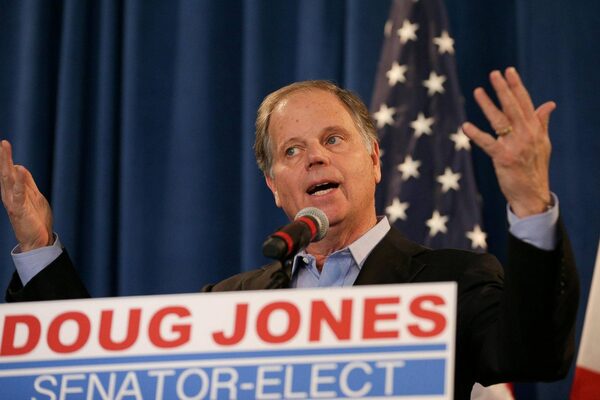
Democrat Doug Jones, who won the special U.S. Senate election against Republican candidate Roy Moore, speaks during a news conference in Birmingham, Alabama, on Dec. 13, 2017.Marvin Gentry/The Globe and Mail
The day after pulling off an upset victory in Alabama, Democratic Senator-elect Doug Jones declared that his defeat of Roy Moore would spell the end of the Republican Party's domination of his state. And the leaders of the U.S. left were quick to declare the vote as a mighty blow to Trump-style politics.
"This state is going to be progressed," Mr. Jones told a news conference. "We're on the road to having a competitive, two-party state without one-party domination."
Bernie Sanders, the socialist Vermont senator, said in a statement that Mr. Jones's triumph showed Mr. Trump's "vulgar and reactionary agenda is extremely unpopular" and "there is not a state in our country where we cannot win."
But the numbers tell a different story: Mr. Jones won by less than 2 per cent of the vote on less than 40-per-cent turnout. And he began leading pre-election polls only after Mr. Moore was accused of molesting underage girls – suggesting that his anti-Muslim and anti-gay views were not a barrier to victory for him.
From the start, the election took on national importance. Mr. Moore ran a populist campaign similar to Mr. Trump's 2016 bid – backed by the President's nationalistic former chief strategist, Steve Bannon – but with even more extreme views. Mr. Moore has said Muslims should not be allowed to sit in Congress, homosexuality should be a crime and America was last "great" during the era of slavery.
"This last year has been really difficult. We have to get our guy in," said Joel Pryor, an event manager, as he stood in the audience for a Democratic rally in Birmingham the weekend before the vote. "All these Bannon puppets are coming up now. They call themselves 'alt-right' – it's just old-fashioned racism."
The Democrats poured cash and people into the race, with a particular focus on turning out the state's urban and black voters – concentrated in Birmingham, the only metropolitan area of more than a million people in the state, and the "black belt" region that covers the state capital of Montgomery.
Mr. Trump's fans also flooded the state in hopes of tipping the scales.
"America needs a chance to experience the Trump agenda," said Jeff Hulbert, 64, who drove down from Maryland to wave a massive "Alabama needs Roy Moore in D.C." sign in towns across the state. He said Mr. Moore would be particularly crucial in helping Mr. Trump's agenda to tighten the country's borders.
The race also connected directly to the country's reckoning over sexual misconduct when Mr. Moore was accused of molesting adolescent girls as a prosecutor in the 1970s. He denied the allegations.
Other more specific circumstances, however, were in play. For one, the Democrats nominated an unusually strong candidate for a race that initially seemed a foregone conclusion: A former prosecutor, Mr. Jones is a polished public speaker who already had some public profile because of his successful jailing of two Klansmen for bombing a black church.
And a deliberate rejection of Alabama's past – the state became a byword for white supremacy when its government heavily resisted the end of segregation in the 1960s – helped motivate some voters.
"We don't want the state of Alabama to have the same stereotypes we did years ago," Joseph Gray, a 29-year-old personal trainer, said at the Jones rally in Birmingham.
Mr. Moore, for his part, clung to a rapidly vanishing hope he had not lost. He told his election-night party "it is not over" because his campaign expected as-yet-uncounted military ballots to narrow Mr. Jones's victory to less than half a percentage point, which would trigger an automatic recount.
On Thursday evening, he released a videoed statement in which he railed against sodomy and again refused to concede.
"Today, we no longer recognize the universal truth that God is the author of our life and liberty," Mr. Moore said. "Abortion, sodomy, and materialism have taken the place of life, liberty and the pursuit of happiness."
Alabama Secretary of State John Merrill, who oversees elections, told the Associated Press it was "very unlikely" the election result would be reversed.
At Mr. Moore's election party, in a wood-panelled hall a few blocks from the state legislature, his niece hinted at another line of attack against the result: She said two people she knew had been turned back from the polls.
"They're very upset," Sonya Moore Cone said. "God is in control of this."