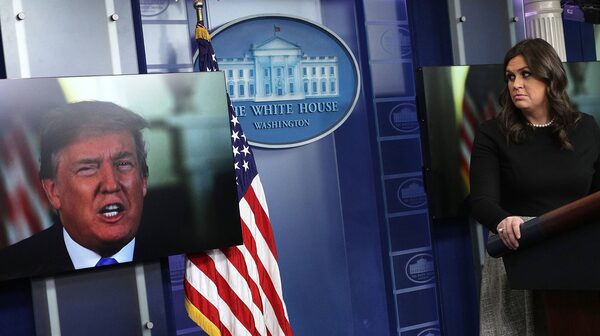
U.S. President Donald Trump speaks via a video as White House Press Secretary Sarah Sanders listens during a daily news briefing at the James Brady Press Briefing Room of the White House, in Washington, D.C., on Jan. 4, 2018. Sanders spoke on various topics including the new book "Fire and Fury", written by Michael Wolff.Photo by Alex Wong
Both Steve Bannon and Ivanka Trump are angling to become president of the United States. Rupert Murdoch thinks Donald Trump is an "idiot." Melania Trump "was in tears – and not of joy" on election night when she realized her husband was going to win.
Fire and Fury, Michael Wolff's behind-the-scenes account of the Trump campaign and administration, is every bit as dishy as advertised, offering an avalanche of juicy anecdotes on this made-for-reality-TV presidency.
The book comes out Friday, but several excerpts from the book – some authorized, others not – were published earlier this week. And they have already set Trumpworld on fire: After The Guardian revealed Wednesday that Steve Bannon, Mr. Trump's ex-chief strategist, had described a Trump Tower meeting between Mr. Trump's son, Donald Jr., and a Kremlin operative as "treasonous" in an interview with Mr. Wolff, the President swiftly disowned his former would-be Svengali.
On Thursday, Mr. Trump's lawyers sent a cease-and-desist letter to Mr. Wolff and publishers Henry Holt & Co., demanding the book not be printed and Mr. Wolff retract all of its reporting. The publishing company responded by announcing it would instead move up the book's publication date from next week to Friday to capitalize on runaway demand. Pre-orders for the volume have pushed it to the top of Amazon's best-seller list.
Mr. Bannon, meanwhile, was reportedly facing ouster from the chairmanship of Breitbart News, the rightwing media organization that is required reading for Mr. Trump's supporters. In a statement Thursday billionaire Rebekah Mercer, whose family has long financed Mr. Bannon's operations, distanced herself from him and said she continued to support Mr. Trump. The Wall Street Journal reported that Ms. Mercer, her father Robert, and other Breitbart board members were discussing deposing Mr. Bannon.
The White House, for its part, fought back against the book's portrayal of Mr. Trump as incompetent and his administration chaotic. "It's disgraceful and laughable. If he was unfit, he probably wouldn't be sitting there … This is an incredibly strong and good leader," press secretary Sarah Huckabee Sanders told reporters in the daily briefing.
What, exactly, has the White House so riled? As revealed by a lengthy extract published by New York magazine, as well as shorter sections printed by other media that obtained advance copies of the book, show that Mr. Bannon's candour was only the beginning.
Mr. Trump was so convinced he would lose the election that he didn't want to spend money on his campaign
No one in Mr. Trump's circle, including him, actually thought he would become President.
When billionaire financier Robert Mercer offered Mr. Trump a $5-million donation, Mr. Wolff writes, Mr. Trump was "baffled" he would want to help out a losing campaign. And when Mr. Bannon told Jared Kushner in September that the effort needed $50-million of Mr. Trump's money, the candidate's son-in-law said Mr. Trump wouldn't hand over that much without a guarantee of victory. (Ultimately, Mr. Trump agreed to loan just $10-million.)
On election night, Mr. Trump was so surprised at his victory that he "looked as if he had seen a ghost," Mr. Wolff writes. Melania Trump cried.
Whatever reservations Mr. Trump had, he quickly got over them: By the end of the night, Mr. Wolff says, Mr. Trump "became a man who believed that he deserved to be, and was wholly capable of being, the President of the United States."
Mr. Trump likes to get into bed by 6:30 p.m., eat cheeseburgers and call people to complain about everything
Mr. Trump, who keeps a separate White House bedroom from his wife, had two extra television screens installed in the room (there was already one when he moved in) and a lock put on the door, Mr. Wolff reports.
The President enjoys eating fast food for dinner in bed while phoning up his friends. During these candid conversations, Mr. Wolff writes, Mr. Trump labelled Mr. Bannon as "disloyal," former chief of staff Reince Priebus as "a midget" and Mr. Kushner as a "suck up."
In a call last Feb. 6, Mr. Trump vented to one interlocutor about media reporting on a dossier of unconfirmed intelligence, including a salacious tale that Russian agents videoed Mr. Trump and prostitutes in a Moscow hotel room.
In these conversations, Mr. Wolff says, Mr. Trump frequently complains that details of his personal life in the White House keep leaking out. It apparently did not occur to Mr. Trump that the source of the leaks may very well have been the President himself.
Mr. Bannon doesn't take Mr. Trump seriously, gives him just a one-in-three chance of finishing his term, and is planning his own presidential run in 2020
Mr. Bannon's musings to Mr. Wolff didn't end with his evisceration of the President's son.
In a January, 2016, conversation with former Fox News boss Roger Ailes (at a dinner party hosted by Mr. Wolff), Mr. Bannon spoke about his plans for the new administration as if Mr. Trump was "merely a large and peculiar presence to both be thankful for and to have to abide." When Mr. Ailes remarked that Mr. Trump might be "Nixon in China," Mr. Bannon replied "Bannon in China."
"Bannon was curiously able to embrace Trump while at the same time suggesting he did not take him entirely seriously," Mr. Wolff writes.
Mr. Wolff also quotes Mr. Bannon as saying that Mr. Trump is more likely to resign or to get impeached than be President by January, 2021, and that Mr. Bannon is organizing his own 2020 campaign.
"He's not going to make it," Mr. Bannon told Mr. Wolff, according to the Daily Beast. "He's lost his stuff."
No one else close to Mr. Trump really takes him seriously, either
A consistent theme in all the Fire and Fury excerpts is the irritation of everyone who deals with Mr. Trump at his inability to read, process information or even have a conversation.
One former campaign aide, Sam Nunberg, describes an attempt to brief Mr. Trump on the U.S. Constitution: "I got as far as the Fourth Amendment before his finger is pulling down on his lip and his eyes are rolling back in his head."
Mr. Trump doesn't like to read – some close to him believe he may only be semi-literate – and trusts his own "paltry and irrelevant" expertise on policy over experts' recommendations, Mr. Wolff says.
One Trump confidant advised Mr. Priebus that an hour-long meeting with Mr. Trump would most likely consist of 54 minutes of Mr. Trump telling the same stories over and over again – making it crucial that Mr. Priebus go in with just a single point to make.
"He neither particularly listened to what was said to him nor particularly considered what he said in response," Mr. Wolff writes of speaking with Mr. Trump. "He demanded you pay him attention, then decided you were weak for grovelling."
Ivanka Trump wants to be president. Also, Mr. Kushner is an ordained minister
The President's daughter and her husband ignored "the advice of almost everyone they knew" to take up positions in the White House, Mr. Wolff reports. Their end-game includes a presidential run for the first daughter herself.
"Between themselves, the two had made an earnest deal: If some time in the future the opportunity arose, she'd be the one to run for president. The first woman president, Ivanka entertained, would not be Hillary Clinton; it would be Ivanka Trump," he writes.
During a White House lunch last winter with Morning Joe hosts Joe Scarborough and Mika Brzezinski, Mr. Kushner revealed another surprising detail. When Mr. Trump asked when Mr. Scarborough and Ms. Brzezinski planned to marry, his son-in-law abruptly interjected: "I can marry you! I'm an internet Unitarian minister."
Both the Washington Examiner and Jerusalem Post, which tried to fact check the claim, concluded it was unlikely the Orthodox Jewish Mr. Kushner is actually a Unitarian clergyman. More likely, he was referring to the Universal Life Church, a California organization that instantaneously ordains people over the internet. (Lady Gaga, The Rock and Richard Branson, among others, are ministers of the church.)
In any event, the President immediately shot down Mr. Kushner's suggestion: "Why would they want you to marry them when I could marry them? When they could be married by the President!" Mr. Trump is quoted as saying. "At Mar-a-Lago!"
Mr. Trump has a massive unrequited man crush on Rupert Murdoch
The Australian media mogul has long whispered in the ears of world leaders – from Margaret Thatcher to Tony Blair – but no one seems to have fallen under his spell quite like the Donald.
A few days after his election victory, Mr. Wolff reports, Mr. Trump grew agitated when Mr. Murdoch did not show up on time to a Trump Tower social gathering. "He's one of the greats, the last of the greats," Mr. Trump is quoted as saying. Even after he was installed at the White House, Mr. Trump would "brag" to his staff about how often Mr. Murdoch telephoned him.
The feeling is not mutual.
Mr. Murdoch has complained "that he couldn't get Trump off the phone," Mr. Wolff reports, and generally views the President as a "charlatan and fool."
On one occasion, Mr. Trump declared to Mr. Murdoch that he wanted to help Silicon Valley companies by expanding a work visa program. Mr. Murdoch pointed out the obvious contradiction of a President elected on the promise of a border clampdown letting in more foreign workers, but Mr. Trump shrugged it off.
After the call ended, Mr. Murdoch called Mr. Trump an "idiot."
The White House let a journalist sit around on a couch in the West Wing
Despite Mr. Trump's non-stop complaints about the "fake news media," he granted Mr. Wolff a surprising amount of access to the inner sanctum of his government – or at least didn't stop it.
In a Hollywood Reporter column, Mr. Wolff recounted that when he pitched Mr. Trump on the book, he didn't push back. So Mr. Wolff showed up in the West Wing and had at it.
"Since the new White House was often uncertain about what the President meant or did not mean in any given utterance, his non-disapproval became a kind of passport for me to hang around," he wrote.
Mr. Wolff says he installed himself in an anteroom in the West Wing, from where he was able to pull aside the President's advisers to talk.
"The surreal sense of the Trump presidency," he quickly concluded "was being lived as intensely inside the White House as out."