The basics
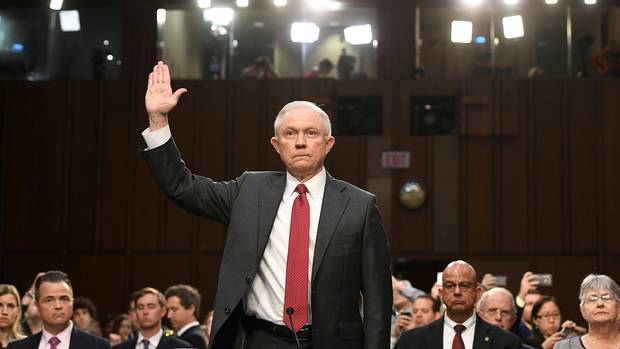
- Mr. Sessions said that there was no indication during the campaign that anybody in the Trump campaign team was colluding with Russia. In his opening remarks, Mr. Sessions stated emphatically that he had no conversations with any Russian officials regarding interference in the election.
- After initially saying he couldn’t recall meeting Russian Ambassador Sergei Kislyak or any other Russian officials during the campaign, Mr. Sessions said that “it’s conceivable” that he talked to the envoy at the Mayflower Hotel, the site of Mr. Trump’s first major foreign policy speech during the campaign, but that he couldn’t remember. He said that if there was a meeting it wouldn’t have been improper in any way. Mr. Sessions said in the hearing that he has since seen video of Mr. Kislyak in attendance at the Mayflower event.
- Under questioning, Mr. Sessions said that he has not asked for nor received a briefing a briefing into Russian hacking of the election campaign as Attorney-General.
- Mr. Sessions said he recused himself from a “specific investigation” into Russian meddling into the election, not from his role as Attorney General. As such, Mr. Sessions believes that he had the right to fire FBI Director James Comey. Mr. Trump said that Mr. Comey was fired at least in part because of his involvement in that “specific investigation.” Mr. Sessions said he wanted Mr. Comey fired because he spoke publicly about the FBI’s investigation into Hillary Clinton’s emails, apparently contradicting Mr. Trump.
- Mr. Sessions refused to discuss whether he had any conversation with Mr. Trump on Mr. Comey’s firing. He also refused to say if Mr. Trump was angry with him after recusing himself from the Russia investigation. It was reported earlier that Mr. Sessions had offered his resignation to Mr. Trump in recent weeks.
- Senators Angus King and Martin Heinrich repeatedly questioned why Mr. Sessions did not answer particular questions. Mr. Sessions said he is not asserting executive privilege to avoid answering questions and neither has Mr. Trump. But, because Mr. Trump may do so in the future, Mr. Sessions isn’t answering questions about conversations with the president.
- Read more about the Sessions testimony here from Globe and Mail Washington correspondent Adrian Morrow, who also livetweeted the proceedings.
- The President thought Mr. Sessions “did a very good job” before the Senate committee, White House spokeswoman Sarah Huckabee Sanders told reporters Tuesday.
Jeff Sessions calls Russia collusion suggestion ‘an appalling and detestable lie’
What's happened since the Comey hearing
- Mr. Trump and his team have been trying to discredit Mr. Comey since last Thursday’s hearing, where Mr. Comey accused the administration of lying about “disarray” in the FBI and said Mr. Trump decided to fire him in May because the Russia investigation was “irritating him.”
- Mr. Sessions’s testimony comes a day after Newsmax CEO Chris Ruddy, a friend of Mr. Trump, suggested the President was already thinking about “terminating” Robert Mueller as special counsel to the Justice Department and FBI’s Russia probe. “I think he’s weighing that option,” Mr. Ruddy told PBS NewsHour.
- Mr. Trump can’t dismiss Mr. Mueller directly: That decision would fall to Rod Rosenstein, the deputy attorney-general, who told a Senate budget hearing Tuesday that he has seen no good cause to fire the special counsel.
- Also Tuesday, Mr. Comey’s friend Daniel Richman – who outed himself as the one who leaked the contents of Mr. Comey’s memos about the Trump meetings to a reporter – said he would hand over any memos in his possession to the FBI, according to media reports.
Which Trump-Russia probe is this again?
There are four congressional investigations under way into Russia's alleged meddling in the 2016 election. The Senate intelligence committee's is the broadest and most well-known so far, but there are also investigations by:
- The House intelligence committee
- The House oversight committee
- The Senate judiciary committee
Democratic Senator Dianne Feinstein wants Mr. Sessions to testify before the judiciary committee too, because she says it's better suited to explore legal questions of possible obstruction of justice by the President.
But the biggest Trump-Russia probe – the one that could result in criminal charges against Mr. Trump's people – is the investigation by Mr. Sessions' Justice Department and the FBI, under the leadership of special counsel Robert Mueller. Mr. Sessions has recused himself from that investigation (more on that in a minute), leaving deputy attorney-general Rod Rosenstein with oversight of the probe.

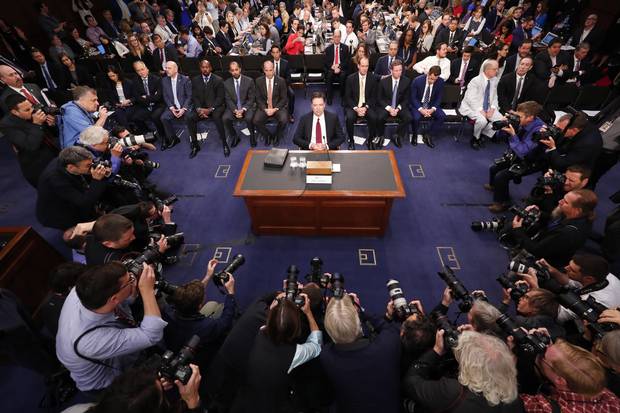
James Comey prepares to testify before the Senate Intelligence Committee on Capitol Hill on June 8, 2017.
Doug Mills/The New York Times
Comey Day: What you missed last week
Here's a recap of what James Comey, the former FBI director, told the Senate committee last Thursday. Most of his remarks centred on nine encounters with Mr. Trump, and Mr. Sessions's name came up a few times, too. Here are some highlights:
The Flynn meeting: The Mr. Comey alleged that Mr. Trump repeatedly tried to interfere in the FBI's Russia probe, and at one Feb. 14 meeting in the Oval Office, the President said he "hoped" the bureau would back off its investigation of former national security adviser Michael Flynn. Mr. Sessions and others left the room before Mr. Trump's remarks; afterward; Mr. Comey told Mr. Sessions never to leave him alone with the President again.
What Comey couldn't say: Asked by Democrat Senator Ron Wyden if Mr. Sessions was staying away from the Russia probe as promised, Mr. Comey said he couldn't answer:
WYDEN: How would you characterize Attorney-General Sessions's adherence to his recusal, in particular with regard to his involvement in your firing, which the President has acknowledged was because of the Russian investigation?
COMEY: That's a question I can't answer. I think it's a reasonable question. If – if, as the President said, I was fired because of the Russia investigation, why was the Attorney-General involved in that chain? I don't know, and so I don't have an answer for the question. ...
WYDEN: Michael Flynn resigned four days after Attorney-General Sessions was sworn in. Do you know if the Attorney-General was aware of the concerns about Michael Flynn during that period?
COMEY: I don't, as I sit here – I don't – I don't recall that he was. I could be wrong, but I don't remember that he was.
Trump says Comey testimony showed ‘no obstruction’
Why this was weird for Jeff Sessions
Mr. Sessions's position before the Senate is a strange one: He was answering questions about a Trump-Russia probe he's officially uninvolved in, prompted by testimony from a man he helped to fire, to defend a President he allegedly doesn't want to work for any more. (More on that last point in the next section.)
The various Russia investigations centre on contacts between Mr. Trump's key staff during the 2016 election and, most crucially, during the two-month transition period between that election and Mr. Trump's swearing-in. Russia's ambassador to the United States, Sergei Kislyak, met with Mr. Trump's national security adviser, Michael Flynn, who discussed lifting U.S. sanctions against Russia; with his son-in-law, Jared Kushner, who sought a secret "back channel" to communicate with Moscow; and Mr. Sessions, a former senator and Trump campaign adviser who is said to have interacted with Mr. Kislyak twice during the 2016 race.
Mr. Sessions didn't disclose those Russian contacts at his confirmation hearing for the Attorney-General's job. In March, to clear a cloud of suspicion over the Russia probe, Mr. Sessions recused himself from the investigation. But in May, he got indirectly drawn into it again when he co-signed on the decision to fire Mr. Comey as FBI director, a decision Mr. Trump later said was motivated by the Russia probe.
This is the memo Mr. Sessions wrote in May about Mr. Comey:
Dear Mr. President:
As Attorney-General, I am committed to a high level of discipline, integrity, and the rule of law to the Department of Justice – an institution that I deeply respect. Based on my evaluation, and for the reasons expressed by the Deputy Attorney-General in the attached memorandum, I have concluded that a fresh start is needed at the leadership of the FBI. It is essential that this Department of Justice clearly reaffirm its commitment to longstanding principles that ensure the integrity and fairness of federal investigations and prosecutions. The Director of the FBI must be someone who follows faithfully the rules and principles of the Department of Justice and who sets the right example for our law enforcement officials and others in the Department. Therefore, I must recommend that you remove Director James B. Comey, Jr. and identify an experienced and qualified individual to lead the great men and women of the FBI.
Sincerely,
Jeff Sessions

What was his endgame?
Mr. Sessions was one of the earliest supporters of the Trump presidential campaign, but recently, reports of internal tensions in the White House suggested a fraught relationship between the President and his Attorney-General. Last week, The New York Times reported Mr. Sessions had recently offered to resign, but Mr. Trump refused him. The Times also reported Mr. Trump "intermittently fumed for months" over Mr. Sessions's recusal because it opened the door for the appointment of a special counsel.
But in his testimony, Mr. Sessions stayed mum on any behind-the-scenes tension in the White House. He repeatedly invoked the President's "constitutional right" to private communications and refused to answer questions about in-person meetings with Mr. Trump, even when committee members questioned his legal right to do so when no executive privilege has been invoked.
When Tuesday's hearing was over, the President thought Mr. Sessions "did a very good job" before the Senate committee, White House spokeswoman Sarah Huckabee Sanders told reporters on a trip with Mr. Trump aboard Air Force One. She said Mr. Trump thought the Attorney-General was especially "strong" on denying any collusion between the Trump campaign and Russia.
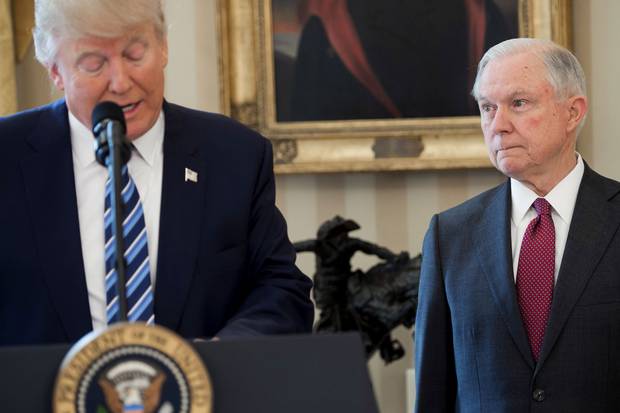
Mr. Trump and Mr. Sessions appear in the White House after the Attorney-General’s swearing-in on Feb. 9, 2017.
SAUL LOEB/AFP/GETTY IMAGES
With reports from Associated Press and The New York Times News Service
MORE FROM THE GLOBE AND MAIL