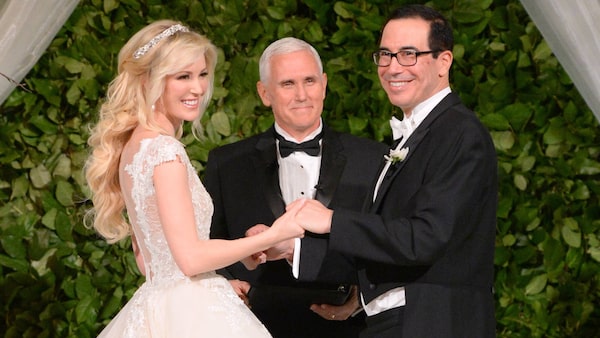
Vice President Mike Pence (C) officiates the wedding of Louise Linton (L) and Secretary of the Treasury Steven Mnuchin (R) on June 24, 2017 at Andrew Mellon Auditorium in Washington, DC.Kevin Mazur
For the White House, it was the wedding of the year: a glittering affair of wealth and power, attended by a beaming President Donald Trump and most of his closest aides.
But for many Africans, the glamorous nuptials of U.S. Treasury Secretary Steve Mnuchin and Hollywood actress Louise Linton brought back memories of a recent "memoir" that contained dangerous myths of dark jungles, tribal warriors and white saviours.
The book by Ms. Linton triggered a backlash in social media across Africa as critics found evidence that its narrative was riddled with fictional passages and stereotypes. It was eventually withdrawn and Ms. Linton apologized. But now the wedding has revived the controversy.
Mr. Mnuchin, a former Goldman Sachs executive and hedge-fund founder with an estimated fortune of $300-million (U.S.), married Ms. Linton last weekend in an elegant wedding attended by Mr. Trump, Vice-President Mike Pence and many senior White House officials, cabinet secretaries and Wall Street tycoons. Canadian Finance Minister Bill Morneau was also reported to have attended.
In Zambia and other African countries, however, the wedding has revitalized a Twitter hashtag: #LintonLies. The hashtag became the rallying cry for Africans who are increasingly fed up with invented tales of violence, chaos and noble white saviours.
Ms. Linton, a 36-year-old Scottish-born actress who has had mostly minor roles in dozens of Hollywood films and television shows, angered Zambians by claiming that she had narrowly escaped death at the hands of Congolese rebel fighters when she was volunteering as a teenager in northern Zambia. They noted that the region had never been involved in Congo's wars, and they found a host of other errors in her account.
Her book – In Congo's Shadow: One Girl's Perilous Journey to the Heart of Africa – purported to be a memoir of her gap-year experiences as a teenaged volunteer in Zambia in 1999.
The book's errors made it clear that her account was grossly exaggerated or invented. She spoke of "monsoons" and "dense jungle canopy" in Zambia (both inaccurate descriptions). She portrayed the African continent as "rife with hidden danger" and filled with "random acts of violence."
In one of the most cited passages, Ms. Linton described herself as the "central character" in a "horror story" when the "Hutu-Tutsi conflict" spilled over into Zambia from the neighbouring Democratic Republic of the Congo. In reality, there was no fighting in Zambia, and the "Hutu-Tutsi conflict" was in Rwanda, not Congo. But that didn't deter her from giving a dramatic account of gunfire drawing nearer to her.
"As the night ticked interminably by, I tried not to think what the rebels would do to the 'skinny white muzungu with long angel hair' if they found me," she wrote, referring to her white skin and blonde hair.
Zambians were also annoyed by her claim to have brought great joy to deprived children – a common narrative among short-term Western volunteers, but increasingly challenged by Africans who see it as condescending and inaccurate.
In her book, Ms. Linton described "a smiling gap-toothed child with HIV whose greatest joy was to sit on my lap and drink from a bottle of Coca-Cola."
The Zambian High Commission in London criticized her book, calling it a falsified portrait of "a savage Zambia." The book had "tarnished the image of a very friendly and peaceful country" by perpetuating a stereotype of "a backward country in a jungle," the High Commission said.
Thousands of Zambians and other Africans reacted strongly on social media, expressing their outrage when an excerpt was published in a British newspaper. The only thing missing from the book was "Tarzan swinging to her rescue," one commentator said.
"As a Zambian, the whole article just made me cringe," said Lydia Ngoma, a Zambian writer who created the #LintonLies hashtag.
Ms. Linton later apologized, and her self-published book was withdrawn from sale. "I am deeply sorry to those whom I have offended," she said.
"I now see how my characterization of the country and its people have been interpreted as condescending and harmful and how such naive descriptions could indeed perpetuate negative stereotypes," she said.
The Telegraph, the British newspaper that published an excerpt from the book, later apologized for the "misleading" impression that it created. It withdrew the excerpt from its website.