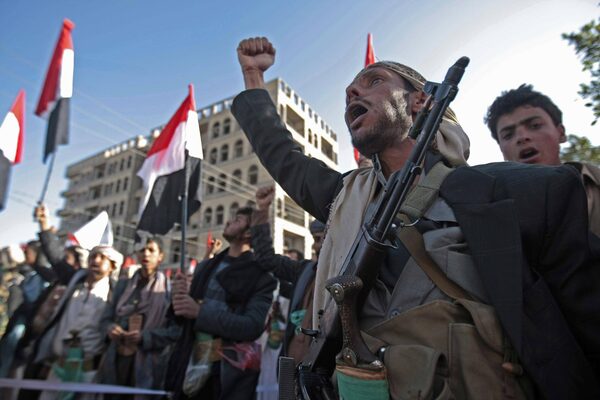
Supporters of Shiite Houthi rebels attend a rally in Sanaa, Yemen, on Dec. 5, 2017.Hani Mohammed/The Globe and Mail
The war in Yemen has moved into the realm of unresolvable as Iran and Saudi Arabia, the two great rival powers of the Middle East, resort to brute force to try to carve up the region.
The slim hope that the Yemeni war, which has triggered the world's biggest humanitarian crisis, might soon end through peace negotiations utterly vanished on Monday, when former president Ali Abdullah Saleh was assassinated outside Sanaa, the capital, by Iran-backed Houthi rebels. Images of the bloodied corpse of the man who had ruled the Arab world's poorest country from 1990 to 2012 made it onto social media in an instant.
The Saudis had hoped that Mr. Saleh was about to become their strong ally, one who might be able to swing the war in their favour. Instead, his assassination delivered the message that Saudi Arabia will find no easy way out of a war that had started in March 2015 and was supposed to hand the Saudis a quick and easy victory over a ragtag Houthi militia that they consider a proxy for arch-rival Iran.
Explainer: What's happening in Yemen? A guide to Saleh's shifting loyalties and what his death means
After seeing Iranian political and military influence surge in Iraq, Syria and Lebanon in recent years, the Saudis are apparently in no mood to see Iran emerge as the dominant force on their very own southern border (Yemen shares frontiers with Saudi Arabia and Oman on the Arabian Peninsula).
"This war might end if the Saudis accept Yemen as separate from their sphere of influence," said political analyst Kamel Wazne, director of the Centre for American Strategic Studies in Beirut. "But the Saudi mentality would not accept that, with Iranian victories in Iraq and Syria. I think the Saudis will exhaust themselves in a war that no one can win."
Mr. Saleh evidently signed his own death warrant when he switched sides in the war. His forces had been fighting with the Houthis against the Saudi-led alliance that was supporting the internationally recognized government in Yemen's south, led by President Abed Rabbo Mansour Hadi. On Saturday, Mr. Saleh gave a televised address to announce that, in effect, he would seek a dialogue with the Saudi-led coalition fighting the Houthis. "Yemeni citizens have tried to tolerate the recklessness of the Houthis over the last 2 1/2 years but cannot any more," he said.
Two days later, the Houthis sought their revenge on the man they considered a turncoat. "In Yemen, revenge is the order of the day," said Riad Tabbarah, an economist who is a former Lebanese ambassador to the United States and a former Arab League and United Nations diplomat. "This will intensify the civil war. Saleh had good military support and they will go after the Houthis. And not much will change with the Saudis. They will not give up, and continue to bomb."
The Saudis did just that. Overnight on Monday, the Saudis launched at least seven air strikes on the presidential palace in Sanaa. The palace was being used by the Houthi leadership.
Johan Mooij, country director in Sanaa for the CARE International humanitarian charity, said in an interview on Tuesday that the bombs fell about a kilometre from CARE's offices. "The bombs were quite fearsome and my building was shaking from the explosions," he said. "We have learned to go into the basement when we hear planes go over.… Before, the bombs were used against military targets. But now they're bombing houses in the middle of the city that they think are occupied by the Houthis."
As the violence escalated, and the United Nations and humanitarian agencies called for a pause in the fighting to allow medical aid to reach wounded civilians, Mr. Saleh's son, Ahmed Ali Saleh, called for revenge for the revenge killing of his father. "I will lead the battle until the last Houthi is thrown out of Yemen … the blood of my father will be hell ringing in the ears of Iran," he said, according to a Reuters report that could not immediately verify the authenticity of the quotation.
The Yemeni war is both civil and international, pitting the southern-based government against the Houthis who occupy Sanaa and the rest of the north, tribes against tribes, and the Houthis against the Saudi coalition, which includes the United Arab Emirates, Kuwait and Egypt.
As if the shattered country did not have enough problems, Islamic State (also known as ISIS or Daesh) is active in Yemen, as is al-Qaeda's Yemeni affiliate, known as AQAP. In March, the United States conducted 40 air strikes against AQAP, according to a U.S. Congressional Research Service Report. The raid was the first acknowledged counterterrorism operation of the Donald Trump administration.
The warring domestic and international forces have ripped Yemen apart, to the point that it may cease to exist as a country. "With little prospect of an immediate resolution to the conflict in the face of increasing complexity, as tribal, sectarian and counterterrorism issues are introduced, Yemen's ultimate survival as a unified country hangs in the balance," Gerald Feierstein, who was U.S. ambassador to Yemen from 2010 to 2013, said recently.
Mr. Saleh lost his job as president of Yemen following the Arab Spring uprisings in 2011, which saw the ouster of the leaders of Tunisia and Egypt and the death of Libyan strongman Moammar Gadhafi. Mr. Saleh was succeeded by his former deputy, Mr. Hadi, but he didn't last long in Sanaa. Anti-Hadi protests erupted in Yemen in 2014 and, before the year was out, Houthi forces backed by Iran had taken control of the capital. They formed an alliance with Mr. Saleh, who wanted his presidency back. (The Houthis, concentrated in Yemen's north, have long sought greater share of power and access to development money controlled by the central government.)
The Houthi-Saleh alliance, though never strong and beset with infighting, did manage to send Mr. Hadi packing. In January, 2015, he fled to Aden, Yemen's second-largest city, in the southern part of the country. Two months later, the Saudi-led coalition began bombing the Houthi rebels and Yemen has been a misery ever since. Mr. Mooij, of CARE, said "Yemen is more dangerous than Afghanistan."
The United Nation's Food and Agricultural Organization (FAO) says that risk of famine in Yemen is "high." It estimates that some 17 million Yemenis (out of a population of 28 million) are "food insecure," meaning their nutrition requirements are inadequate, and that seven million "are at risk of famine" – starvation. As of October, cases of cholera and suspected cholera had reached 860,000. Food is scarce because of the ports blockade that began in November. Fuel for electrical generators and water-well pumps is scarce and very expensive when it is available.
Some 10,000 people have died in the war, though the estimate is several months old. The number could be significantly higher today.
Mr. Tabbarah, the former Lebanese diplomat, sees no quick end to the Yemeni war, all the more so since Mr. Saleh's death just cost the Saudis an on-the-ground ally in the making. He blames the power struggle between Iran and Saudi Arabia, whose new Crown Prince and heir apparent, Mohammed bin Salman, seems to have staked his reputation on the outcome of the war. "The whole [Middle East] region is affected by the struggle between Iran and Saudi Arabia," he said. "Yemen is on the Saudi border. So if the Iranian military has a foothold in Yemen, Saudi Arabia will treat it as a real danger."