Mark Kingwell is a professor of philosophy at the University of Toronto. His latest book is Question Authority: A Polemic About Trust in Five Meditations.
It’s convocation season. Bored graduates everywhere will be forced to listen to earnest speeches about how they should make their way in a world short on decent jobs. I’ve given a couple of those orations myself. Here’s the one I won’t be giving this year but would have if asked.
Hey guys! You’ve probably heard that philosophers are in the habit of declaring their discipline dead. Thinkers are forever claiming that everyone before them had the wrong ideas about time, being, or knowledge. Great – it’s a vibrant patricidal enterprise. But I’m here today to tell you that philosophy is dead for good this time. So is humanistic education in general, maybe academia itself.
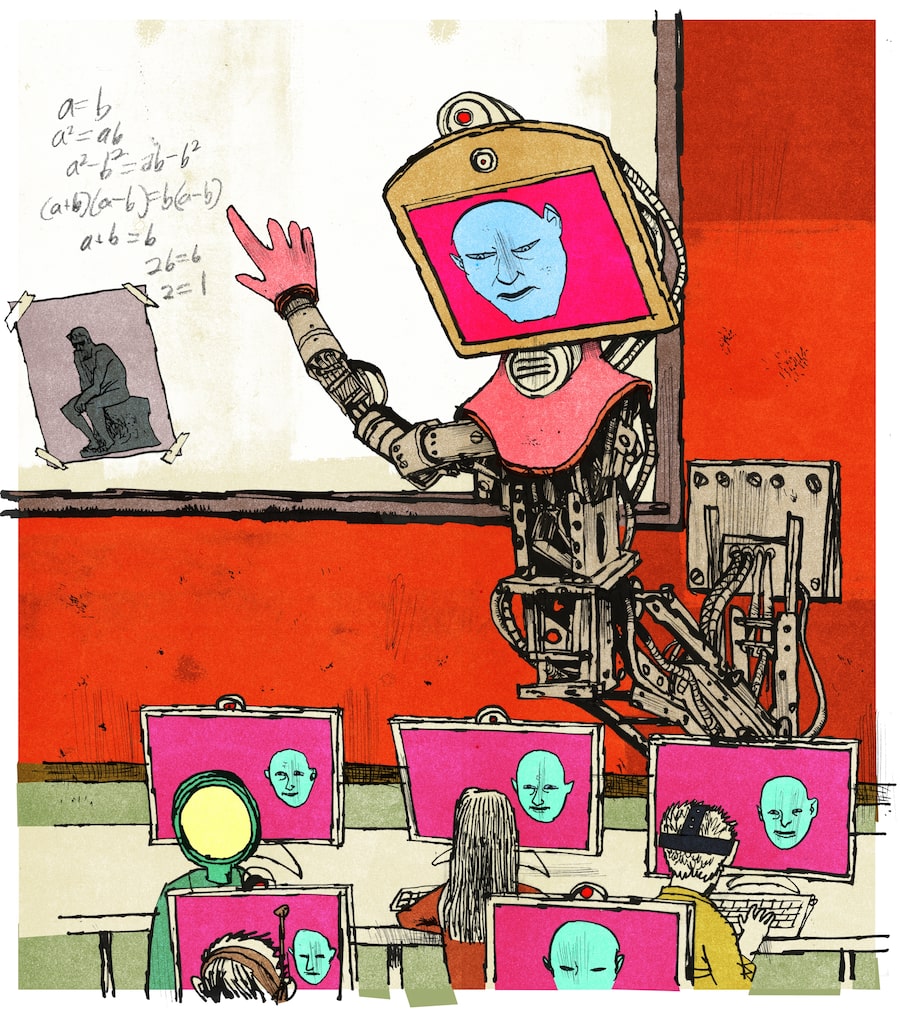
The murderous force isn’t just anti-elitist, Trump-driven depredation. No, as Nietzsche said of the death of god, we have done the killing. Smartness destroys from the inside out: The AI revolution has signalled the demise of the university as we know it. After all, how do we teach undergraduates philosophy, history or anything else when it’s now so easy to fake the whole process?

Assigning full books from philosophers such as Spinoza, Montesquieu, Smith and Locke is an increasingly passé thing to do in academic circles.iStock
Students still think it might be wrong, or maybe risky, to have an algorithm write their essays wholesale. But increasingly they don’t see what’s wrong with using programs to take notes, summarize readings and create or correct first drafts.
Reading, meanwhile, is tedious and hard, and so the idea of assigning entire books – even novels – is sliding out of academic fashion. Average attentions spans have shrunk from several minutes to about 40 seconds. You won’t counter that by putting Aquinas’s Summa or Spinoza’s Ethics on the syllabus.
At the same time, these same students resent knowing that professors might use countervailing programs to grade their work. They also dislike the idea that somebody in authority might consider them cheaters.
Indeed, some students now resort to surveillance-society mechanisms, once the bugbear of free citizens everywhere, to prove that they are not cheating, including YouTube videos of them composing their guaranteed-human-origin essays.
So: programs for recording screen activity or documenting keystrokes are now being asked to view performative acts of being-watched. And programs for cheating on essays confront programs designed to catch cheaters but also programs designed to counter the need for human grading altogether.
These countervailing programs produce and consume each other; they watch and are watched, cheat and are cheated, pursue grades and are duly graded.

Students increasingly don’t see the issue with using programs to take notes or summarize material.DARRYL DYCK/The Canadian Press
I’m not the first to notice that there is no further need for human middle men here. Students and professors alike are extraneous to the system. A techno-bureaucratic loop enfolds them, then snips them off as messy loose ends. We have created the ultimate state of frictionless exchange, a circulating economy of the already-thought, the banal, the pre-digested, where every Google search leads to a fabricated source that eventually bounces back to base.
Peak efficiency, with net gains in eliminated boredom. Yay!
So why resist assimilation? Recently I sat in a seminar organized by my colleagues to consider ways of testing students in class, as a foil to chatbot cheating. The proposed tests involved various small-scale fact-finding exercises, truncated arguments, and the logic-skills equivalent of a magazine puzzle page. One professor suggested that actual written essays should be reserved only for upper-level undergraduates and graduate students, if anyone.
Fine, I suppose, but how would those upper-level students ever learn how to write in the first place, let alone write well? Forget AI essay cheating. Basic writing ability, always prone to deterioration, is now disappearing faster than map-reading skills and short-term memory. You can no longer assume that first-year students know how to compose even the most basic “hamburger” essay (bun, lettuce, tomato, patty, bun). And still we believe – do we not? – that clear writing is the foundation of clear thought.
Alas, that faith no longer seems so warranted. Writing seems more and more surplus to requirements. It can be off-loaded as a dreary chore, like so much dirty laundry sent out for cleaning.
I recently wondered, not for the first time, if I had been labouring under a mistaken notion of philosophy, and teaching it, all along. If the subject can be distilled down to a roster of positions, specific argumentative moves and technical terms – which is how I believe some of my colleagues see it – then we can indeed dispense with sustained discursive engagement, and the clunky old-fashioned fraud-prone essay with it.

But then, what would education be like? What would it be for? Good questions. Maybe the current proclaimed academic death-rattle is actually an opportunity to go back to first principles, inside the walls and out. In my discipline’s case, the issue is not so much the end of philosophy, in other words, but the ends of philosophy.
Like most teachers of the subject, I have long been conflicted about our mechanisms of assessment. Essays are a slog for everyone, even when they’re legit products of individual minds. In-person final exams can control for essay cheating, most of the time, but they are a poor method of gauging the depth of philosophical insight. The old joke from Annie Hall makes the point: “I was thrown out of college for cheating on the metaphysics exam,” it goes. “I looked into the soul of the boy sitting next to me.”
Like many philosophy professors, I prefer discussion in seminars, close reading of textual passages, and face-to-face assessment over both essays and exams. I ask for short, ungraded weekly reflection papers that my students seem to enjoy writing and I certainly enjoy reading. But these small-bore tools are not scaleable for our vast budget-driven enrolments. And always, grades loom far larger than they should over the whole enterprise.
Once you start questioning assessment, you slide very quickly into uncomfortable thoughts about the larger purpose of any teaching. The irony is doubled because asking “What is the use of use?” is one of those typical philosophical moves. Updated version for the age of neo-liberal overproduction: What is the use of asking what is the use of use, when large language models can do it for you?”
I admit I get impatient when, at this stage of things, people invoke some vague notion of distinctive humanness, a form of species-centric superiority. I mean those hand-wavy claims that there is something about what we humans do that is just, well, different from AI versions of things. Different and better. No AI could ever match the uniqueness of the human spirit!
Well, maybe. But let’s be serious: This line of argument is ideological special pleading. There are some 8.2 billion unique human souls on the planet. Yes, a minority break free of the sludge of mediocrity, and we celebrate them. We also cherish the experience of our own lives, however mundane. But we’re now forced to realize that some, even many, sources of human pride can be practised as well, if not better, by non-human mechanisms. Art and poetry fall before the machines’ totalizing recombinative invention. Even athletics, apparently deeply wedded to the human form, are being colonized by cyborg technology.

Short weekly reflection papers that are ungraded seem to be enjoyable for students.Galit Rodan/The Globe and Mail
You might think this is just griping from another worker whose sector is destined for obsolescence. True, neoliberal overproduction and dire job prospects have likely produced more philosophy teachers – and many more student essays – than the world needs. From this angle, AI’s great academic replacement is just a market correction. It completes a decades-long self-inflicted irrelevance program, those thousands of punishing essays that nobody reads, the best ones published in journals that are, more and more, pay-as-you-go online boondoggles.
I still think those abstruse debates are important, though, and you should too. We are at a transitional point that demands every tool of critical reflection, human or otherwise. Anxiety about the future of work and life is pitched high, for good reason. For now we are still mostly able to spot uncanny AI slop, bizarre search-engine confabulations, and bot-generated recommendations for books that have been invented by bots – presumably so that other bots can then not-read them, scrape the data for future reconstitution, and maybe submit unread book reports for academic credit somewhere.
We can even, for the moment, recognize that non-bot government bans on actual books, and state-sponsored punishment of legacy liberal education, pose a threat to everyone’s freedom. But I still think we are losing, in the current murk, something that only philosophy can provide. It’s something that has always been posthuman in the dual sense of transcendent and transformative.
I don’t just mean a critical-thinking skill set, or body of facts, or even the basics of media literacy and fallacy-spotting – though these are essential tools for life. I mean, rather, the things that animate the hundreds of students who still come to our classes: the value of self-given meaning and purpose, the pleasure of being good at hard things for their sake alone, a consuming joy in the free play of imagination. A desire to flourish, and to bend the arc of history toward justice. I don’t know if those things are exclusive to humans; I do know that they are threatened and in short supply among existing humans.
The love of wisdom can’t really be taught, for it is a turning of the soul toward the beautiful and good. You can’t justify the value of that turning to someone who has not yet felt the necessary shift in value. That’s the paradox of all philosophy, and of all philosophy teaching.
There will be no exam after this lecture, graduates. The real test is no more, but also no less, than life itself. You are a speck of dust in an indifferent universe. Now make the most of it.

AI on our minds: More from The Globe
Is AI dulling critical-thinking skills? As tech companies court students, educators weigh the risks
Will AI go rogue? Noted researcher Yoshua Bengio launches venture to keep it safe
AI adoption is upending the job market for entry-level workers
Machines Like Us podcast
In Imagination: A Manifesto, Ruha Benjamin argues that the Musks and Zuckerbergs of the world have usurped our ability to dream of better futures. But it doesn’t have to be that way. She spoke with Machines Like Us about what could be done differently.