Anthony Feinstein is a professor in the Department of Psychiatry at the University of Toronto and a researcher at Sunnybrook Health Sciences Centre and St. Michael’s Hospital.
The strongman is resurgent in today’s world. India’s Narendra Modi, Turkey’s Recep Tayyip Erdogan, Saudi Arabia’s Mohammed bin Salman, Russia’s Vladimir Putin, China’s Xi Jinping – they have many traits in common: an intolerance for dissent, an insistence on blind fealty, a conviction that they, and only they, know what is best for their people. No subject is too big or too small to escape their all-knowing certitude. Take Mussolini for example, who not only dreamed of empire, but wanted pasta prohibited. Il Duce was convinced it made his people lazy.
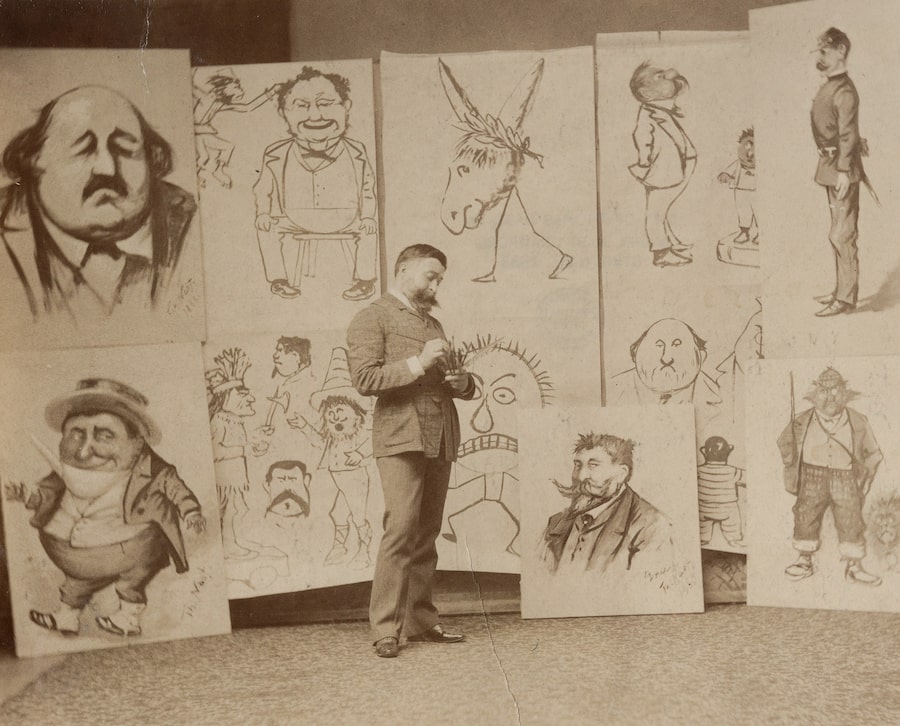
And then there is the strongman’s extraordinarily thin skin when it comes to laughing at himself. It is a striking that these men with enormous power, vast armies, lethal weapons, and apparently limitless self-confidence fear the simple cartoon. Is it because they know instinctively that Mark Twain was correct when he had one of his characters observe, “Against the assault of laughter, nothing can stand”?

David Low’s cartoons of Adolf Hitler, like this one from 1933, got his work banned from Nazi Germany.Associated Newspapers Ltd.
History is replete with examples of cartoonists infuriating autocrats. Hitler for one was tormented by the Evening Standard’s David Low. Lord Halifax, the British foreign secretary, met with Joseph Goebbels, Hitler’s propaganda minister, in Berlin in 1937 to discuss tensions between their governments. Afterward, he reported to Low’s publisher at the Standard: “You cannot imagine the frenzy these cartoons cause. As soon as a copy of the Evening Standard arrives, it is pounced on for Low’s cartoon, and if it is of Hitler, as it usually is, telephones buzz, tempers rise, fevers mount and the whole government system of Germany is in an uproar. It has hardly subsided before the next one arrives. We in England can’t understand the violence of the reaction.”
Hitler’s fury at being lampooned by a cartoon pales, however, when compared to the violence unleashed more than half a century later by 12 cartoons of the Prophet Muhammad published by the Danish newspaper Jyllands-Posten. Considered deeply offensive by many Muslims, the cartoons triggered protests, boycotts, and riots, with dozens killed and the storming of the Paris offices of Charlie Hebdo, a satirical magazine, by two gunmen that left 12 people dead.
That cartoons should have so much power belies how they are seen by one of this generation’s most famous cartoonists, Ralph Steadman. “To this day, the cartoon remains a poor man’s art, a dogsbody seen as a space-filler, a last-minute scribble that, in its humblest form, jockeys for a place somewhere between the crossword puzzle and the small ads.”

This engraving by William Hogarth satirized what came to be known as the South Sea bubble, which ruined the fortunes of many British investors in the 1700s.
Cartoons and caricatures – grotesque or ludicrous representation by exaggeration of characteristic traits – have been part of the political landscape for centuries. William Hogarth’s Emblematical Print on the South Sea Scheme (1721) is considered the first editorial cartoon. The subject satirized was one that capitalist societies over the years would become all too familiar with: financial speculation, greed, credulity and fraud leading to the collapse of a financial bubble and the ruin of investors.
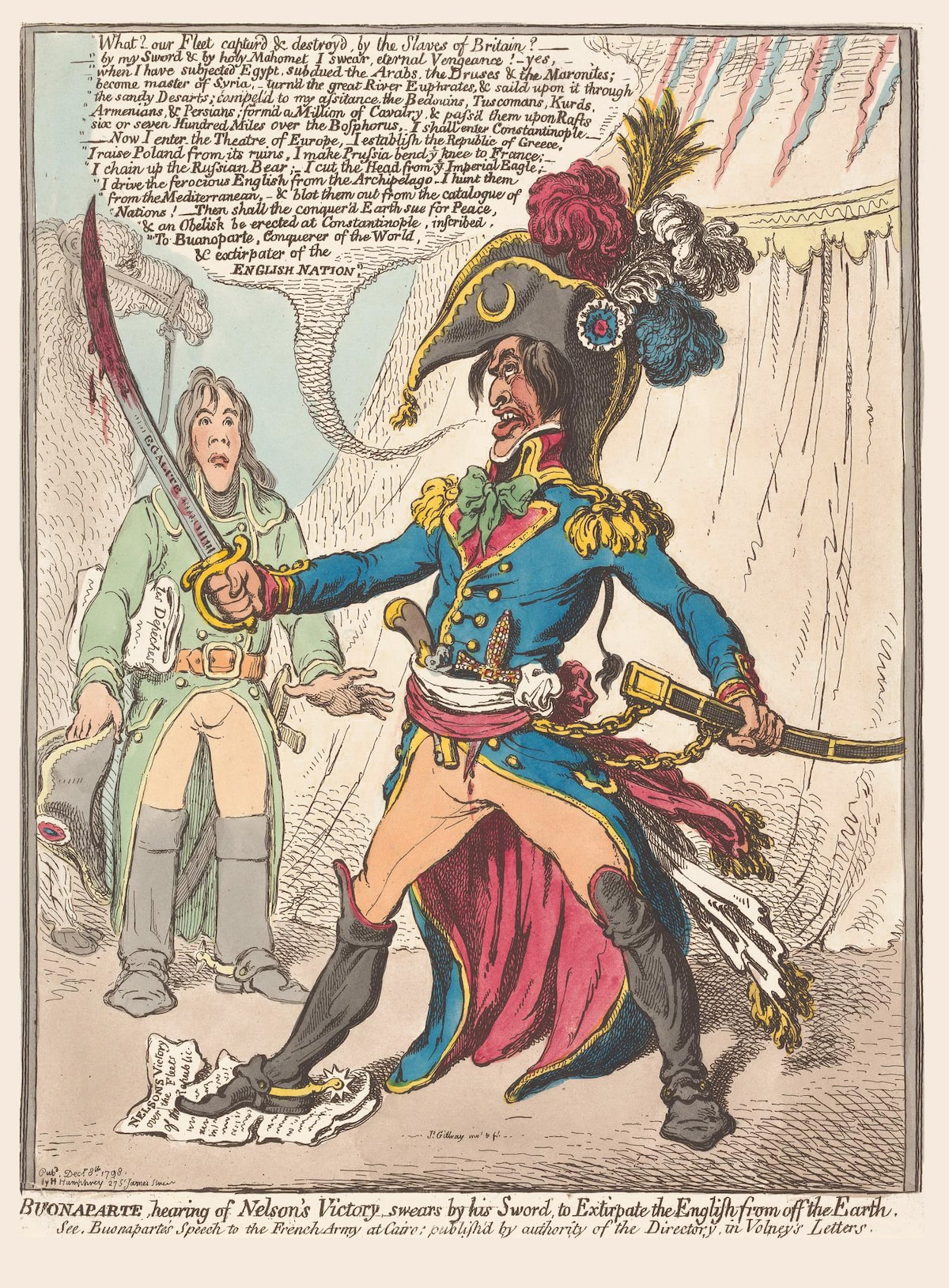
Hogarth’s comic-like engraving of “modern moral subjects” ushered in the golden age of caricature in Georgian England (1759 to 1838), a period that also saw the rise and fall of England’s great enemy, Napoleon. The Emperor is reported to have said that James Gillray, the English caricaturist, “did more than all the armies of Europe to bring me down.” One might forgive Napoleon his hyperbole, for by then his own subjects were beginning to embrace the medium with considerable zeal.
Between 1830 and 1920, more than 350 caricature journals were established in France. Such was the unease of the ruling political class with this development that King Louis Philippe reintroduced press censorship, lifted following the French Revolution, to control it. Tellingly, reporters were spared the king’s scalpel. They were considered less of a threat.
Louis Philippe’s pique was also personal. His head, somewhat pear-shaped to begin with, had been skilfully morphed by caricaturist Charles Philipon into a pear. The image began appearing on graffiti in Paris. Adding to the insult, the word pear in French – la poire – had the double entendre at the time of implying a dupe or an idiot in French slang.
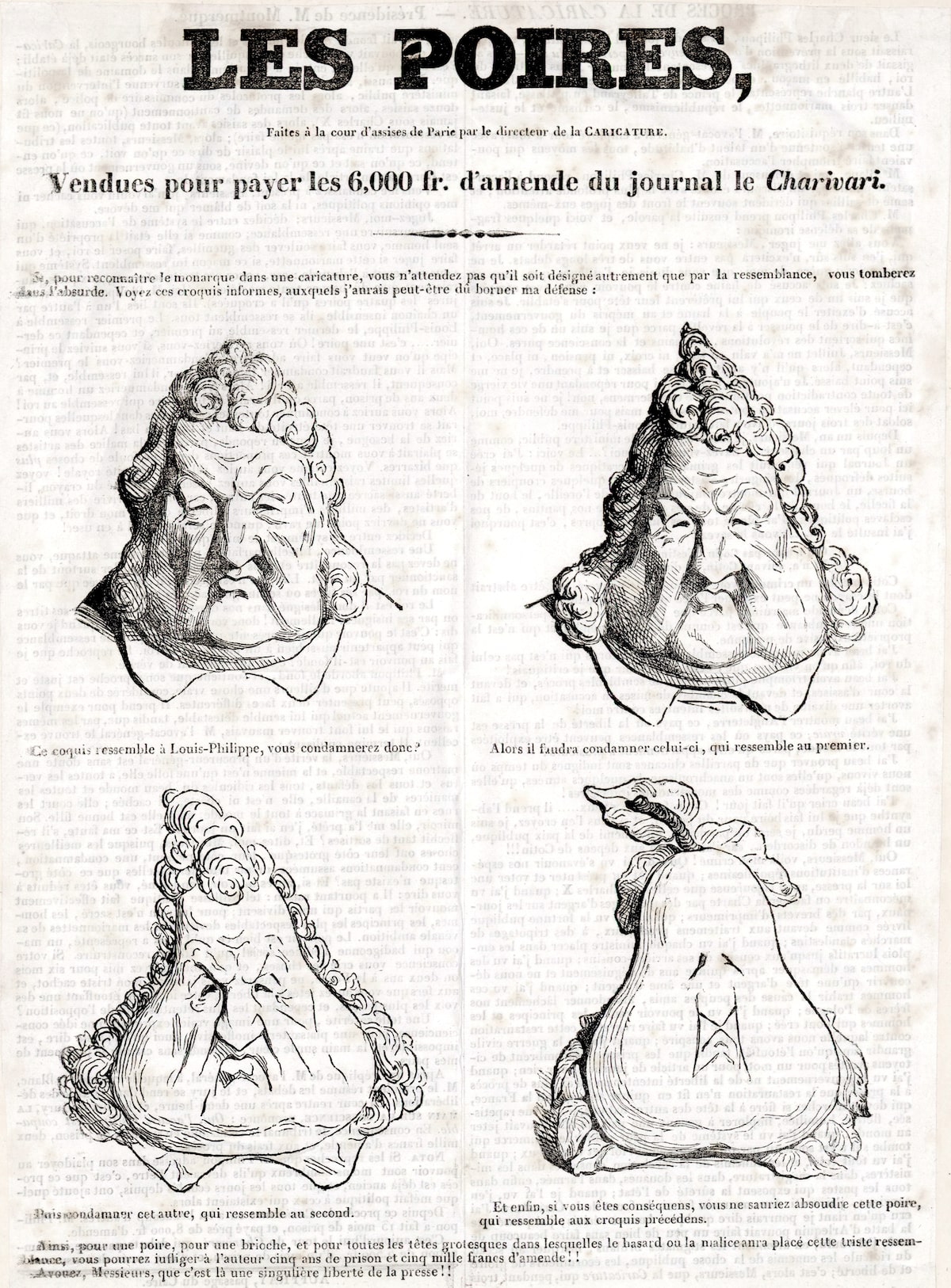
If Louis Philippe’s face was primed for caricature, the same was true for Richard Nixon as well. For Doug Marlette, Newsday’s cartoonist, Nixon was to cartooning what Marilyn Monroe was to sex. “Nixon looked like his policies,” he said. “His nose told you he was going to invade Cambodia.”
Nixon’s five o’clock shadow was also catnip to cartoonists, used by Herb Block (a.k.a. Herblock), the chief editorial cartoonist for the Washington Post, to signify his shady, untrustworthy character. Nixon took to shaving twice, sometimes three times a day in a futile attempt to shut down this avenue of ridicule.
Soon after Nixon became president, Herblock had a cartoon published depicting a barbershop with an open chair and the sign: “THIS SHOP GIVES TO EVERY NEW PRESIDENT OF THE UNITED STATES A FREE SHAVE. H. Block., Proprietor.” Nixon had by then cancelled his subscription to the Post after Herblock drew him emerging from an open sewer.

Nixon was vice-president when Herb Block lampooned his stubble in this 1954 cartoon. Block would return to that topic during the Nixon presidency.© The Herb Block Foundation
There is, however, no escaping character. Nixon’s torturous relationship with the Post reached its apotheosis six years later when two of the paper’s investigative journalists, Bob Woodward and Carl Bernstein, broke news of the Watergate story. The president’s resignation followed two years later.
Lyndon Baines Johnson is another American president whose larger-than-life presence was irresistible to cartoonists.
On Oct. 20, 1965, Johnson, recovering from elective gallbladder surgery, lifted up his shirt to display his surgical scar to reporters. Johnson later claimed he had done so to dispel rumours that he had been hospitalized for cancer. This moment of presidential disinhibition was not lost on cartoonist David Levine, who depicted LBJ with his shirt raised and his cholecystectomy scar visible in the shape of Vietnam. Levine’s brilliant, prescient drawing endures to this day, highlighting Johnson’s failed foreign policy that had become a scar on the body politic and which ultimately undid a presidency.

Why do cartoons and caricatures elicit such a strong response? Victor Navasky, in his book The Art of Controversy: Political Cartoons and Their Enduring Power, offers three complementary theories. The first pertains to the cartoon as content. In the LBJ example given above, there was no more emotive content for Americans than the Vietnam War in the 1960s.
The second factor cited by Navasky is the cartoon as image. Levine’s deft manipulation of Johnson’s cholecystectomy scar into a map of Vietnam leaves the viewer with an indelible impression. So, too, does Herblock’s image of Nixon emerging from a sewer. And as Navasky insightfully notes, the clever, skillful cartoon marries content and image so that the reader is subject to an instantaneous one-two punch, the whole proving greater than the sum of the individual parts. There is a quote from Joseph Conrad cited by Navasky in the introduction to his book that beautifully captures this effect: “A caricature is putting the face of a joke on the body of a truth.”
In giving his third reason for a cartoon’s trenchant impact, Navasky dips into neuroscience and references two Nobel laureates: Daniel Kahneman, a psychologist, and Eric Kandel, a psychiatrist. In his book Thinking, Fast and Slow, Kahneman explains that the brain has two broad systems of processing stimuli. System 1 is automatic, instinctual, outside of voluntary control, and therefore fast. System 2 demands effortful attention, is voluntary, includes complex computations, and is therefore slow. Eric Kandel has written that to recognize a face, we require little more than a few contour lines defining the eyes, mouth and nose, which in turn gives cartoonists considerable latitude to distort a person’s physiognomy without hindering our ability to recognize it.
Navasky goes on to note that the part of the brain that recognizes faces, the fusiform gyrus, reacts more quickly to caricatures than photographs, which he does not find surprising given that caricatures emphasize the same features we use to distinguish faces.
Here he cites the neuroscientist Margaret Livingstone’s view that faces hold such a rich source of visual stimuli, it takes no more than a fleeting glance for us to determine a person’s age, sex, and race, amongst other characteristics. If we view Kahneman’s system 1 alongside the empirical observations of Kandel and Livingstone, we can begin to appreciate how brain structure and function provide a mechanistic explanation for the power of cartoons to affect us.
Informative as these three reasons are, there are other factors unique to cartoons that give them a punch that transcends words alone. For example, how is one to respond to a wounding cartoon? When one takes personal offense at something written in a newspaper, there is the letter to the editor by way of riposte. But there is no such thing as a cartoon to the editor, as Navasky points out. The sense of impotency engendered stokes the victim’s frustration. Furthermore, trying to neuter the impact of a waspish cartoon with words is doomed to fail. Hitler, with all the resources of a resurgent Germany at his disposal, tried it. His foreign-press secretary, Ernst (Putzi) Hanfstaengl, suggested a book highlighting what the Führer saw as cartoonists’ errors in their depiction of him. Their self-published book, Hitler in der Karikatur der Welt: Tat gegen Tinte (Hitler in the World’s Cartoons: Fact versus Ink), sunk like a stone.

David Levine's caricature of Henry Kissinger, published in The Nation in 1984, gave form to a metaphor that few U.S. newspapers would have ever printed in words.© Matthew and Eve Levine
According to the cartoonist Art Spiegelman, another factor that gives cartoons their potency to wound is that “visual grammar doesn’t function the way verbal grammar does.” Cartoons have no punctuation to add nuance to the message conveyed. As a result, text lends itself to a more civilized discourse than caricature. This can, in certain circumstances, prove a hindrance, because one can convey a message with a cartoon that may be too crude or risqué to be put into words. One infamous example is David Levine’s devastating critique of Henry Kissinger, Nixon’s secretary of state and national security adviser. Simply put, the language required to viscerally match the raw message conveyed by Levine’s cartoon of Kissinger copulating with the world could not be printed. But the artist can get away with it, the controversy generated by the image amplifying the message in the process.
This does not mean that cartoons have no moral guardrails. Editors do pull them from publication. One example from the Los Angeles Times in 1999 is a cartoon by Paul Conrad ridiculing congressional bipartisanship. The image of an elephant mounting a donkey, symbolizing Republicans vociferously espousing bipartisanship while at the same time vigorously trying to impeach then-president Bill Clinton, was considered too obscene for publication. One could persuasively argue that 27 years on, the message conveyed has even greater salience today.
Interestingly, it was a cartoonist, Thomas Nast (1840 – 1902), who gave Democrats their symbolic donkey and Republicans their elephant. Nast’s cartoons were enormously influential. Abraham Lincoln called him “my number-one recruiting sergeant” because of his Civil War cartoons. Nast’s cartoons were also responsible for bringing an end to Boss Tweed’s corrupt hold on Tammany Hall, the seat of the Democratic Party’s political machine in New York City. “Stop them damned pictures!” a desperate Tweed reportedly pleaded. “I don’t care a straw for your newspaper articles. My constituents can’t read. But they can’t help seeing those damned pictures.”


Whether Thomas Nast drew William H. Tweed as a rotund giant or a stuffed bag of money, the ‘Boss’ was annoyed by the public attention. Tweed was convicted of embezzlement for his handling of New York public funds.
Given the degree to which skilled cartoonists exquisitely hone ridicule when portraying their subjects, the profession comes with risk, particularly if those offended carry great power.
“When despots rule, cartoonists die,” noted David Wallis in his book Killed Cartoons. History backs him up. The Dutch cartoonist Louis Raemaekers had a bounty put on his head, dead or alive, by the German government for portraying Kaiser Wilhelm as Satan during the Great War. During Argentina’s Dirty War (1976-1983), legendary cartoonist Héctor Oesterheld was “disappeared” by the junta in 1977. In 1987, Palestinian Naji al-Ali, an illustrator, was murdered on a street in London. In 1995, Algerian cartoonist Brahim Guerroui was kidnapped before being murdered. In 1999, rebels in Sierra Leone killed leading cartoonist Muniru Turay and burned down the office of his newspaper. And then there is the Charlie Hebdo outrage in which five French cartoonists – Stéphane Charbonnier (Charb), Jean Cabut (Cabu), Georges Wolinski, Bernard Verlhac (Tignous) and Philippe Honoré (Honoré) – were murdered in their Paris bureau. That some of these cartoonists were killed in the midst of open, democratic societies supports humorist Art Buchwald’s observation that “no totalitarian government can afford to be ridiculed,” to which one can replace “government” with “entity” and add, “irrespective of where their perceived tormentors reside.”
It is sobering to reflect that 11 years on from its cruel decimation, Charlie Hebdo is once against under siege, threatened by the Iranian regime after it published caricatures of the Supreme Leader and mullahs. The magazine is also facing legal proceedings in Turkey for “insulting President Recep Tayyip Erdogan” by publishing a cartoon of him in October, 2020, that depicts him in his underwear lifting the dress of a women with a head covering.
The killing of cartoonists underscores a message on repetitive loop for viewers to the website Cartoonists Rights: “The most absolute form of censorship is murder.” Another message informs viewers that “fear of criminalization” is a cartoonist’s biggest worry. Additional concerns include displacement and exile, which was forced on 23 cartoonists between 2020 and 2022.
Then there is the risk of losing your job when a message is considered too sharp for an autocrat’s sensitivities – as with Rob Rogers of the Pittsburgh Post-Gazette, who believes he was fired after 25 years with the newspaper because of his six unflattering cartoons, all spiked, of President Donald Trump. Some cartoonists chose to resign rather than see their work internally censored by an editor fearful of angering a newspaper’s owner or bucking strong political headwinds. Such was the choice of Washington Post’s Pulitzer Prize-winning cartoonist Ann Telnaes when her proposal for a cartoon depicting the Post’s owner Jeff Bezos and other billionaires offering money to the President was rejected.

This was the rough draft of a cartoon by Ann Telnaes that The Washington Post rejected. Its owner, Jeff Bezos, is the bald man on bended knee before a statue of Donald Trump.Ann Telnaes
The plethora of threats and challenges faced by political cartoonists begs the question: How is this group faring emotionally in these turbulent times? The answer is not known, an omission that is at odds with a burgeoning literature describing the psychological difficulties affecting print journalists and photographers in response to covering war, revolution, natural and man-made disasters, crime including narco-trafficking, online harassment, the COVID-19 pandemic and climate change.
The number of full-time political cartoonists has declined markedly since the beginning of the millennium, attributed to newspapers shuttering, less opinion page space and a move toward digital, less lucrative freelance work. Whether cartoonists have also quit out of fear or for mental-health reasons is not openly discussed. What is clear, however, is that a vibrant, free press embracing the creativity of political cartoonists – one that allows a populace to laugh at the foibles, vanities, hubris and mistakes of its leaders – ultimately nourishes civil society. As we mark World Press Freedom Day on May 3, recognizing that this work can come with costs for political cartoonists is important too.
Lest we lose sight of this, cartoonists also help society at large look not only at its leaders, but at itself, too, and smile, chuckle, squirm, blush and laugh out loud at what it sees. That’s surely one marker of a robust, confident and mature democracy.
Video: Brian Gable draws his own conclusions
Before his retirement as The Globe's editorial cartoonist, Brian Gable collected his work in a book. Here, he explains the rigorous selection process and the surefire fame that now awaits him.