
By November, 2021, my neighbour Mark Wessel had been looking for a new car for almost a year.
His gas guzzler had more than 200,000 kilometres on it. Maintenance costs were starting to climb. The price at the pump was shooting up. His monthly gas bill was broaching $600 thanks to his daily 70-km round-trip commute changed from “excursion” to work. While he always thought he’d buy another car with an internal combustion engine, he increasingly became intrigued with the idea of an electric vehicle.
“When I ran the numbers on an EV it just made the most financial sense,” he recently told me. “I realize that range anxiety [fear about how far you can drive on a fully charged battery] is a concern for a lot of people but I felt it was based more on perception than actual experience.”
He decided on a 2022 Model 3 Tesla. After taxes, the cost was $66,933. But the total after taking advantage of federal and B.C. rebate programs – both offered at the time – was $58,933. A lot of money, but in his view, still worth it.
Ottawa in talks with automakers over EV sales mandates, Joly says
Facing such fancy Chinese EVs, do Western carmakers even have a future?
He installed a charging station at his home at a cost of $800. Today, what was formerly a $7,200-a-year gas bill is now just over $700 extra annually in electricity charges. That savings covers most of the cost of his monthly loan payment for the Tesla. So, far he’s spent little on car maintenance beyond new windshield wipers and tires.
“I can’t speak for all EV owners, but my experience so far has been nothing but positive,” Mr. Wessel told me. “I understand some people’s apprehensions, but any concerns I might have had have so far not materialized.”
In many respects, Mr. Wessel could be the poster boy for EV ownership. It’s difficult to dispute the economic case going electric makes, especially for those who drive a lot. And yet, Mr. Wessel’s conversion is far from the norm. In fact, the future of the industry in Canada is in a state of limbo.

An assembly robot at General Motors' electric-vehicle manufacturing plant in Ingersoll, Ont., in 2022.Carlos Osorio/Reuters
Sales have stalled, if not plunged, in some parts of the country. EV mandates are being assailed by conservative politicians who liken them to the carbon tax – a policy they say is being foisted on people for ideological reasons. Increasingly, it appears both federal and provincial targets for EV sales are going to have to be reimagined or abandoned altogether. Looming ominously over the entire conversation is U.S. President Donald Trump, whose tariff tirade has created worldwide chaos, disrupting everything from trade to, well, the auto industry.
And EVs have not been spared amid the tumult.
Of all new vehicles registered in Canada in the first quarter of this year, only 8.7 per cent were zero-emission. That represents a 54-per-cent drop from the previous quarter, a decline that Statistics Canada largely attributes to Quebec pausing its EV purchase subsidy program. (It has recently restarted it.) Historically, Quebec has been an EV leader, accounting for more than 54 per cent of new zero-emission vehicle (which includes battery and plug-in) registrations in Canada last year. But Quebec wasn’t the only jurisdiction that stopped its EV incentive program: B.C. halted its plan, and so, too, did the federal government.
All of this has been bad news for the momentum the EV industry had acquired. In 2024, EVs represented 17 per cent of all new cars sold in Canada, up from 13 per cent the previous year, according to the International Energy Agency. But underneath that number lies another story: Most of those sales – 92 per cent – were racked up in three provinces: Ontario, B.C. and Quebec. Everywhere else the sales figures were anemic. In Saskatchewan, zero-emission vehicles made up just 2.5 per cent of all vehicle sales in 2024. In Newfoundland and Labrador it was 2.6 per cent, in Alberta, 4.2 per cent.
The recent crash in sales of EVs, along with the tariff war Mr. Trump has initiated with the world, has focused renewed attention on zero emission policy in Canada, especially as it pertains to the transportation sector. And a plaintive cry has gone up from some quarters for the federal government to suspend, or abandon altogether, its electric vehicle availability standard.

Electric vehicle battery components at a Magna production facility in Brampton, Ont., in 2023. EV sales have stalled in some parts of the country.Christopher Katsarov/The Globe and Mail
Under the standard, auto manufacturers and importers must meet annual zero-emission vehicle sales targets. By 2026, 20 per cent of light-duty vehicles offered for sale must be zero-emission.
That percentage increases annually to 60 per cent by 2030 and 100 per cent by 2035. Manufacturers get one credit for every zero-emission car they sell and a full or partial credit for a plug-in hybrid depending on how far the model goes on a single charge. Companies that sell more EVs than they need to meet that year’s quota can either bank their credits or sell to other manufacturers who fall short of their annual allocation. Companies are fined $20,000 for every EV they are short of meeting from their base allocation limit for that year.
B.C. has its own measures. By next year, 26 per cent of vehicle sales must be zero emission vehicles, going up to 90 per cent by 2030 and 100 per cent by 2035. Quebec recently modified its plan, adding hybrids to what qualifies as a zero-emission vehicle as opposed to rechargeable battery only. By next year, 32 per cent of all new vehicles must be zero-emission and by 2030 that number jumps to 85 per cent.
So you can see the disparity that exists between the goals Ottawa and some provincial governments have set for EV sales and the reality. At this point, barring unforeseen circumstances, they’re not going to be met. There are several reasons why, starting with a lack of charging infrastructure.
There are currently just over 35,000 charging stations across this very large country. Canada has set a goal of having more than 100,000. And according to Natural Resources Canada, 88 per cent of the current stations are in three provinces – Ontario, Quebec and B.C. That’s the bad news.

An EV charging station in Squamish, B.C., in March of 2023. The vast majority of stations are currently in Ontario, B.C. and Quebec.DARRYL DYCK/The Globe and Mail
The good news is EVs are evolving every year and many models can now charge up to 80 per cent in 30 minutes or less. Still, access to charging stations remains an issue, particularly for those living in condo towers and apartment buildings as well as downtown houses without driveways. This, in turn, has created a huge impediment to broader take-up of EVs.
“The government put the cart before the horse,” Barry Penner, chair of the Energy Futures Institute and a former B.C. Liberal environment minister, told me in an interview. “If you look at the B.C. government’s own polling around EVs, it shows that the No. 1 issue for people is cost. And the second issue right behind it is ability to charge your car. And they haven’t solved those issues.”
Installing a charging station at your house is relatively painless and not too onerous on the pocketbook. But getting stratas, especially those in older buildings, to agree on a way to retrofit underground parking to accommodate charging stations has been a challenge, despite laws in different parts of the country that insist this is something that has to be done.

Access to charging stations remains an issue, particularly for those living in condo towers and apartment buildings.Fred Lum/The Globe and Mail
Many residents are balking at the costs, especially older people who have no intention of ever owning an EV. There are all-in-one service providers who will install charging stations and supply the electricity but they are expensive. The upfront cost for installation, per condo dweller, can be as much as $5,000. And then the electricity costs can be higher than it would be accessing directly from your electrical utility.
This is adding to the uncertainty that exists in the market and is holding people back from taking the EV plunge.
So is the price of cars. In many respects, we are tied to automobiles manufactured in North America, including EVs. According to Canadian Black Book, the average cost of an EV in Canada last year was $73,000.
The Big Three automakers in the U.S., meantime, are years behind the Chinese when it comes to building highly advanced, and cheap, EVs. Ford Motor Co. says it lost US$5.1-billion in 2024 with its EV line and expected similar losses this year because of high production costs and price pressure in the EV market.

A component of a F-150 Lightning electric pickup truck at a Ford facility in Dearborn, Mich., in 2022. The company lost US$5.1-billion in 2024 with its EV line.REBECCA COOK/Reuters

Workers at an electric-car factory run by Chinese automaker Great Wall Motor in Iracemápolis, Brazil, in March.VICTOR MORIYAMA/The New York Times News Service
Meantime, when the U.S. announced a 100-per-cent tariff on highly subsidized EVs coming from China – mostly to protect domestic automakers – Canada quickly fell in line and did the same.
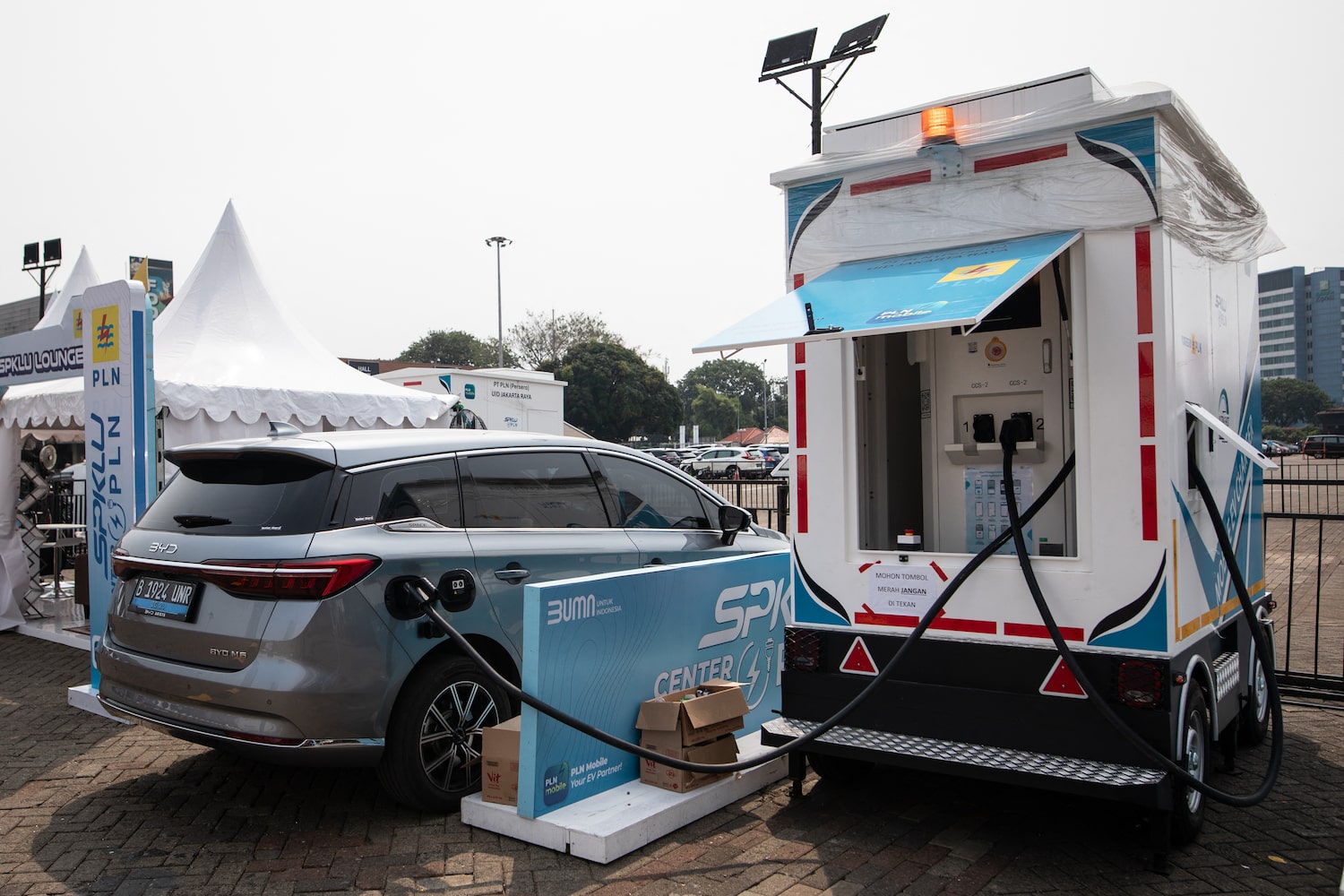
Among other things, the move means we have no access to the Chinese BYD (Build Your Dreams), the most talked-about EV in the world. Its least-expensive models retail in China for about $13,600. Even some American auto executives have had to concede the car is vastly superior to anything being made in the U.S. right now.
The BYD creators have announced they are developing a new “flash-charging technology” they say will soon be able to fully charge certain models in five minutes. You can imagine the uptake a car like that would receive in Canada, even with the misgivings some have about supporting a Chinese, heavily subsidized automaker.
But alas, this is not likely to happen. One can only imagine the wrath that Mr. Trump would unleash if Canada decided to break ranks and open the doors to Chinese EVs, which would hurt American car makers and likely have a damaging impact on the auto manufacturing sector in central Canada too. In fact, Canada’s fledging EV industry is already in trouble.
The Liberal government of Justin Trudeau went all in on EVs and batteries in recent years, including billions of dollars in subsidies, with the expectation that sales would continue on an upward ascent.

Canada's former prime minister Justin Trudeau, Honda CEO of Honda Toshihiro Mibe and Ontario Premier of Ontario Doug Ford at a Honda assembly plant in Alliston, Ont., in early 2024.Carlos Osorio/Reuters
That hasn’t been the case. In May, Honda Canada announced it was delaying for two years a $15-billion EV project in Ontario that was supposed to be producing 240,000 cars by 2028. A $7-billion EV battery plant in Quebec launched by Northvolt AB is stalled after its parent company filed for bankruptcy.
Given the precarious state of the EV industry in Canada at the moment, one can fairly rule out getting access to cheap Chinese EVs, at least in the short term. (China is refusing to sell their EVs in Canada because of the 100-per-cent tariff we have imposed.)
That means we are stuck with the EV market we have, which remains too expensive for many people. Light pickup trucks, favoured by families in western Canada but also popular more broadly in this country, are especially costly, in part because the battery needed to power them is bigger and pricier.
Given that everything that Mr. Trump says south of the border reverberates north of it, it should come as no surprise that the U.S. President’s declaration that people should be able to choose whichever kind of car they want to drive and not have it dictated to them by government would resonate in Canada among conservative politicians.
Federal Conservative Leader Pierre Poilievre recently released a video denouncing the federal EV mandate. In it, he says people who work in cold weather and in rural areas need a gas-powered truck to do their jobs. “Mr. Carney and the Liberals plan to ban that work by effectively banning your gas-and-diesel powered vehicles,” Mr. Poilievre says in the post. He goes on to say that it will be a “major hit” to the quality of life of many people. Alberta Premier Danielle Smith has also jumped on the bandwagon, saying Ottawa needs to cancel its EV mandate immediately.
The two conservative politicians have no doubt been watching Mr. Trump’s actions on this front. In June, the President signed a Congressional act that would eliminate California’s vehicle-emissions standards, which includes an EV mandate similar to the ones introduced in this country. To Mr. Trump, EV mandates are more woke, virtue-signalling nonsense. California has taken the President to court over the matter.

Electric vehicles in San Pedro, Calif., in 2022. President Donald Trump signed a Congressional act in June that would eliminate California’s vehicle-emissions standards.ALEX WELSH/The New York Times News Service
There is little question that as things stand now, the EV mandate makes a pretty inviting target. And conservative politicians can smell an opportunity to do to it what they did to the carbon tax – turn the public so against it so that the government has no choice but to cancel it.
And some changes do seem inevitable now.
There is no way car manufacturers are going to hit the firm targets Ottawa has set. Brian Kingston, president and CEO of the Canadian Vehicle Manufacturers’ Association, told me the federal mandate needs to be repealed – full stop. He believes the current standards should be enough to make inroads on cutting emissions and that mandates are unnecessary. Which is what you might expect the car industry to say. But there are also practical considerations that are impossible to ignore.
Mr. Kingston says EV sales in Canada, for 2025, are tracking towards something just under 10 per cent. So, if that number was to hold for 2026, the year the 20-per-cent EV sales mandate is scheduled to kick in, manufacturers would have to “pull back from the market between 700,000 and a million [gas-powered] vehicles,” in order to achieve the ratio the government is insisting on.
“So you’d be cutting the auto market in half to balance the federally mandated ratio,” he said.
Even if the scenario Mr. Kingston describes was half as bad, it would be political suicide for the federal government to contemplate keeping the 2026 target.

Prime Minister Mark Carney on a tour of an auto parts factory in Vaughan, Ont., in April.Adrian Wyld/The Canadian Press
The same goes for those provinces with their own, in some cases stricter, mandates. That’s just not going to happen. The only question now is: What does a retreat from these mandates look like? And what are the implications of that directive?
Daniel Breton, president of Electric Mobility Canada, believes governments in Canada need to make short-term adjustments to the mandates. “Lowering the targets between now and 2030 would be reasonable,” Mr. Breton said in an interview. “I think as long as Donald Trump is in charge south of the border that policy makes sense, let’s put it that way.”
But he is firm in the belief that mandates have to remain – just leaving it up to the automobile industry to cut emissions on their own isn’t going to work. “We tried that before,” Mr. Breton told me. “In 2005, the federal government signed a voluntary agreement with the car industry to lower their greenhouse gas emissions by 5.3 megatons by 2010. Because it was voluntary they missed their target by 95 per cent. So, modify the mandates but don’t get rid of them.”
The B.C. government has already signalled that it’s preparing changes to its EV strategy. In a presentation to auto-industry representatives this summer, B.C.’s Environment Ministry indicated it was considering several changes to the zero-emissions act that respond to “current economic conditions, support affordability for consumers and puts less pressure on automakers.” The slide presentation was obtained by the Energy Futures Institute and made public.
But while it’s clear things need to change Canada certainly can’t entirely abandon its climate goals.
Transportation is the second-largest source of emissions behind the oil and gas industry. In 2023, transportation accounted for 23 per cent of GHG emissions, which have grown 33 per cent since 1990. Passenger vehicles on their own contributed roughly 12 per cent of Canada’s emissions in 2023. According to one analysis done by Ross McKitrick, an economics professor at Guelph University, the federal government’s current EV mandate would cut Canada’s GHG emissions by about 8 per cent by 2050 – compared to an environment in which such a dictate was absent.
There are other considerations.
Bloomberg forecasts 22 million battery-electric or hybrid vehicles to be sold globally this year, a 25-per-cent increase over 2024. It expects one in four vehicles sold globally will be zero-emission or hybrid.


We can’t be oblivious to what is happening around us, Rachel Doran, executive director of Clean Energy Canada, told me in an interview.
“In Canada, we’re clearly falling behind where the rest of the world is going,” said Ms. Doran. “And that’s not good.”
She believes mandates serve a strong purpose; they create some certainty around EVs’ future. It’s easier to make the case, for instance, for spending billions on critical infrastructure if you know there is going to be a certain percentage of EVs on the road. That said, she concedes that more needs to be done to bring the cost of EVs for consumers down. (The magical price point for EVs seems to be around $40,000, according to research by Clean Energy Canada.) That could include making it easier to buy EVs made in Europe, which are cheaper than ones being manufactured in North America, and lowering the tariff on Chinese EV imports.

A BYD car in São Paulo, Brazil, in February. Its least-expensive models retail in China for about $13,600.VICTOR MORIYAMA/The New York Times News Service
Both measures, she said, have the support of the Canadian public according to polling commissioned by Clean Energy Canada.
While the federal and provincial governments can’t ignore the fundamental facts on the ground when it comes to the mandates they have initiated, they also can’t capitulate entirely when it comes to taking action to reduce emissions from the transportation sector.
The prudent course now would be for Ottawa to step back and evaluate current factors like the impact U.S. tariffs are having or could have on EV costs and whether, for instance, the 100-per-cent tariff Canada has imposed on Chinese EVs should be reappraised. The government also needs to also assess whether there is enough EV infrastructure in place to meet demand and quell legitimate consumer worry in this area. It would also be worthwhile evaluating whether a new suite of incentives beyond a price rebate (like tax breaks) needs to be dangled in front of consumers to entice them into buying their first zero-emission or hybrid vehicle.
But it’s important that current EV mandates, federal and provincial, be readjusted – not abandoned altogether.
The rest of the world is moving on from the gas engine and right now much of Canada is being left behind in that righteous march toward a cleaner environment. It doesn’t have to be this way. We should be pushing harder than ever to make EVs an everyday reality in this country.
It just needs to happen in a smart, sensible manner. It can be done. It must be done. It will be done – eventually.