
Nicholas Pimlott is a family doctor in Toronto and the editor of Canadian Family Physician.
One crisp and sunny September afternoon, I was called to do a home visit while attending a family gathering. Although they obviously know that I am a doctor, friends and relatives are often surprised to learn that throughout my career as a family doctor, I have made house calls. This time it was to pronounce the death of an elderly patient of one of my younger colleagues.
The call had come from the woman’s daughter who lived with her, and fortunately (for me), they were only a short drive away. Their home was a large, detached, two-storey red brick house typical of one of the most affluent parts of midtown Toronto. But as I stepped from the car with my black bag in hand and made my way to the door, it became clear that the occupants had fallen on hard times. The flagstone path was in disrepair, the small lawn overgrown with weeds, and the concrete steps to the front door were badly cracked and loose in several places. House calls can be hazardous in more ways than one.
As I knocked on the door, anticipating my arrival, her daughter quickly answered, and I entered the dimly lit front hallway. After I introduced myself and offered my condolences, she ushered me into the living room.
“My mother is just in here,” she said.
The scene before me was Dickensian. It was hard to know how long the living room had served as a sickroom, but likely for years. Her elderly mother lay still and lifeless under layers of old blankets, dressed in a threadbare, pink and white floral cotton nightgown. The bed was surrounded by stacks of old magazines and newspapers. It had been years since the walls had seen a new coat of paint. As is often the case at the deathbed of the very old, the room was sweltering.
“What time did your mother die?” I asked.
“About 45 minutes ago,” the daughter replied. “That’s when I called the family practice after-hours number.”
I carefully manoeuvered an old dining chair between two stacks of newspapers on the right side of the bed and took my stethoscope and otoscope (which doubled as a flashlight) from the bag. The old woman was pale and cachectic, her flesh eaten away by the cancer that had ultimately caused her death. As I touched her forehead, her body had already started to grow cold. Although it was a formality, first I shined the light onto her pupils, looking for signs of a response. None. Then I checked for breath sounds using the stethoscope. Again, none. Last, using the index and middle finger of my right hand I checked for a carotid artery pulse. Finally, none.
From my black bag, I took out the death certificate. Resting it on one of the tall stacks of newspaper, I quickly filled it out and handed it to her daughter.
“You can call the funeral home now and arrange for them to come for your mother’s body,” I told her. “Please give them this certificate.”
“Thank you again for coming out to do this.”
House calls to pronounce the death of a patient is just one of the many reasons that family physicians make them. Over the years I have made house calls to pronounce death; to provide palliative care for the dying; to attend to the acutely ill; to provide care to patients unable, due to chronic illness or disability, to come to my office; and in one memorable case, to try to prevent one of my patients from visiting emergency rooms several times a week.
Now the house call itself is the sick patient, and has been for many years. Will it, too, die?
The house call has long held a romantic place in the hearts and minds of both doctors and the public.
Perhaps we owe it to the influence of The Doctor, the 19th-century British artist Luke Fildes’s famous painting of the house call to a sick child, reproductions of which hang in many modern family doctors’ offices. The original hangs in London’s Tate Britain.
In the painting, an older, bearded male physician sits contemplatively by the child who lies wrapped in blankets on a makeshift bed made of two chairs, his face illuminated by the morning sun. The child’s parents are shadows in the background, the father gently consoling the mother, who has likely been awake all night attending to her sick child.

Reproductions of The Doctor, a painting by 19th-century British artist Luke Fildes that depicts a house call to a sick child, hang in many modern family doctors’ offices.Supplied
Back then, physicians had very few treatments for most illnesses, and most of them were either ineffective or outright dangerous. General practitioners’ greatest asset was their willingness to be present and bear witness to their patients’ suffering and attend to their deaths.
Perhaps an even greater and more recent influence has been American photographer Eugene Smith’s groundbreaking photo essay in a 1948 edition of Life magazine. In beautiful and stark black-and-white images, Mr. Smith captured the life and work of Dr. Ernest Ceriani, who practised in Kremmling, Col. Dr. Ceriani was the sole physician for an area of 400 square miles in the shadow of the Rocky Mountains, inhabited by some 2,000 people. Despite the challenges of geography, much of his work involved house calls. As Life’s editors wrote at the time: “His income for covering a dozen fields is less than a city doctor makes by specializing in just one, but Ceriani is compensated by the affection of his patients and neighbors, by the high place he has earned in his community and by the fact that he is his own boss. For him, this is enough.”
The iconic cover photograph shows Dr. Ceriani, on foot, making a house call. He is dressed in a jacket and tie, his brow furrowed beneath his stylish fedora hat as he approaches the house. In his right hand he carries a large black leather bag about three times the size of my own. Behind him, dark trees and dark clouds loom, perhaps foreshadowing what awaits him inside. Against the darkness he appears almost luminous.
Despite these moving portrayals of the power and the humanity of the house call more than a half-century apart, they have been in steady decline in Canada and the United States since the 1950s.

A family doctor pays a house call, circa 1950. These medical visits have been in steady decline in Canada and the United States since the 1950s.Getty Images
Before the Second World War, house calls made up around half of all visits between doctors and patients; by 1950, that had fallen to roughly one in 10, and by the 1980s house calls made up just one in 200 of all such visits. An often-cited paper published in the Canadian Medical Association Journal in 2002 by Dr. Benjamin Chan showed that older physicians were two-and-a-half times more likely to do house calls and nursing home visits. Furthermore, rural family physicians were much more likely to make house calls. Overall, however, from 1990 to 2002 the percentage of family doctors who provided home visits declined from about 70 per cent to just below 50 per cent.
The reasons for the decline of house calls are myriad, ranging from the impact of urbanization and atomization of families to the declining involvement in palliative care by family physicians, especially in larger cities, and to the basic economic fact that they are inconvenient for doctors, who are poorly compensated for the time involved compared to office visits.
Despite this, there have been many attempts since the 1980s to breathe new life into house calls by physicians, in part out of recognition that with an aging population and the attending increase in chronic illness and disability, the need to provide them will only grow. In Britain, for example, researchers experimented with providing preventive care to homebound patients over the age of 75, hoping to show that such visits were cost-effective – and they weren’t.
Within the last decade researchers in different countries have experimented with “virtual” wards in which older, chronically ill patients are cared for at home by a team of physicians and nurses monitoring them remotely. But these, too, have not caught on widely.
Could it be that when ill, people prefer face-to-face human contact?
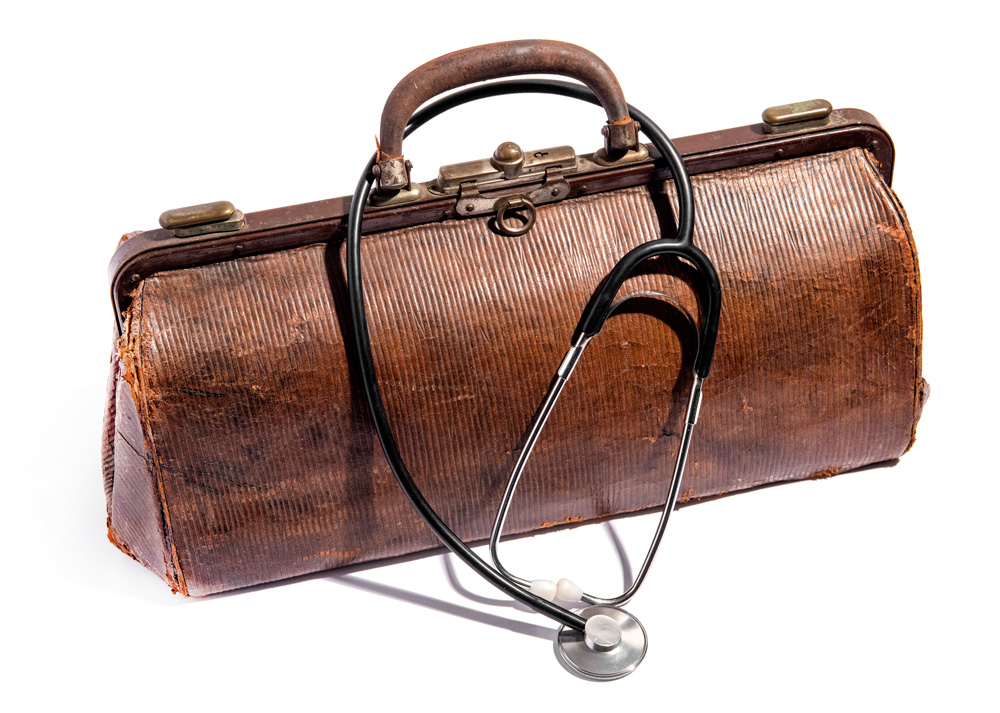
In an era when fewer family doctors make house calls than ever before, it is ironic, but also telling and symbolic, that one of the first purchases medical students still make as they transition from the classroom in first year to the clinic in second year is a black bag and its basic tools: a stethoscope; an otoscope-ophthalmoscope; a small reflex hammer; a portable blood pressure cuff; and two tuning forks – one to test hearing, and a second to test sensation in the hands and feet.
More than a century ago, when most visits by doctors were to the home, a well-equipped black bag was a necessity. Doctors making house calls needed a reliable bag specially fitted with compartments to carry several instruments and drugs. A wide range of leather doctor’s bags evolved from earlier wooden and leather chests and pocket cases. A typical doctor’s bag contained the diagnostic instruments of the day including a thermometer, a stethoscope, a sphygmomanometer (for measuring blood pressure), tongue depressors, an otoscope, ophthalmoscope, percussion hammer and laboratory equipment including a hemoglobinometer and a urinometer (neither of which exists today, and I would be hard pressed to recognize either device), reflecting the importance of the role of diagnosis. Although treatments were limited, vaccination for the prevention of smallpox was a priority in the early 20th century.

A country doctor is shown vaccinating a baby in this illustration by Ed Hamman from 1890.History of Medicine (IHM) / U.S National Library of Medicine (NLM)
The doctor’s bag also contained a few drugs and a few instruments for the management of emergencies in the home.
My own black bag remains a simple affair, given that I practice near several downtown hospital emergency rooms and an ambulance is just a 911 call away. In addition to the basic tools, I carry a glucometer for checking blood sugar, a small thermos to keep vaccinations cool, clinical note paper, a prescription pad and a couple of death certificates in the side pouch.
My own education in house calls, their uses and what to carry in my bag was, if not exactly haphazard, then certainly unsystematic. My first exposure was during an elective in second year of medical school with Dr. Maurice Smith, an old-school, Scottish-trained general practitioner, and the father of a friend.
Dr. Smith’s practice encompassed a section of southeast Toronto bordered by Danforth Avenue to the north; Gerrard Steet to the south; the Don Valley Parkway to the west; and Main Street to the east. Most of his patients were middle-aged and older patients of working-class background, many of whom had emigrated from England, Scotland and Ireland in the 1960s, much like my own parents.
For six weeks, every Tuesday morning at eight o’clock, I would meet him at the subway station near his office at Danforth and Main, and we would then drive to see several patients at home before beginning the office at half-past nine. As I recall, most of the home visits I attended with him were for his patients recently discharged from hospital after an acute illness or surgery. Some were to simply check in on older patients unable to make the trip to his office.
Neither of my family medicine residency mentors at Toronto General Hospital routinely made house calls, so most of my more formal training happened during my rural teaching practice in the second year of my residency (a requirement in all University of Toronto family medicine training programs) in a small town in the Northumberland hills and through a second-year residency elective rotation in downtown Toronto with a skilled geriatrician and brilliant teacher, Dr. Jim Kirkland.
The usual skills of taking a careful history and performing a thorough physical examination are important when making a house call. But it was from him that I learned the importance of paying careful attention to the state of a person’s home itself. Most ill people can get themselves together for a 15-minute office appointment, but a home visit usually reveals how they are really doing. He also taught me that a doctor on a home visit is a guest of the patient and must acquit themselves accordingly.
By the time I began practising family medicine at Women’s College Hospital in the early 1990s, I felt well-trained enough to make regular home visits on foot to many of my older homebound patients who lived within walking distance of the practice. The rest I made on the drive to and from the office from home.
My first house calls early in my career remain fresh in my memory and were a powerful influence on why I continued to do them throughout the years. One of the most rewarding kinds of house calls is to provide palliative care to a terminally ill patient who wishes to die at home (which is what the majority of Canadians desire).
Though never lucrative, perhaps the only time that I lost money making a house call was when I was making regular visits to a patient who was dying of lung cancer. His home was directly on my drive to and from my office. One morning on my way in, I had to make an illegal right-hand turn into his neighbourhood. An unsympathetic policeman stopped me and, unmoved by my explanation and the evidence of my doctor’s bag, issued me a very expensive ticket.
Although family doctors like me aspire to provide birth-to-grave care to their patients, some patients inevitably come and go after just a few years (sometimes due to a change in circumstances like a move, a falling-out between patient and doctor, or a premature death). Often it is only long after they are gone that you realize their impact.
One of the patients I eventually paid house calls to was a woman in her 60s suffering from schizophrenia whom I’ll call Isabel. She joined my practice after a colleague left the clinic and moved too far away for Isabel to continue to be part of his new uptown practice.
Isabel was what family physicians used to call a “heartsink” patient – what your heart did when you saw her name on the appointment list. In her case it was from knowing that in addition to her appointment with you she would have been to one of the downtown emergency departments for at least one visit the week prior. By the time I became her doctor she had accumulated no fewer than six thick paper charts, each stuffed with dozens of pink, carbon-copy emergency room discharge notes. Every time I received one of those discharge summaries and added it to her chart, evidence that she was using up valuable and finite resources, I was filled with a vague but unmistakable sense that I was not doing my job as her family doctor.
The reasons for the emergency room visits were usually the same – pressing chest pain that could have been caused by angina or a heart attack, given her risk factors (advancing age, high blood pressure and smoking) – but in her case, more likely caused by heartburn from stomach-acid reflux brought on by her habit of a large black coffee three times a day and a pack-and-a-half a day cigarette smoking habit. Her treatment was usually the emergency doctor’s standby for severe heartburn: a “pink lady,” a mixture of pink liquid antacid and the topical anesthetic xylocaine. Once her symptoms subsided and a heart attack had been ruled out, Isabel was discharged to follow up with me, tasked yet again with the challenge of helping her quit smoking and reduce her coffee consumption.
Over the years I tried to reduce the number of times she would visit the emergency room for chest pain – first by trying to get her to quit smoking using all the tools at my disposal, from motivational interviewing to offering nicotine patches and various medications, but after years of living with a chronic mental illness, cigarettes had become a comfort and a companion to her and I failed miserably. At the same time, I increased the number of regular office appointments with me, hoping to circumvent the hospital visits, first monthly and, over the span of a year or more, eventually weekly. But this ploy failed too.
One day, she came in to see me to share some good news.
“Good afternoon, Dr. Pimlott,” she greeted me as I entered the examination room.
There was always a delightful formality of manners that might have reflected her affluent upbringing before her schizophrenia developed in her late teens; soon after, her mother died, leaving her for the first few years of her adult life to fend for herself on the street.
As usual she had her large paper cup of coffee in hand, the rim and the plastic cover heavily stained with lipstick. As usual she was dressed in a navy-blue shift dress, dark nylon stockings that fit loosely around her thin legs, and sensible black, flat dress shoes that she wore year-round, regardless of the weather. She wanted to share the news that she was moving into a one-bedroom apartment in an assisted living facility in Toronto’s Little Italy.
It was then that I inexplicably offered to pay her a home visit once a month in exchange for her now almost weekly office visits.
Thus began a ritual that lasted almost two years before she eventually died in her sleep, likely from a heart attack that she had remarkably evaded during the decade that I was her family doctor. It was a ritual that I very soon began to look forward to.
My home visits with Isabel were usually on a Thursday morning. Sometimes if pressed for time I would drive, but more often I would walk to and from the office with my black bag in hand – about 20 minutes each way. Her new apartment was on the top floor of a three-storey low rise, and on the main floor was a nursing station that was open 24 hours a day and a common room. Next door to the building was a small park with a bench shaded by a few trees, and a play area for children. Sometimes as I arrived, I would find her sitting on that bench enjoying the summer sunshine, both a cigarette and a cup of coffee in hand before we would move to her small apartment.
“Good morning,” I would say as I sat down at one end of the sofa, putting my black bag on the floor beside me and getting out my blood pressure cuff and stethoscope.
“Good morning, Dr. Pimlott,” she would reply, sitting at the other end of the sofa, preparing for me to update her history and check her blood pressure.
For years she had refused the blister packs that both her pharmacist and I had suggested, so at the conclusion of every visit, I would carefully check her bottles of pills – for her blood pressure, her high cholesterol and her arthritis pain – and put those which she had accidentally scattered on the coffee table around the large ashtray back in the bottles. If need be, I might, on occasion, adjust her blood pressure medications according to her readings.
“See you in a month.”
“See you in a month, Dr. Pimlott.”
Not long after I started making those monthly home visits to her, the weekly trips to the emergency department suddenly stopped. Whether or not it was because my regular home visits finally had an impact, or because in her new home she had easy access to the help and advice of a nurse, I cannot say. Nor did I ever ask her. Like many doctors, I am vain enough and arrogant enough to think that somehow, I had changed her behaviour. The more obvious truth is that she changed mine. After years of frustration, I had finally stopped treating Isabel as a problem to be solved and began treating her like a person to be cared for.
Although still inadequately compensated compared to office visits and not always convenient to do, I have found making house calls to be one of the most meaningful and satisfying aspects of my work as a family doctor. They have provided me with insights into the lives of my patients that have helped me to better understand and care for them, and they have deepened my sense of connection to them.
And there is, I think, renewed hope that today’s family doctors are rediscovering these benefits, too. A 2020 study from Nova Scotia published in the journal that I edit, Canadian Family Physician, showed that while older male and rural family physicians are still more likely to visit their patients at home, overall, almost 85 per cent of family doctors in the study reported making regular home visits to their patients.
There may still be life left yet in the venerable art of the house call.