Katherine Dunn is a journalist based in London. Her book on the history of GPS will be published in 2026.
Some time around 250 BC, Eratosthenes – a Greek poet, mathematician and chief librarian of the Library of Alexandria – looked into a well in Syene, which is now the city of Aswan in Egypt, and saw the shape of the Earth.
It was the summer solstice, and the light of the sun shining directly overhead disappeared neatly into the darkness of the well. At exactly the same time, Eratosthenes later realized, the sun was casting a shadow in Alexandria. The astronomer already believed the world was round, but by comparing the shadow with the distance between the two cities, the librarian was able to estimate its rough circumference, and with remarkable accuracy.
This was the founding legend of geodesy, a heady mix of physics, math and astronomy that comes from the ancient Greek word meaning “to segment the Earth.” It is the quest to understand the planet’s true shape, its relationship with time, and the forces of gravity.
Eratosthenes, who bisected maps with vertical and horizontal lines in what became the forerunners to longitude and latitude, attempted a kind of objective, scientific rigour to how we understood the Earth. But it only took a century for politics to muddy the picture. In the second century BC, the astronomer Ptolemy published the book Geography, which was collated and illustrated into one of the seminal early maps of the “world”, as he saw it; it depicted the reach of the Roman Empire, the equator bisecting the globe in the middle, with “poles” on each end. It was a visualization, in other words, of conquest.

Geographia of Claudius Ptolemy (ca. AD 100 - AD 170). The 1482 Ulm edition. Four new regional maps that show geographical knowledge gathered after the time of Ptolemy were also added to this edition.Thacher Collection, Rare Book and Special Collections Division, Library of Congress
It is easy to imagine our map of the world as accepted and unchanging, with the seeming inflexibility of rock and ocean. With access to the Global Positioning System (GPS) on our phones, we engage with maps so continually and unthinkingly – on the way to work, to see friends, to order food to our doorstep or to plan a run – that it’s no surprise we get used to feeling as if the ground underneath us is fixed and unmoving, parked on a stable and precise grid.
But there is no true objectivity, even in our understanding of how the world looks; our viewpoint has always been political. Conflicts or treaties might change borders, or merge them. Places may change name by government dictum, such as U.S. President Donald Trump’s recent declaration that the Gulf of Mexico would be renamed the “Gulf of America” after more than 425 years.
The human relationship with maps has the ability to do something that feels remarkable and fundamental: reshape how we see the Earth, and unmoor us from our sense of time and space itself.
Humans have a long history of mapping and navigating long distances, whether it’s in search of meaning beyond their own lives or for pure political or economic conquest.
Thousands of years ago, the ancient Polynesians sailed across the Pacific, relying on their senses and the patterns of the stars, the flows of currents and the tides. From the late 10th century, the Vikings explored the North Atlantic. The Islamic Empire traversed the Indian Ocean, and Chinese dynasties traded across Southeast Asia, using complex compasses equipped with magnetic needles. In Canada, Indigenous communities were creating maps long before Europeans arrived, marking territory and routes and governing where families or communities could live.
But from the 1500s onward, European sailing maps, inspired by Ptolemy’s grid design, attempted to produce a fixed, unchanging – and European – picture of the world. The results were decidedly mixed.
The horizontal lines, or latitude, were relatively simple to establish; the equator is fairly easy to identify through the orientation of the stars. But longitude – the vertical lines – have always been much harder to pin down. The issue is that the world’s rotation doesn’t have a fixed starting or ending point – after all, the globe never stops – so the location of the meridian, or the “zero point” of longitude, is essentially a matter of opinion. It’s no surprise that colonial map-makers tended to place the meridian wherever they themselves were based, which was usually a European capital. As the scientific historian Dava Sobel argues in her book Longitude, latitude is nature – longitude is politics.
In part because of this unstandardized approach, early European maps of North America were often decidedly misinformed, or outright weird; large sections of land were missing, or they depicted the continent in odd shapes or with vast inland seas.

A 16th century map of the Western Hemisphere by Sebastian Münster from Basel, Switzerland. South America is labeled in German. Geographic features otherwise in Latin. Appears in the author's Cosmographei.Library of Congress
For a ship sailing from Europe to the Americas from the 1500s through the 1700s, these distortions weren’t just philosophical. Navigators had to rely on “dead reckoning”, a navigational method that forms a crucial and practical link between time and space: calculating the ship’s location based on where it started, how fast it’s going and how much time has passed. This was often dangerous; ships tended to get lost. But the alternative required travelling by slower waypoints, the same way that we might stick to main streets rather than cutting through a more direct but less straightforward route.
To make it more efficient to sail between, say, Britain and Canada, navigators needed either a way to calculate their location from the stars, or a more robust and accurate clock – one that could withstand the rough seas and temperature swings of a long journey. The major innovation eventually came in the form of the marine chronometer, but the race for better maps and better clocks didn’t stop there.
By the interwar years, the rise of postal mail by air and the first commercial airlines had produced the “airways” of the skies, and a Canadian engineer had invented the more accurate quartz clock. And by the Second World War, the forerunners to today’s satellite navigation systems were in their infancy, broadcasting rudimentary, radio-beam-based highways.
Different countries had separate systems, but the best known ones had a clear purpose: Better navigation meant it was easier to bomb the right town. Warfare was a motive that carried over into the Cold War; in 1958, just months after the Soviets launched the first satellite, Sputnik, American physicists at the Applied Physics Laboratory began work on what would become the Transit satellite navigation system, the forerunner to GPS. Transit was built for one major client: U.S. Polaris nuclear submarines. If you were going to launch a nuclear missile at Moscow, you needed to know exactly where the missile was – and, for that matter, where Moscow was. It was just a bonus that it turned out that the Transit system had so many other uses, including helping to map the Canadian Arctic.
The Global Positioning System, which was originally built to enable precision bombing in the aftermath of the Vietnam War, had similar, unexpected effects. GPS was built to drop bombs; today, it really does it all, and all at our fingertips.
Throughout the 20th and 21st centuries, mapping has become more and more precise. And yet, there is no such thing as a truly perfect map. The mere process of making a map flat, and therefore readable on paper and screens, requires reshaping and distorting the world’s complexities – and often in ways that reflect our own biases and priorities. While some continents and oceans are squeezed, others are stretched (notably, Greenland). By necessity, even very complex maps serve as mere snapshots – moments in time that can’t fully capture the way the Earth is constantly lurching, shaped by its shifting plates and swirling tides. In its fullest sense, then, the Earth is almost impossible to fathom – a planetary caveat to what we understand about the rules that govern time and space.
From a practical point of view, this complexity poses endless challenges. To try and bridge the gap between reality and usefulness – to find a comprehensible route between A and B, for instance – we use shortcuts. These shortcuts are, essentially, math.
This model, which still involves mind-boggling levels of complexity, is a figure called the geoid. The geoid is based on “mean sea level”: that is, the sea level if water extended around the globe unrestricted by land or mountains or cities, shaped only by the forces of gravity. The result is a shape with a smooth but uneven skin, swelling where gravity is strong (the Arctic), and dipping where it is weak (the summit of Mount Everest). Essentially, the geoid resembles a lumpy potato.
There is also another, even simpler model: the ellipsoid. This is the far smoother orb that evens out those gravitational hills and valleys, approximating the Earth in a more familiar way, slightly flattened at the poles and bulging at the equator. Basically, this model swaps out the potato shape, and replaces it with a grapefruit. (Fruits and vegetables are common metaphors in the world of geodesists.)
One of the first major models of the geoid was used as the reference map for the Transit navigation system. The next, developed in the early 1980s, became the World Geodetic System 1984, or WGS84. This map directly influences how you experience the world, because it is the reference map on which GPS is based. When your floating blue dot moves along streets on a templated map on your phone, your GPS-defined location is moving along the surface of the geoid. The Earth is below your feet, yes – but your location is mostly the product of physics and math, the legacy of mathematicians, satellites, and powerful U.S. military computers.
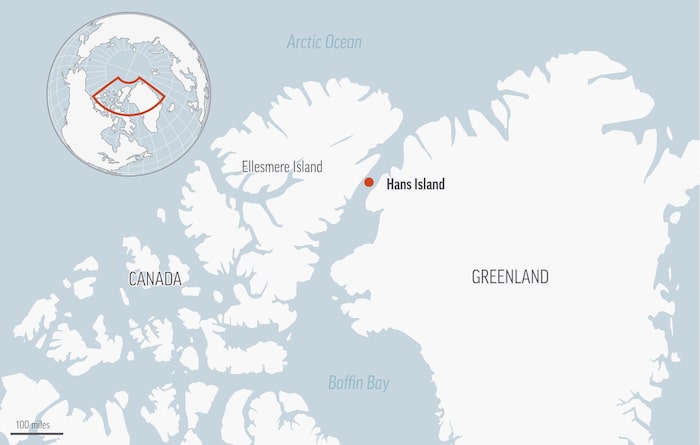
So there is always some slippery gap between theory and truth in how we understand the Earth – it’s just a matter of by how much. GPS has its discrepancies; in 1997, the Statue of Liberty’s real location and its GPS location were off by several yards, and in 2007, satellite imagery revealed that Hans Island, then a disputed 1.3 square-kilometre island between Greenland and Nunavut, was slightly east of where the Canadian map had placed it. In the end, a political line was drawn: Canada and Denmark settled the dispute in 2022 by splitting it through the middle.
Climate change is now subtly shifting the GPS map, too, as ice-sheet melt flows from the poles to the equator, slowing the planet down and lengthening our days at a rate of 1.3 milliseconds per 100 years, according to NASA.
In a very real way, Google Maps changed everything: an app driven by GPS that many of us use as unthinkingly as oxygen. When it first launched as a website in February, 2005, a new default vision of the world was suddenly unleashed – and that vision started with America.
The launch version of Google Maps on browsers just featured a disembodied outline of the U.S.; the team hadn’t even added the names of other countries. Once the rest of the world was added, there were immediate political faux-pas to deal with. As former Google marketing executive Bill Kilday wrote in his book Never Lost Again, Taiwan was labelled as part of mainland China, and the border between Nicaragua and Costa Rica was placed incorrectly, which had real-world consequences: Nicaragua deployed soldiers to the island of Isla Calero “and claimed it as its domain, saying, effectively, ‘Google Maps says that it is our territory.’ ”
Since then, Google seems to have adopted a split-the-difference policy: Show what that country’s government wants you to see. That’s why “Gulf of America” is what Americans can find on Google Maps, while Mexicans can see the Gulf of Mexico; in Canada, you’ll see “Gulf of Mexico (Gulf of America.)” Similarly, the sea between Japan and Korea goes by the Sea of Japan in the former, and the East Sea in the latter – it’s “Sea of Japan (East Sea)” in Canada – and it’s the Arabian Gulf in Arab countries and the Persian Gulf otherwise.
In that way, Google Maps is part of a long tradition, stretching from the Roman Empire to the “Gulf of America.” Depending on your IP address, or just your perspective – you might be seeing a different world.
Editor’s note: This article has been updated to correct the given name of Dava Sobel, author of the book Longitude.