Taras Grescoe is the author of Straphanger: Saving Our Cities and Ourselves from the Automobile, as well as High Speed, a newsletter about the global passenger rail renaissance.
This is definitely different, I thought to myself, as I wheeled my suitcase through the sliding doors into the multistorey station in Miami’s Overtown neighbourhood. Inside the sun-drenched, air-conditioned lobby, an ad for a bank on a slanting floor-to-ceiling screen flashed reflections in the polished floor. Just beyond a juice bar, attendants in polo shirts stood at podiums, helping clients register larger pieces of luggage. Architecturally, Brightline‘s Miami Central station looked less like a chronically down-at-heel North American train station, and more like a freshly built air terminal in East Asia.

Brightline's Miami Station.Supplied
As I rode an escalator beneath a soaring skylight, a recorded voice, in English and Spanish, announced that my Fort Lauderdale-bound train would be departing from Track 3 at 12:50 pm. That left me all of five minutes to enjoy my access to the Premium Lounge, included in the price of my ticket. Noting the Sauvignon Blanc and Pinot Noir on tap, and an impressive array of salads, cheeses and omelettes, I settled for a take-away espresso from a self-serve machine, before deciding that I’d better hurry up and join the queue to board the train.
In its publicity, Brightline, which runs trains from Miami to Orlando, with an extension planned to Tampa, bills itself as a “high-speed train unparalleled in speed, comfort, and style.” When the service first began in 2018, the first new intercity passenger train in North America in the 21st century was hailed as a triumph of entrepreneurship. As the Wall Street Journal put it: “The high-speed intercity line is privately funded, built and operated. None of the $1.3-billion cost of the first phase of the operation – laying track and building bridges, stations and complete trains – is coming out of taxpayers’ pockets.”
The implication was clear: Amtrak, famous for its aging rolling stock and long delays, providing the kind of inefficient service you might expect from government-run rail, was the past; Brightline was the future. At the same time, the Trump administration has signalled its intent to choke off funds to California’s long-delayed high-speed line in the Central Valley, the company has already broken ground in Nevada, and plans to have trains running on its Brightline West high-speed line between Las Vegas and Southern California some time after the opening of the Los Angeles Olympics in 2028. Brightline‘s owner reportedly has his eyes on routes linking dense cities in Texas, the Pacific Northwest, the American South and the Midwest.
In Canada, the Liberal government has announced the selection of a consortium to build high-speed rail from Quebec City to Toronto, a public-private partnership to be managed by Alto, a new Crown corporation accountable to the Minister of Transport. There is talk of building a private rail line to Banff, and even a hyperloop between Edmonton and Calgary. As a believer in the environmental advantages of railways over runways and highways, I was curious to see whether Brightline‘s vision of privately funded, for-profit rail was a potential solution for the intercity commuting woes of our car-addicted continent.

Travellers board an Amtrak train at Chicago's Union Station in November 2018.Scott Olson/Getty Images
To get to Florida, I’d ridden an Amtrak train from Chicago’s Union Station. The boarding process was a confusing slog through a maze of construction barriers, followed by a long wait on a frigid platform, where staff manually checked our tickets. By the time we reached Amtrak‘s Miami depot – less impressive than a Midwestern Greyhound station, and stranded 20 kilometres from downtown – the trip had lengthened from just under two days to over 52 hours. My experiences on Via Rail are often as frustrating: The inefficient boarding process at Toronto’s Union and Montreal’s Central Stations, combined with lengthy and usually unexplained delays on even the shortest runs, is no recipe for producing a happy repeat customer.
At the Miami Central station, I didn’t have to worry about joining a slow-moving queue to board. I simply scanned the QR code on the Brightline app on my phone, and strolled through an automated barrier gate. (This is now standard practice in major Asian and European terminals.)
After a second escalator ride up from street level, my train was waiting on the open-air platform. Four economy coaches – “Smart” service, in Brightline-speak – and one “Premium,” or first-class, coach were bookended by the aerodynamic-looking, slant-nosed locomotives at either end of the trainset. After following a neon-bright yellow line that shimmied along the side of the coaches, I settled into a jetliner-style seat, styled by the same designer employed by Ferrari and Lamborghini. By the time we pulled out of the station – exactly on schedule – I was nibbling on a complimentary snack of prosciutto-wrapped mozzarella, and counting myself a pretty satisfied Brightline customer. Clean, convenient, modern, stylish and on time: the contrast between Brightline and publicly run passenger rail, as one currently experiences it on this continent, couldn’t have been starker.
But, as the journey progressed, I began to have second thoughts. I noticed there was no indication of our speed on the in-car video screens, a standard feature on European and Asian bullet trains. Checking a speedometer app on my phone, I noticed we never got past 127 kilometres an hour. This corresponds to 79 miles per hour, the maximum speed in the U.S. for passenger trains travelling on Class IV tracks, which are meant to accommodate heavy, long-haul freight trains.
As I disembarked at Fort Lauderdale, my first stop, the reason for our lack of velocity was obvious. Unlike high-speed lines in France, Spain, and Japan, which are built on dedicated rights-of-way, Brightline slices through a highly developed landscape, past at-grade crossings where lines of traffic were held back by crossbars. This has made it America’s deadliest railroad; more than 125 people have been killed on Brightline property since 2018. If its trains were permitted to go any faster, Brightline‘s death toll might be even higher.
Outside the station, I searched in vain for a city bus. Posters advertised shuttles to the airport, but because there is little co-ordination with local public transport, Brightline encourages riders to use Uber or use another rideshare services. (An employee told me I could hail a free electric golf cart, but the required app wasn’t available for download to non-U.S. residents.) I chose to walk, and, as I trundled my suitcase across a level crossing, I was panhandled by an unhoused man, who had wandered my way from a makeshift encampment next to the tracks. Brightline blames the high number of deaths on its tracks on suicide, trespassing and drug addiction. But in Europe and Asia, deaths and injuries are prevented by the simple expedient of fencing off high-speed lines from wildlife, people and cars.

Canadian Pacific Railway Locomotive #5068. Leanchoil, B.C. 1913 or later.Library and Archives Canada
The building of North America’s railways, across Rockies, rivers and prairies, is often portrayed as a triumph of private enterprise. At its peak, half a million kilometres of tracks criss-crossed the continent, cutting ancestral Indigenous territories to ribbons in the name of nation building. While Canada began to nationalize its railways in the First World War, the United States boasted of being the only industrialized country with an entirely private railroad system.
In reality, private entrepreneurs were given absurdly generous handouts from the federal government, in the form of publicly funded surveys and grants of trackside land. Once the coming of the railway had increased the land’s value, they could sell it at a handsome profit. Robber barons like Henry A. Flagler, who founded Standard Oil with John D. Rockefeller, made their fortune not by carrying passengers, but by developing land.
Flagler, who liked to take his bronchitic first wife south for the winter, got the Florida legislature to grant him 8,000 acres of free land for every mile of track he laid. His Florida East Coast Railway carried passengers to his own resort hotels, which in turn became the nuclei of the future cities of Palm Beach and Miami. (Eventually, Flagler would build the “Eighth Wonder of the World,” extending tracks over 200 kilometres of ocean, via concrete arches, to Key West.) To save on construction costs, he employed convicts for US$2.50 a month, rather than railway workers, who could then expect to earn a living wage of two dollars a day.

Children waving circa 1915 as a train travels over the Overseas Railroad, an extension of the Florida East Coast Railway to Key West. Image is one half of a stereoscopic image.Graphic House/Getty Images
The right-of-way I was riding on Brightline was the original, Florida East Coast Railway (FECR) line. Brightline in turn is the brainchild of Wes Edens, a veteran of Lehman Brothers and Black Rock, who founded the private equity firm Fortress Investment Group with four other partners in 1998. After Mr. Edens read about how Flagler conceived the FECR line to Key West to open trade to the Caribbean and the Panama Canal, Fortress purchased Flagler’s long-neglected line, then mostly used for freight, for US$3.5-billion. Mr. Edens’s stated goal was to target trips that were “too short to fly, but too long to drive,” competing with both airlines and the heavily congested Interstate-95, which parallels the southern portion of the Brightline route.
During the Obama presidency, Florida was offered US$2.4-billion in federal funds to cover the cost of building a high-speed line from Orlando to Tampa. When Republican governor Rick Scott rejected the funds in 2011, Fortress announced the formation of All Aboard Florida, the precursor to Brightline, and claimed that it could build a high-speed rail line from Miami to Orlando in three years, for just US$1-billion.
In fact, the first trains to West Palm Beach didn’t run until 2018, and, by conservative estimate, the line has so far cost US$5.5-billion. Early claims that construction costs would not “come out of taxpayers’ pockets” have also proved unrealistic. Of the US$70-million it cost to build that impressive Miami Central station, for example, Miami-Dade County provided US$43-million; Brightline reportedly only contributed US$10-million to the construction of the federally funded, US$221-million Orlando airport station.
Public funds also went to upgrade the FECR line, including US$130-million to replace the St. Lucie Bridge. What’s more, Brightline benefitted from billions in tax-free bonds, which means that income from interest, which would normally go into the public coffers, is exempted from taxation.
Flagler’s original line was never a money earner. Going back to the 19th century, passenger rail was almost never a reliable source of profit for investors; carrying freight, and selling off publicly granted land, was what made the original robber barons rich.
It’s a formula that’s been revived by the billionaires of the 21st century. After developing Miami Central, which was built on the site of Flagler’s original Miami train depot, Fortress sold two station-adjacent apartment buildings for US$400-million. Brightline West is benefitting from an even more direct public subsidy: The company recently accepted US$3-billion in federal infrastructure funds to build its line through the Mojave Desert.
“This is what you call a get-rich-slow scheme,” says Anthony Perl, an urban-studies professor at Simon Fraser University, who has ridden and studied the Brightline. “They’re patient capitalists, who are using the same techniques as the first generation of robber barons. You make your money by the land development that the transportation infrastructure enables, and the value it generates.”
Dr. Perl argues that by selling the project as a socially beneficial passenger rail project, Fortress was able to increase the capacity of the freight corridor, using public funds to upgrade bridges and crossings, which forestalled opposition from trackside residents. Before the pandemic, Fortress sold off the freight line for US$2.1-billion, on the condition that Brightline passenger trains would be granted a perpetual easement. (The current owner is Grupo México, a conglomerate responsible for the acid-waste spill considered the worst mining disaster in Mexican history.)
That leaves Fortress free to sell off condo towers, and other trackside assets, whose value has been increased by their proximity to a new passenger rail line. The problem is, because Brightline is private, should it decide that it’s losing too much money on passenger rail, it’s under no obligation to keep running trains for the people who have come to depend on it.

Brightline passengers use the new MiamiCentral terminal to board the inaugural trip from Miami to West Palm Beach on May 11, 2018.Joe Raedle/Getty Images
Last time I was in Florida, I got around exclusively by rental car. This time, I relied on transit. Riding Tri Rail’s elevated light rail in the Miami area, and SunRail, the Orlando area’s commuter rail network, was a novelty for me, and a welcome one. Brightline markets itself with the slogan “Go car free – Carefree,” and as I talked to riders, it became clear many of them were grateful to have an alternative to cars and highways.
In the Smart Lounge of the Ft. Lauderdale station, whose striking façade was fronted by white struts that formed inverted pyramids, I chatted with Moses Mogene, a 25-year-old finance student from West Palm Beach, who attends Keiser University in Fort Lauderdale. He told me a family member had driven him to the station that day.
“I’ve got a car, but it’s much easier to take the train than to be in traffic on the I-95,” he said. “On the train I can get some work done, watch some YouTube, or just relax and stare out the window.”
By then, our Orlando-bound train was boarding. This time, I rode in a Smart car, which had four seats per row, rather than the three in Premium. Ahead of me, in a mid-car bank of facing seats, a half dozen Latin American men were having a lively conversation in Spanish; one of them told me they’d been attending an air-conditioning conference in Miami, and were returning to the Orlando airport to catch flights home. Later, I struck up a conversation with Alyssa Balzanta, who was relishing the ride. She told me she’d recently studied in England, where she’d ridden the trains everywhere.
“This is actually cleaner than the trains in the United Kingdom,” she said, She was visiting a friend in West Palm Beach, but didn’t want to drive. “On the train, I can read a book. Let somebody else do the driving. It’s just so much more relaxing.”
Both Mr. Mogene and Ms. Balzanta told me they found the tickets expensive, as did I. Both had paid about US$70, a little higher than the average price of a Brightline ticket, which is US$55. Brightline‘s stated target is 650,000 passengers a month, but as of 2024, it had yet to top 260,000 monthly riders. To fill the revenue gap, in May, 2024, Brightline killed off a pass that offered discounted fares to regular riders, boosting the per-ride cost by 251 per cent. Many riders, lured by the promise of reduced car-dependency, had already rearranged their lives to be near a Brightline station.
One of the arguments for private rail operators is that, in Europe, competition has brought ticket prices down. But Brightline is the only long-distance operator in this part of Florida; it’s competing against gas prices, highway tolls and airline tickets, not other trains. During the pandemic, Amtrak and most metropolitan commuter rail providers offered some level of service. Between March, 2020, and November, 2021, Brightline laid off nearly 250 employees, and completely suspended service.
Nor is there any guarantee that Brightline will always run passenger train service on Henry Flagler’s venerable line. If Fortress judges it’s earned enough from selling off trackside assets, it’s under no obligation to keep transporting Floridians.
In the 20th century, private rail companies shut down passenger lines when they stopped being profitable; Amtrak and Via Rail were cobbled together in the 1970s out of the remains of private railways, to ensure passengers weren’t completely abandoned, and some level of service remained.
A publicly funded national passenger rail network strives to balance commercial and social goals; highly used services, like the Boston to Washington Northeast Corridor, and Via Rail’s Quebec City to Windsor Corridor, subsidize money-losing, but socially important, long-distance and rural routes. Critics say that when private operators are allowed to cherry-pick lucrative city-pairs – for example, Brightline West’s Las Vegas to Los Angeles route – public, national networks could be denied the funding they need to keep basic services alive.
It’s an argument I sympathize with. But the part of me that was enjoying the ride, past marinas and golf courses, was also thinking that, in car-crazy North America, any passenger rail, public or private, is better than none. If nothing else, Brightline‘s sunny styling, smooth boarding and excellent food and drink service might provide motivation for Amtrak and Via Rail to step up the travel experience.
One thing is certain: In Canada, where there is finally momentum to build high-speed rail in Quebec and Ontario, we need to be having a national conversation about what form our rail service should take. As things stand now, Cadence, the consortium charged with building the line, is overseen by Alto, a Crown corporation that is independent from Via Rail, Canada’s chronically underfunded national rail operator. Many critics see this arrangement as a back door to privatization, and worry that there will be a lack of co-ordination between the existing Via Rail network and the new line. This is the charge levelled at Montreal’s REM light-rail system, which was built by Quebec’s massive public pension fund with little public consultation.
In 1990, the Progressive Conservatives under Brian Mulroney allowed Via Rail’s most profitable tourist offering, a daylight service through the Rockies, to be sold off to private interests; the profits from the luxury Rocky Mountaineer continue to go to a private rail-tour operator in Vancouver, rather than to subsidizing Via Rail’s operation. Anthony Perl of Simon Fraser University believes Canada should hold a royal commission, a public inquiry that has long been a traditional tool for charting national policy, to focus on the future of passenger rail.
In the absence of a national vision, we could be prey to private entrepreneurs, Canadian equivalents of Brightline, who might use the pent-up demand for passenger trains to hive off prime routes for their own profit.

Brightline’s northern terminus at the Orlando International Airport in March 2025.ROSE MARIE CROMWELL/The New York Times News Service
West of Cocoa, our train finally began to accelerate, briefly reaching its maximum of 201 kilometres (125 miles) an hour on the straight length of track, free of level crossings, that approaches the Orlando airport. As gratifying as this was, Brightline‘s claim to run a true high-speed service – the minimum international standard is 200 km/h – is clearly a stretch. The average speed, on a three hour and 25-minute trip from Miami to Orlando, is 111 km/h. That’s not much of an improvement over Via Rail, which can carry passengers from Toronto to Montreal, for a greater distance, at a lower ticket price, at an average of 109 km/h. (Provided, of course, Via is experiencing no delays.)
Disembarking at the platform at the Orlando airport, I walked to the front of the train to take a photo. It was then I realized where I’d seen the locomotive before. It was a Siemens Charger diesel-electric, of the kind that Via Rail now regularly runs in the Windsor to Quebec City Corridor. In fact, even the painfully slow Amtrak train I’d taken from Chicago was hauled by a Siemens Charger locomotive, engineered to top out at 200 km/h.

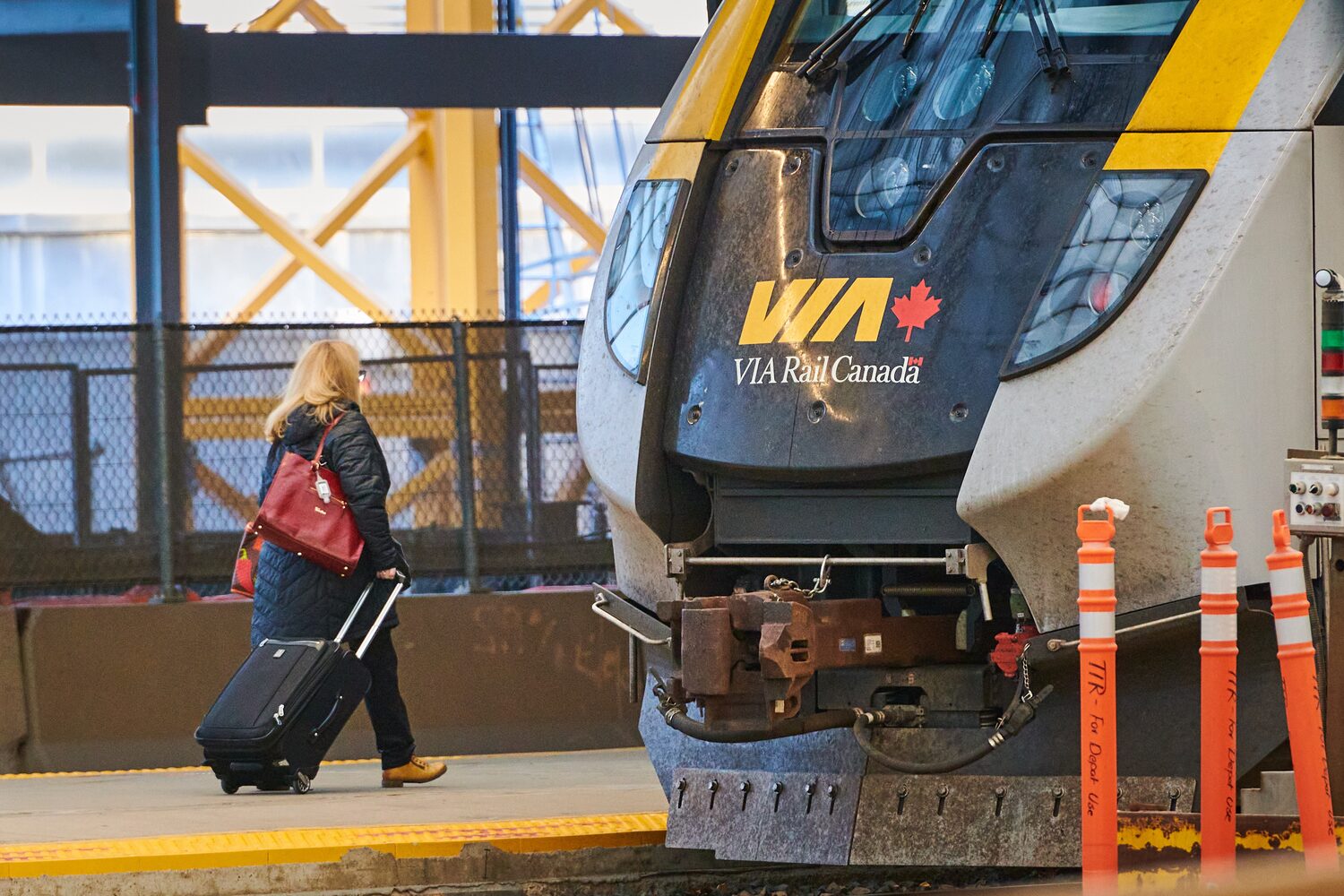
The difference was that Brightline had put a skirt on the side, concealing the wheel assembly, and attached a nose-cone to the front, which gave it the slant-nosed profile associated with cutting-edge bullet trains. There was also a conspicuous absence: On the roof, there was no pantograph, the crucial feature that allows European and Asian trains to draw renewable electricity from overhead wires.
I’d come a long way to discover that the vaunted future of passenger rail in North America was in fact a train hauled by a locomotive fuelled by dirty old diesel, of the kind I could ride back home in Quebec. Brightline, for all the hype, is a standard-issue rail service, dressed up in high-speed finery.