Peter Kuitenbrouwer is the author of Maple Syrup: A Short History of Canada’s Sweetest Obsession.
Parry Island belongs to Wasauksing First Nation. Located in the Georgian Bay off Parry Sound – about 250 kilometres north of Toronto – the island is bigger than Manhattan but sparsely populated, home to about 400 Anishinaabe people.
One thing abounds here: sugar maple trees.
Thanks to this bounty, Wasauksing has a growing reputation for its thick, golden delicious maple syrup.
While conducting research for a book on the history of maple syrup in Canada, I first travelled to Parry Island in the spring of 2023, to visit Wasauksing Maple Products.
Wet snow blanketed the forests. I found several staff hard at work in the sugar shack the community built in 1970: a sagging structure covered in grey tin, from the roof of which poked a half-dozen stovepipes of various diameters and heights, some a bit rusty; guy wires ran from the largest smokestack, to ensure the tall and vital chimney remained upright.

The old sugar shack at Wasauksing Maple Products in spring, 2023.Courtesy Peter Kuitenbrouwer

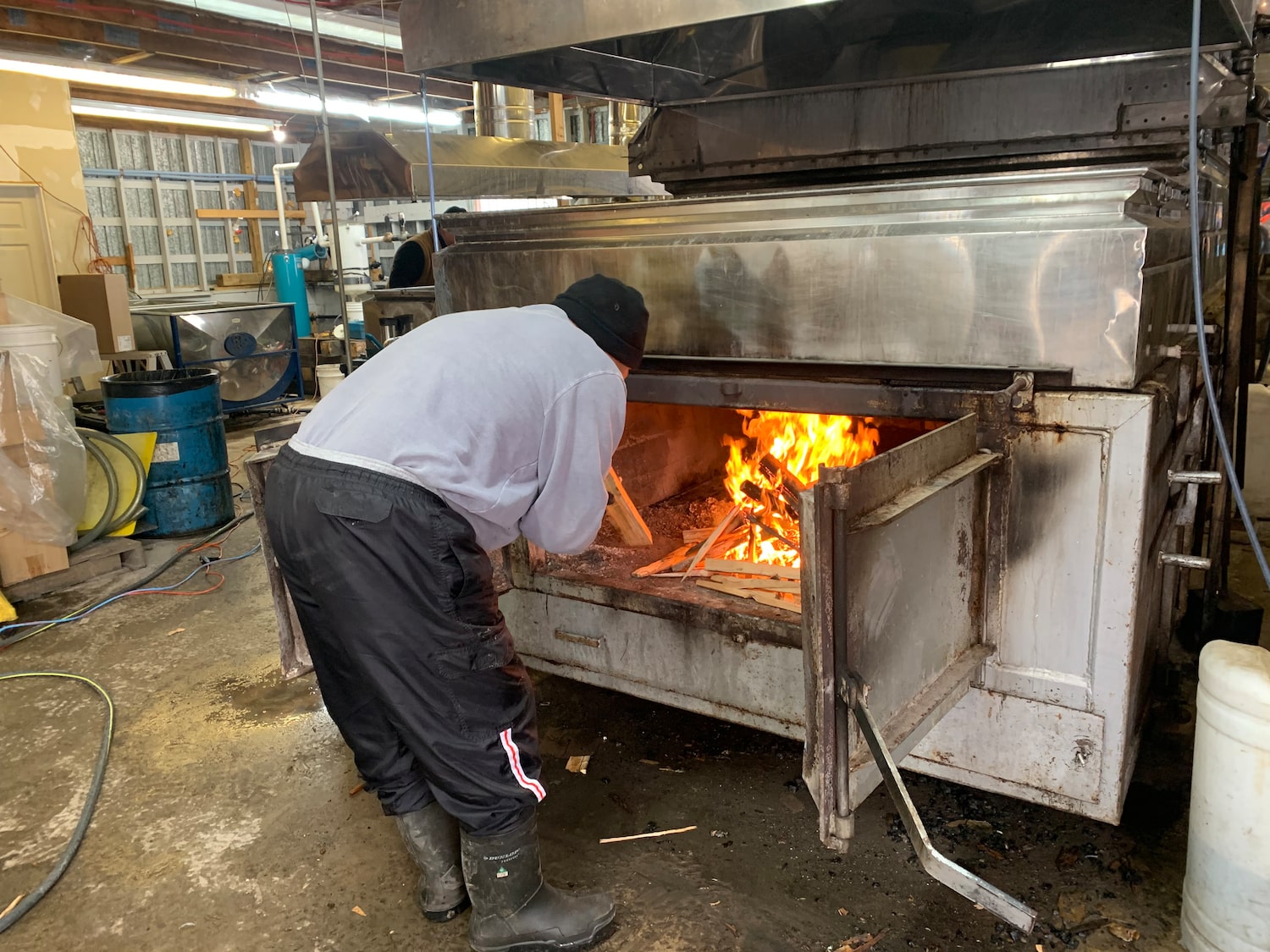
Wasauksing’s sugaring season that year had gotten off to a slow start. Just as the sap began to run, the pump in the sugar shack, which helps draw the maple trees’ liquid into reservoirs, broke down. One staffer described their job as “problem-solving,” which meant determining things such as which was the correct plug to use to avoid tripping the hydro. The sugar-making machine was broken. They had no drying rack, nor a spot to put a drying rack. Amid these travails, the Wasauksing team spoke of big plans for investment in their sugaring operation.
This summer, two years later, I returned to Parry Island to learn more about the role of Indigenous people in the history of maple sugaring and check their progress in revitalizing the sugaring industry at Wasauksing.
For Wasauksing’s Anishinaabe ancestors, like many Haudenosaunee, Huron and other Nations, maple sugar was a dietary staple. In spring it was the women who made the sugar. They used it to season meat, fish, fruit and vegetable dishes. They also used it to remedy breathing problems or heart and stomach problems. Continuing today, First Nations people cherish maple syrup for its healing and nourishing powers.
Across the range of the sugar maple tree, from Nova Scotia to western Ontario, and stretching south into Minnesota and Tennessee, maple syrup season is an excuse for a party. Wasauksing, whose members belong to the Ojibwe, Odawa and Potawatomi Nations, holds two events: before the start of syrup season, at its Sweetwater Ceremony, the locals celebrate ninaatigwaaboo, or maple sap. At season’s end comes the Wasauksing Maplefest; locals compete in pie-baking and vote for the cutest baby, the best chili, the tastiest scones, and the best Mr. and Mrs. Sapsucker.
My book, Maple Syrup, covers a lot of ground, from the sugar bush of my childhood in Papineauville, Que., through to the growth of “Big Maple,” the Quebec cartel that now controls most of the world’s maple syrup. I meet syrup rebels and syrup thieves, and I analyze whether peak industrial efficiency in syrup-making has compromised quality and/or forest health. I look at whether global warming is a threat to the sugar bush, and I end with tales of my family’s own sugaring exploits in eastern Ontario. Indigenous sugaring is one chapter, but worth dwelling on, because the story is poorly understood, pivotal to the history of Canada, and offers hope for the future.
A sugaring classic, Helen and Scott Nearing’s The Maple Sugar Book of 1950, set in Vermont, begins with the assertion that settlers learned sugaring from the First Peoples. But this and other sugaring books leave out two key facts.
1) Once the First Peoples had taught them the art of syrup-making, colonists severed the connection between First Peoples and the sugar bush. Settlers cut the forests for agriculture or took the forests for settler use, while pushing the Indigenous peoples onto reserves. This is the part of the maple syrup story that clouds, discolours and embitters our national condiment.
2) Today, many First Nations are expanding their syrup operations, including Ziibaakdakaan Maple northwest of Toronto, Giizhigat Maple Products near Sault Ste. Marie, Awazibi in west Quebec and Sigewigus, the sugaring operation of the Mi’kmaq de Gespeg on Quebec’s Gaspé Peninsula. Here is a good news story. Many Indigenous communities are adopting the latest syrup-making technology to extract sap from those maple trees to which they still have access. Rebuilding their ancestral connection to the sugar bush is a long journey – and the result tastes very sweet.
Here’s something we didn’t learn in high school history: The First Peoples of the 17th to 19th centuries sold maple sugar in blocks, packaged in birch bark containers known as makaks, that could weigh up to about 12 kilograms each, supplying fur trading companies who redistributed the sugar to their trading posts.

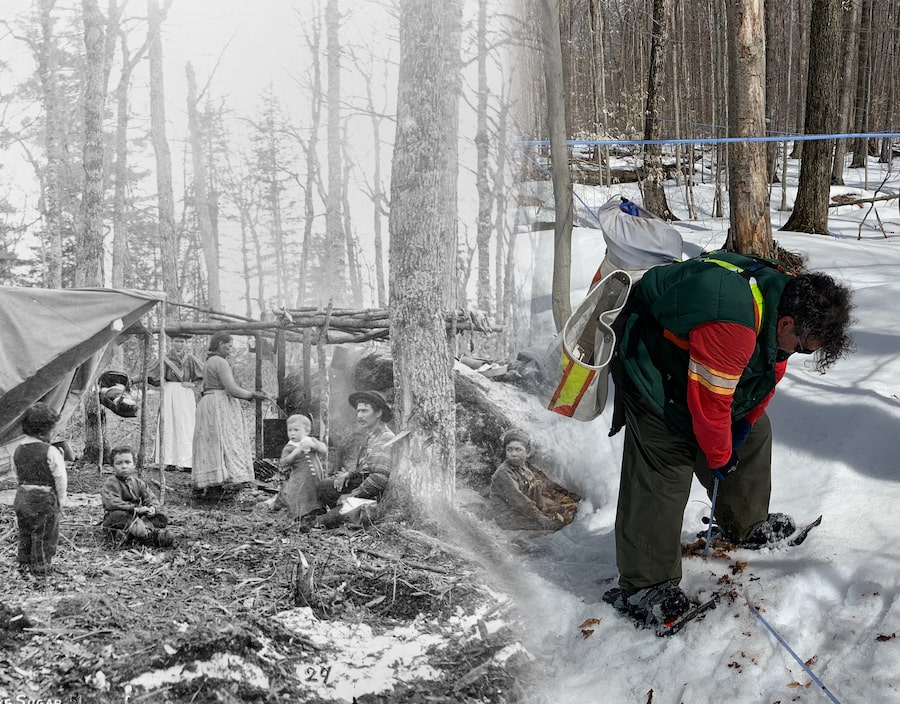
An Algonquin sugar camp, ca. 1900-1913.Harmer, W.M. Collection/National Archives of Canada, C19890
But in 19th-century Canada, as settlement intensified, the colonists kicked the First Nations out of the sugar bush. At Library and Archives Canada in Ottawa, I learned the tragedy of a community on Manitoulin Island in Lake Huron, who, herded onto a reserve, pleaded with their Indian Agent – a non-Indigenous official appointed under the Indian Act to control each reserve – for some forest where they might make sugar in spring.
“This branch of industry is of great importance to the Indians,” the agent reported, in an 1875 letter written with a quill pen, sent to the Department of the Interior in Ottawa, “the quantity made by an average family being five hundred pounds annually, which represents the value of about fifty dollars, adding greatly to their domestic comfort.”
The government did in 1875 “set aside” about 350 acres on Manitoulin for the Anishinaabe to make maple sugar, but withheld title to the land.
Over the years, letters in the file indicate illegal settler logging of this forest; the province of Ontario, without authorization, cut a road through the property, and gave the hardwood timber to settlers for firewood. Indigenous sugar-making on the land waned. A 1907 letter from the Indian Office at Manitowaning explains: “Those who used to go there to make sugar quit doing so [because] the settlers … took delight in destroying the property of the Indians.”
In the 1930s the Manitoulin Island Rural Telephone company installed a line across the lots. In 1943, Indian Affairs sold the land to settlers.
Wasauksing First Nation had its own challenges with settlers. The community originally lived on the mainland but in 1850 the then-British government moved them to Parry Island. But even the fate of the island they did not get to control. In the late 19th century, Ottawa lumber baron John Rudolphus Booth lobbied the government to expropriate reserve land on the island for Depot Harbour, an industrial expanse that today is a ghost town. Settler logging decimated the forest, Wasauksing Chief Shane Tabobondung told me.
Government policy systematically impoverished the First Nations. Under the terms of the Robinson Treaties of 1850 – signed the same year of Wasauksing’s displacement to Parry Island – the Crown was supposed to increase the annuities due to the Indigenous peoples in concert with the increased revenues from the land. The Crown increased the annuity once, in 1875, but has never since; annuity payments to the Indigenous beneficiaries have been frozen at $4 per person per year for 150 years.
Throughout, the Anishinaabe doggedly made syrup. A 1984 master’s thesis by a history student at the University of Waterloo, which I found in the Parry Sound library, notes that, “the gathering of berries and maple syrup remained a constant feature of Anishnawbe [sic] life, with the usual fluctuations in yield caused by the weather.”
The writer, Franz M. Konnecke, continued: “In 1918 as part of its war effort, the Canadian government tried to increase the production of maple syrup, particularly at Parry Island with its large forest of sugar maple trees. Just offering encouragement and no expert advice of how to improve the yield, this call for greater production brought little response from the Anishnawbe, who followed long established patterns which had provide sufficient in the years past. They had always done as much as they could.”
Now Wasauksing is doing more. With more than $1.5-million from the Federal Economic Development Agency for Northern Ontario, the Northern Ontario Heritage Fund Canada, Indigenous Services Canada (ISC) and Wasauksing’s own source revenue, the Nation is investing in a promising new sugaring operation.
This summer, Chief Tabobondung took me for a drive. He threaded his new Denali truck through the island’s forests to a clearing on a knoll, and parked in front of a big state-of-the-art building on a poured concrete pad. The structure was the scale of a hangar, covered in corrugated steel painted blue.
Inside, pumps and filters and vats still wrapped in packaging sat on the new floor. In the centre glittered a stainless-steel apparatus as big as a pickup truck, its shiny steel stovepipes soaring up to jut through the roof. It was a Quebec-made Intens-O-Fire evaporator, not yet used, built to burn stovewood to boil maple sap into great quantities of maple syrup.
I was impressed. I whistled.

The new evaporator, an Intens-O-Fire, in the new Wasauksing Maple Products sugar shack, in August, 2025.Courtesy Peter Kuitenbrouwer
Chief Tabobondung shared my enthusiasm. “The crew is very excited to get back here and see what they can do with this,” he said. “It’s the equivalent of buying a sports car. You just can’t wait to red-line it and see what it’s capable of.”
The Chief showed me maps of a 100-hectare sugar bush; on just a small portion of that forest, the community produced over 2,200 litres of syrup in 2022. The community estimates that, with the new investments, they could make seven times that amount.

Wasauksing Chief Shane Tabobondung, left, shows Peter Kuitenbrouwer around the new sugar shack in August, 2025. The old sugar shack is in the background.Courtesy Peter Kuitenbrouwer
Chief Tabobondung and I were exploring the new sugar shack when we heard noise coming from the old shack. In the tiny bottling room we met Nathan Chechock. Chechock is a forester, and typically works outside, culling maple trees that die and tapping trees in season; today, he was watching TV while he labelled maple syrup. Around him stood cases of glass bottles filled with golden nectar. He’d been up until midnight bottling Wasauksing maple syrup for the Rosseau Fall Fair, a destination for well-heeled cottagers in Ontario’s Muskoka region. Chechock told us he is eager to get into the new, spacious building.
Later I spoke to Chris Chomyshyn, sugar bush operations manager at Wasauksing, who has worked for a decade to rethink the sugaring operation. All his dreams were coming true. He was excited about the new sugar shack: the opportunity to make syrup, maple candy and maple butter, and especially to bring in school groups and show it all off.

Chris Chomyshyn, Wasauksing sugar bush operations manager, holds the North American Maple Syrup Producers Manual in the old sugar shack in April, 2023.Courtesy Peter Kuitenbrouwer
Wasauksing’s maple trees are plentiful and vigorous. But there is lots to do: the building needs hookups to electricity and plumbing. Workers must connect the tubes, which draw sap from the trees to collection tanks in the new sugar shack. A bigger challenge is personnel: with so little opportunity at Wasauksing, many people have moved away; it’s tough to find talent.
The history of Indigenous sugaring and settler legislation betrays a crushing irony. Canadians trumpet maple syrup production as an emblematic Canadian pursuit. At the same time, Canadian government policy for generations aimed to assimilate the First Nations – in short, to make them less Indigenous and more like the settlers. But government policy at the same sought to take away the First Nations’ ability to perform that most “Canadian” of rituals: make syrup.
So is maple syrup a glorious symbol of Canada? I’d argue that we need to evolve that trope. Maple syrup in fact represents Indigenous ingenuity and perseverance in a harsh landscape. Next time you pour the beloved elixir on a waffle, remember those who brought us this bounty.
Dora Tabobondung, mother of Chief Tabobondung, cherishes her childhood memories: During sugaring season she and her sisters and cousins would scamper from tree to tree collecting buckets of sap to pour into a barrel on a sleigh, pulled by a horse. She calls sap “this gift from the Creator.” One night she and her father boiled sap outdoors by a fire in the woods. They boiled all night and could hear wolves howling. They finished the job at dawn.
There is magic in maple syrup season. The days lengthen; the creeks thaw; you tromp around in the thick, wet spring snow. Today, the opportunity in the sugar bush is a beacon of hope for Wasauksing and many other First Nations.