Underexposed is a year-long photojournalism project dedicated to shedding light on the unseen lives of Canadians in every province and territory. Learn more and share your thoughts with The Globe.
Years ago, I spoke with my late grandfather George Cleary about my spiritual conflict.
I was curious about his faith, I told him. He had attended residential school and suffered it. But like most Sahtúgot’ı̨nę (Great Bear Lake Dene), we grew up with the Church in our lives. Imagery of Jesus and the saints existed in tucked-away picture frames, and curiosity led me many times to sniff through drawers where I’d find bibles, rosary beads and other trinkets.

How could he adopt the religion of those who caused him so much harm? We sat down at the kitchen table and it took a few minutes before he spoke. He absently pulled on the small pendant of Saint Christopher that was affixed to his necklace.
He asked me if I knew the meaning of “Dene.”
I nodded and said it meant “people.”
“‘Deh’ is the river and the water, and ‘neh,’ the land,” he told me. “We are people born of the water and the land. That is why we are called Dene.”


My people, the Sahtúgot’ı̨nę, assemble annually in mid-August for a Spiritual Gathering in Délı̨nę, Northwest Territories. Hundreds of us come together from across the North to celebrate and maintain our practices.
Yet our spiritual ways are intangibly intertwined with Christian beliefs. A byproduct of colonization that stems from residential schools and missionary influence, our modern spiritual practices are ones that younger Dene, including myself, now critically examine.
Out here on the shores of Tsa Tue, it is easy to feel a connection to something greater. Our place of worship is not confined to the walls of a church; it is the vastness of the land, the lake and the sky.
“Back in town I’m staying in a rental house … And I always get sick. Bad cold, pneumonia … But out here? With the wood stove on and outside working in the fresh air, nothing! I feel great.”

“And what about living without mǫ́lɑ religion?” I ask.
She stops cutting and smiles at me. I sheepishly smile back. We both laugh but there is something mutual and nervous in the air between us.
“I don’t know,” she says. “It’s not my place to say.”
Ɂehtséo Ayah (Louis Ayah), our greatest prophet, born in 1857, foretold where the caribou would be and explained the Bible page by page without understanding English.
He had visions of the discovery of diamonds and warned of the sickness alcohol would bring to our people.
Quiet and humble, he spends his days helping family and grandchildren. He is one of my greatest spiritual mentors. And a devout Catholic.
“When I drum, I kneel and I pray to Almighty God. I talk to Jesus to ask to open everybody’s heart, because I know that line, a sword shall pierce through thine own soul; that thoughts out of many hearts may be revealed.”
Then David poses a question that catches me off-guard. “Do you pray to God?” he asks.
I pause before answering, “I pray to the land and the water.”
David looks at me with curiosity. “You can pray to the land. But the land is the land you see. One day it will be gone. What about the invisible, what about God Himself?”
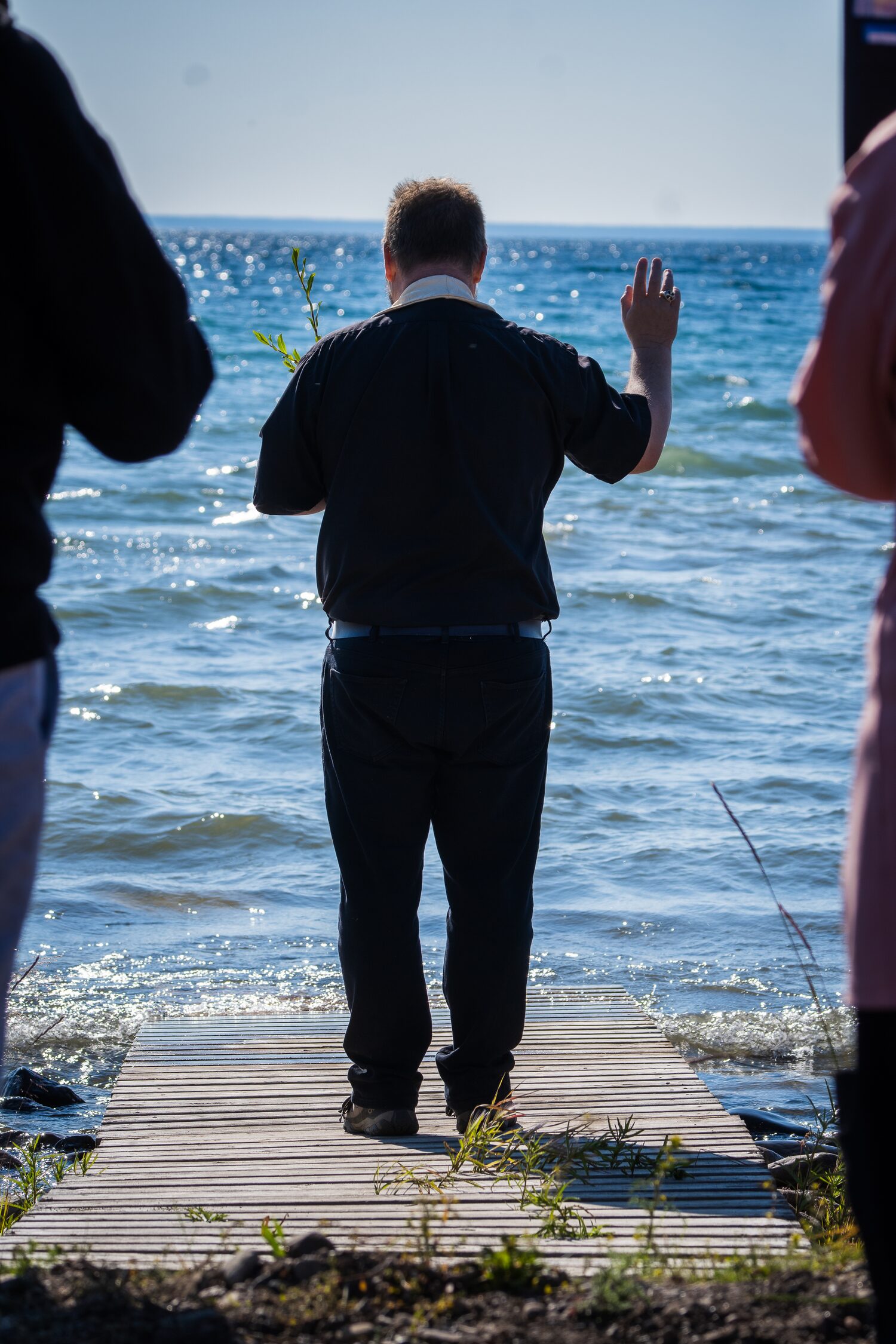
Newehtsine, our Creator, is filtered and flows through generations of colonization.
Today we are born and baptized, live our lives, and are buried in wooden cribs, symbolic of our role as children of the Lord Jesus Christ.

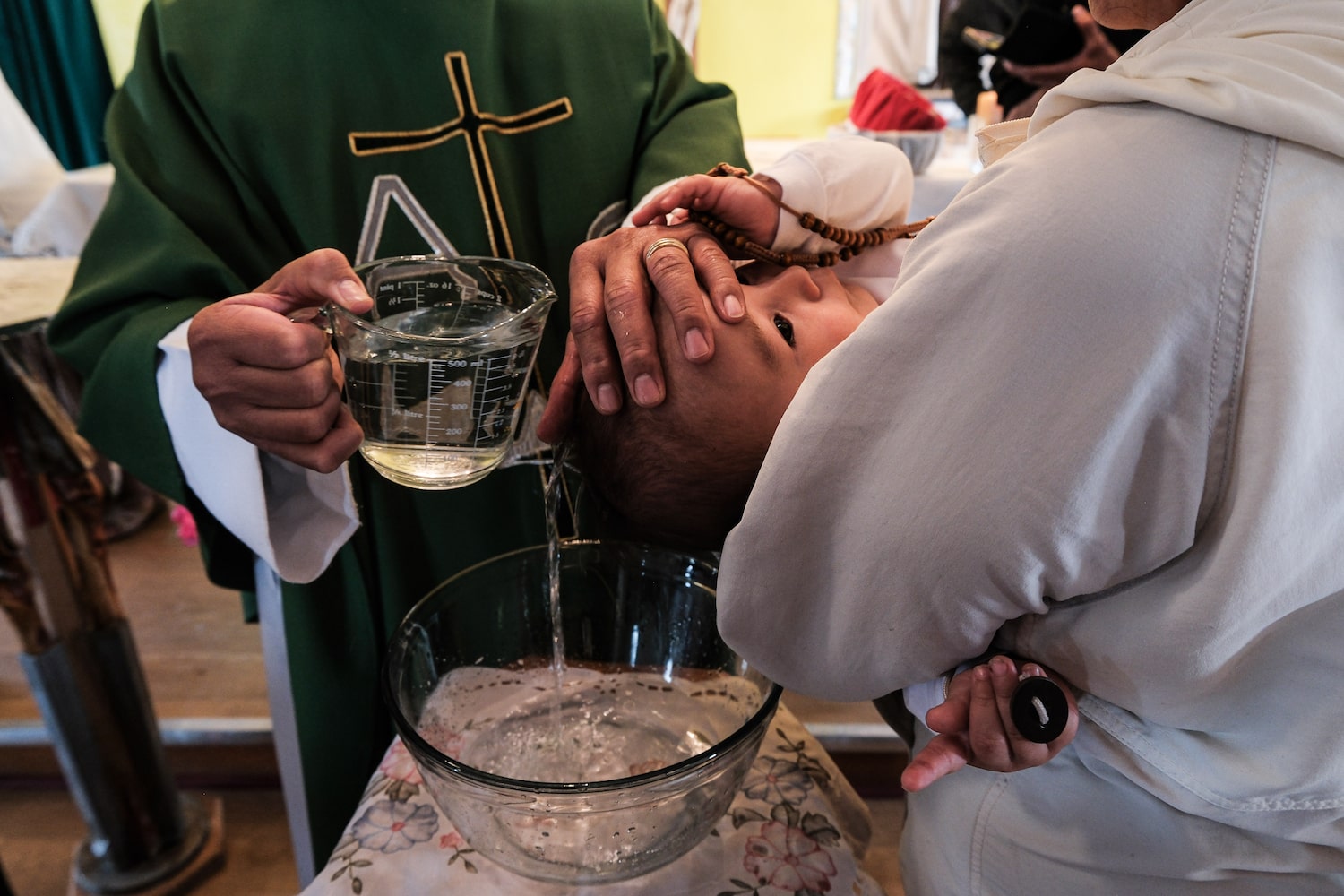


“I’ve spent most of my adult life working to protect our land, language and culture. I’ve also seen how these beautiful teachings were used by men as tools of harm – and that’s why I’ve struggled with having any relationship with the church at all.”
“So I need to figure out how I can have a relationship with Newehtsine in a way that makes sense for me, while respecting how my family prays. It’s an ongoing journey – my perspectives are still shifting as I spend time with David and my family.”
“As Indigenous Peoples, we already face so much institutionalized racism and violence. Our people are hurting. Being told you’re born a sinner, that mentality has been really damaging to our people. How can we raise strong, healthy people in a world designed to tear us down, if at our core we’re told we’re sinners?”
“I don’t see other kids my age when I go to church.”
Taylynn is my 17-year-old cousin, and we are chatting as we drive around town Sunday.
We chat about our beliefs in Newehtsine, the Creator.
“The rocks have a spirit. The trees have a spirit. The animals, the plants, the water – all have spirit,” she says.


“I feel drawn to that. I tried to pray in church when I was having a hard time, but it felt empty, like I was defeated. But at a drum dance, listening first to David talk about God, and then hearing the songs; when it finished, I just felt good inside.”
“To find peace between the two, Newehtsine and God, I think I’ve convinced myself, and I do believe this, like, they’re the same person. God created the world, He created us. And our Creator did the same.”
We sit outside the culture centre on the last evening of the gathering.
“The first time I learned about residential school, I was like, they did what? I was so angry. My family was very faithful – every day at five o’clock my grandpa rang the church bell, and the whole place was packed with elders praying the rosary in our language.”
“So I was going to convince them. I thought they just didn’t know. And then after school, I’m telling my grandpa that they did all of these things and they don’t like Indians. I was so heated.
“My Elder Alfred told me, ‘What is ours and will serve us as Dene people, we have to pick up again. What isn’t ours, we have to just place down. In the ways that we pick up and leave those things, we make what is ours stronger.’”
“It was through these teachings and my journey, I set the foundation of an unshakeable faith. A faith in Creator, our prophets, as Dene and Catholic. The Word says, “Let God be true and every man a liar.” To me this means to seek out the truth for yourself. If you really want it, you will find it, or it will find you.”
“So I have a responsibility to pass on what was given to me from my grandparents. What happens outside of me is other people’s journey. The only real impacts you make are making people feel seen and heard and sharing space.”
“Love is the truth. That’s how I see the world.”

For me, there is no complete answer, no great epiphany surrounding my grandfather’s message. Only that the crisis of Deh and Neh, the old and new ways, and now, Christ and the Creator, pull at me with a fresh intensity that must be the embers of a fire inside I thought long burnt out.
I have come to the graveyard as the sun sets on my trip. I have one final stop.
I place a hand each on the cribs of my grandfather and of my mother, Cheryl. She is buried alongside him, surrounded by family.


However tempted I am in this moment, I do not bother them with my question.
They are at peace.
And in the stillness of this moment, as the distant drums of the closing ceremony swell and rosary beads jingle and sway gently on the wind, I am at peace too.

Tate Juniper, or Tatsǫ́, is a member of the Délı̨nę First Nation's Band. He has a diverse background in finance, economics, the electrical trade and visual storytelling. In 2021, Tate began the videography project We Are The First, driving 45,000 kilometres to take portraits and record stories from Indigenous communities across America.
He is guided by the belief that authentic representation comes through conversation and listening, and seeks to demystify what it means to be a contemporary Indigenous person.

- Photography and story by Tate Juniper
- Editing by Lisan Jutras
- Photo editing by Merle Robillard
- Video editing by Deborah Baic
- Visuals editing by Solana Cain and Liz Sullivan
- Interactive design and development by Christopher Manza