A year-long series looking back on the most significant moments of the past 25 years, how they changed our world, and how they will continue to shape the next 25.
Jacob Mchangama is the founder and executive director of the Future of Free Speech, research professor at Vanderbilt University and Senior Fellow at the Foundation for Individual Rights and Expression. He is the author of Free Speech: A History from Socrates to Social Media.
On Sept. 30, 2005, the Danish newspaper Jyllands-Posten ignited a global firestorm when it published 12 cartoons – some depicting the Prophet Muhammad – under the headline, The Face of Muhammad. What began as a challenge to self-censorship in a secular democracy quickly escalated into an international crisis that reshaped geopolitical fault lines, redefined legal boundaries, and, perhaps most profoundly, tested the resilience of liberal democracies against the rising tide of religious extremism and demands for censorship.

Jyllands-Posten’s cultural editor, Flemming Rose, commissioned the cartoons to challenge what he saw as an emerging climate of fear, in which the threat of violent retaliation for offending religious sensibilities was already influencing public discourse in liberal democracies. In 2004, the Dutch filmmaker Theo Van Gogh was shot and stabbed to death on the streets of Amsterdam by an Islamic fundamentalist, due to Mr. Van Gogh’s Islam-critical film Submission. Later that year, three Muslims became offended by and beat a Danish university lecturer who had recited from the Koran during a class. In 2005, a Danish stand-up comedian admitted that he was too afraid to poke fun at Islam while a Danish children’s author announced that he couldn’t find cartoonists for a book about the Prophet Muhammad. Accordingly, Mr. Rose tested the extent of self-censorship by asking various cartoonists to depict Muhammad as they saw him.
Mr. Rose wrote an accompanying essay entitled Freedom of Expression. His aim was not gratuitous offence or anti-Muslim bigotry, but to defend the foundational principle that free speech must apply universally – including to ideas some may deem sacred, regardless of whether they belong to a minority or not. Therefore, Mr. Rose argued, affording special protections for Islam and Muslims was “incompatible with a secular democracy and freedom of speech, where one must be prepared to endure mockery, scorn, and ridicule.”
As Mr. Rose recently told me, the cartoons were based on the premise that freedom and equality go hand in hand and that Muslims should neither suffer discrimination, nor enjoy special privileges, as equal members of Danish society.
In Western Europe, and in an extremely secular and liberal country like Denmark, where I’m originally from, this seemed like an uncontroversial and long-settled idea – a principle vindicated during the Salman Rushdie affair of the late 1980s, when, despite some debate, most Western intellectuals, writers, and public opinion sided with Mr. Rushdie over Iran’s Ayatollah Khomeini’s fatwa calling for Mr. Rushdie’s death.
Like the Rushdie affair, the cartoon crisis transformed a local debate into a global reckoning over free speech, censorship, and religious sensitivities – one whose aftershocks continue to shape Western democracies two decades later.
From Local Controversy to Global Crisis
In Denmark, the immediate response to the cartoons was relatively subdued. While many criticized the decision to publish them as unnecessarily provocative, others defended Jyllands-Posten’s right to publish images that some might find offensive.
The global reaction, however, soon spiralled out of control with waves of violent protests across the Muslim world. Turkish Prime Minister Tayyip Erdogan gave an early warning during a visit to Denmark in November, 2005. At a news conference, Mr. Erdogan insisted that “freedom of expression is important, but more important is what is holy for me” and that the cartoons “fuel conflict.”
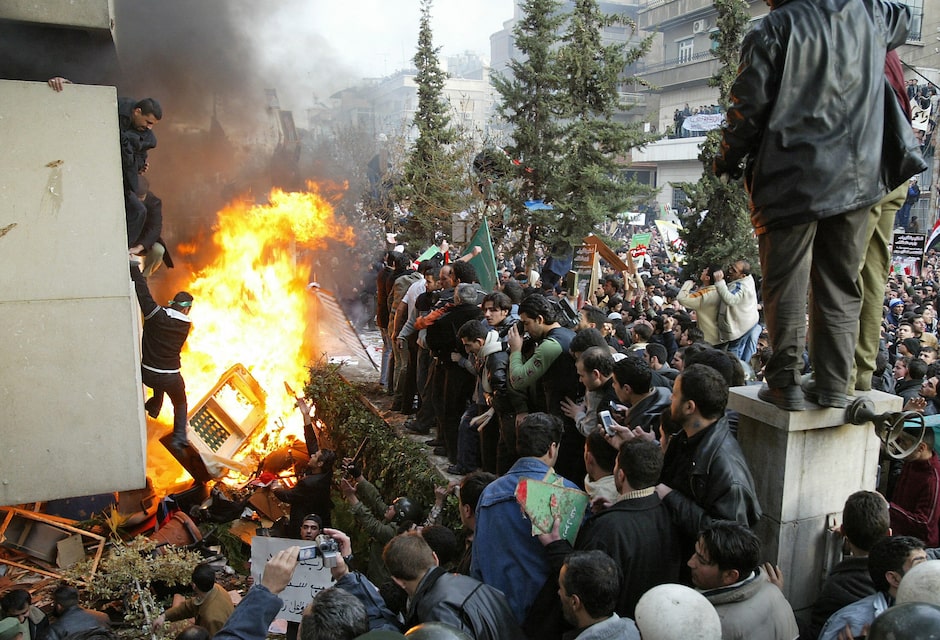
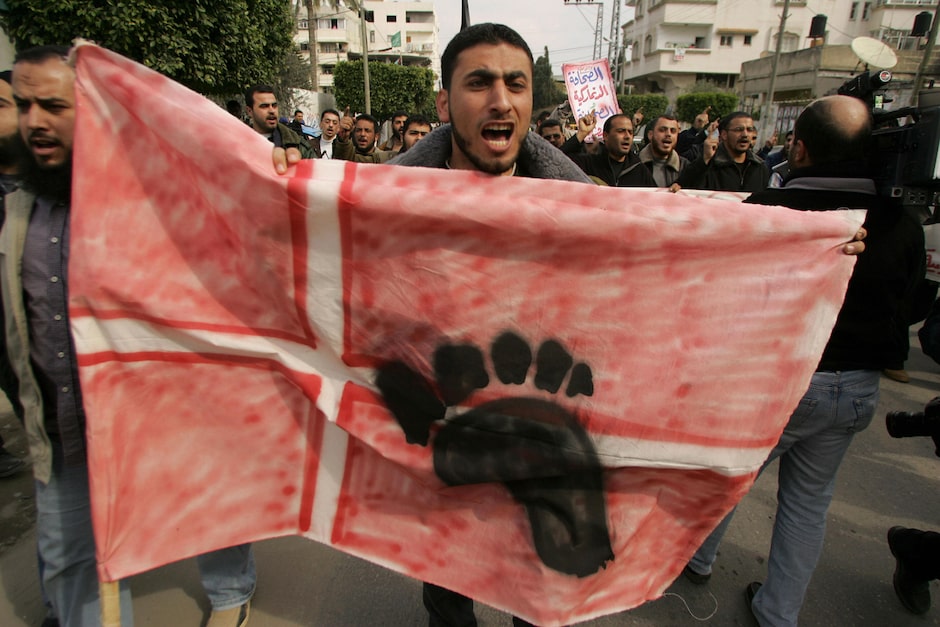
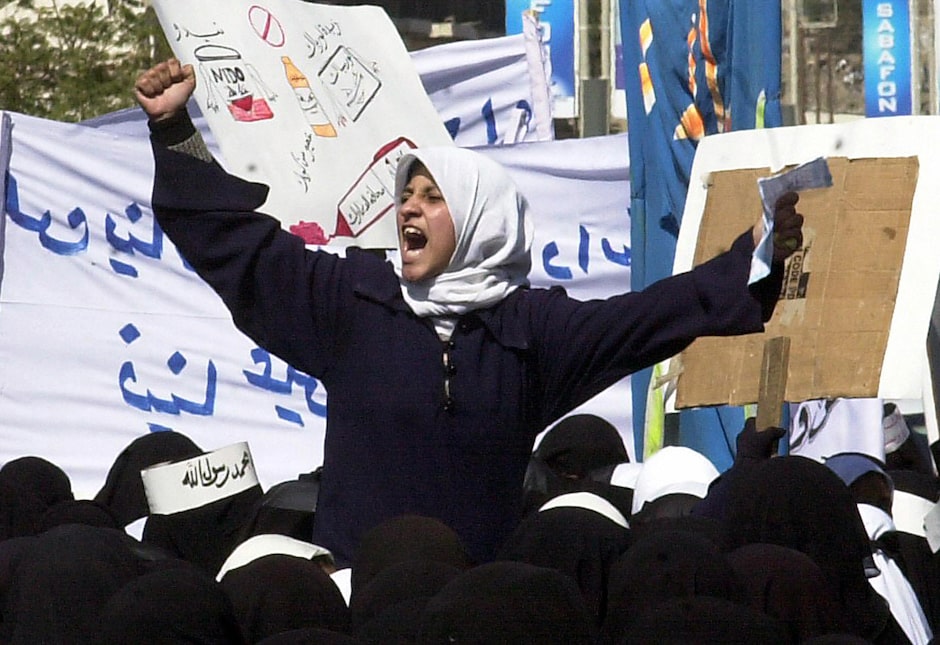
His warning was prophetic. In early 2006, demonstrations erupted in cities from Cairo to Jakarta. Danish embassies were attacked, set ablaze, and several Muslim countries put pressure on the Danish government to intervene and punish Jyllands-Posten. Riots led to the deaths of more than 200 people, while calls for boycotts of Danish products rippled across the Muslim world.
September 30, 2005
The Danish newspaper Jyllands-Posten published cartoons depicting the Prophet Muhammad. The outrage spread globally and grew over months.
File photos: AFP via Getty Images

Thousands protest in Trafalgar Square in London on Feb. 18, 2006.
Yet the global reactions were neither spontaneous nor organic. This campaign was not primarily driven by grassroots outrage, but by geopolitical calculations. Governments in countries like Turkey, Egypt, Pakistan and Iran seized on the opportunity to rile up reactions and appeal to disaffected hard-liners at home and the wider Muslim community abroad.
As the global fallout intensified the pressure on Denmark was ramped up. Editors and cartoonists involved in publishing the drawings received death threats and were forced into hiding under police protection. In the following years, security services thwarted multiple terrorist plots against Jyllands-Posten, including a particularly gruesome plan to infiltrate the newspaper’s offices, behead its staff members and display their severed heads in a public square as a grisly warning to others who might challenge Islamist taboos. Kurt Westergaard, the cartoonist who penned the most controversial of the cartoons depicting Muhammed with a bomb in his turban, only saved his own life by fleeing into a panic room when attacked in his own home by an axe-wielding vigilante.
The Organization of Islamic Cooperation (OIC), an intergovernmental body representing 57 Muslim-majority countries, also seized on the publication of the cartoons as an opportunity to assert international pressure on Western democracies. What followed was a carefully orchestrated campaign to frame the cartoons as not just offensive to Islam, but also as racist hate speech.
Consequently, the cartoons provided further fuel to a long-standing OIC campaign at the United Nations to have “defamation of religions” prohibited under international human-rights law. At a high-level summit in Saudi Arabia in December, 2005, the OIC expressed “concern at rising hatred against Islam and Muslims and condemned the recent incident of desecration of the image of the Holy Prophet Muhammad in the media of certain countries” as well as over “using the freedom of expression as a pretext to defame religions” and called on all UN member states to criminalize such offences.
By invoking existing provisions in international human-rights law – particularly Article 20 of the UN’s International Covenant on Civil and Political Rights (ICCPR), which prohibits “advocacy of national, racial or religious hatred that constitutes incitement to discrimination, hostility or violence” – the OIC aimed to buttress their calls for global laws against blasphemy by characterizing the cartoons as a manifestation of impermissible hate speech.
Western intellectuals, human-rights organizations, and even some governments sometimes aided the OIC’s efforts by blurring the line between blasphemy and hate speech. In 2006, the Nobel Prize–winning German writer Günter Grass compared the Danish cartoons to the virulently anti-Semitic cartoons in Julius Streicher’s Nazi magazine Der Stürmer. But this analogy ignored the fact that the universalist defence of free speech and tolerance motivating the cartoons was the antithesis of Streicher’s genocidal commitment to a racially pure one-party state.
Meanwhile, Amnesty International released a statement titled Freedom of Speech Carries Responsibilities for All that failed to support Jyllands-Posten against calls for censorship and even suggested that the cartoons might violate the ICCPR’s Article 20 as constituting “hate speech.” Such a position was entirely at odds with Amnesty’s traditional advocacy of free speech as encompassing the right to offend religious ideas, and its support of Muslims targeted by blasphemy laws by their own governments and religious institutions.
EU Commissioner for Justice and Security Franco Frattini floated the idea of a European code of conduct for the media when reporting on Islam and other religions to ensure that “the press will give the Muslim world the message: we are aware of the consequences of exercising the right of free expression, we can and we are ready to self-regulate that right.”
Even the U.S. State Department under the Bush administration initially sided with the OIC. In February, 2006, a spokesperson said, “we all fully recognize and respect freedom of the press and expression, but it must be coupled with press responsibility. Inciting religious or ethnic hatreds in this manner is not acceptable.”
Ironically, those most likely to suffer from such expanded definitions of hate speech were Muslims living in Muslim majority countries. Take, for example, Jihad Momani, the editor-in-chief of the Jordanian newspaper al-Shihan, which was the first Arab paper to republish cartoons that enraged many people who had never even seen them. Mr. Momani wrote an editorial asking the question, what hurts Islam the most: an offensive cartoon or beheading hostages with a sword? Soon after he was sacked and then arrested by the police.
Amid rising far-right anti-Islamic sentiment, Western democracies struggled to counter the OIC’s successful UN resolutions on “defamation of religion.” Yet, the tide started turning in 2009 when the Obama administration rejoined the UN’s Human Rights Council. Through diplomatic pressure and incentives, the State Department – backed by European allies – launched a co-ordinated counteroffensive that steadily eroded OIC support.
By 2011, the OIC had abandoned its resolution. The U.S. then secured passage of a speech protective resolution, which affirmed that human-rights law protects people, not religions or ideologies. While it “condemned” advocacy of religious hatred, it only called for criminalizing “incitement to imminent violence based on religion or belief” – language reflecting the U.S. Supreme Court’s very high standard for punishing speech under the First Amendment.
The Rise of Violent Intimidation: From Charlie Hebdo to Samuel Paty
While the OIC’s campaign to outlaw “defamation of religion” through international law seemed to have failed, the battle over blasphemy did not end in diplomatic corridors – instead, it was increasingly enforced through the barrel of a gun, as extremists took it upon themselves to silence critics with threats, attacks and assassinations.
In February, 2006, the French leftist satirical magazine Charlie Hebdo republished Jyllands-Posten’s cartoons alongside their own caricatures of Muhammad, including one with the headline, Muhammad Distraught by Extremists, and the caption, “it’s tough being loved by idiots.” This was par for the course for Charlie Hebdo, which had a long tradition of mocking Christianity, including the Virgin Mary, Jesus and the Pope. The magazine had successfully beaten a dozen legal challenges from Catholic organizations, and French courts also sided with Charlie Hebdo when an Islamic organization sued the magazine for insulting Muslims.
In October, 2011, Charlie Hebdo once again published cartoons of Muhammad following the election victory of an Islamist political party in Tunisia. But this time the magazine’s enemies would not resort to legal measures. The following night Charlie Hebdo’s headquarters were firebombed and burned down. Alas, this was but a prelude.
On Jan. 7, 2015, two French-Algerian brothers armed with AK-47s stormed the magazine’s Paris offices, murdering 12 people, including some of France’s most celebrated cartoonists. The attackers, who claimed allegiance to al-Qaeda’s Yemeni branch, were clear about their motive: This was vengeance for Charlie Hebdo’s repeated insults of the Prophet.

A woman holds a candle and a poster reading 'Je suis Charlie' (I am Charlie) during a spontaneous vigil in front of the French embassy in Berlin on Jan. 7, 2015. Participants expressed solidarity with employees of the French satirical weekly, Charlie Hebdo, after they were attacked by gunmen.Getty Images
The attack sparked global outrage and solidarity. Millions marched through the streets of Paris in defiance, holding signs that read Je suis Charlie – an affirmation that the right to offend and criticize must be defended, even in the face of violent intimidation.
Yet even as the slogans of solidarity echoed around the world, cracks were beginning to show in the West’s commitment to these principles. Some intellectuals and commentators began questioning whether Charlie Hebdo’s satire had crossed a line, accusing the magazine of “punching down” on France’s marginalized Muslim population. A group of prominent authors even protested when the magazine was awarded a PEN America free-speech prize, arguing that honouring Charlie Hebdo would “valorize selectively offensive material.”
The chilling effect deepened five years later with the murder of Samuel Paty, a French school teacher who was beheaded by a radicalized teenager after showing his students the Muhammad cartoons during a civics lesson on freedom of expression. Mr. Paty had even gone out of his way to allow students who might be offended to leave the classroom or avert their eyes – a gesture of respect that did nothing to spare him from becoming a target.

Relatives and colleagues hold a picture of Samuel Paty during the 'Marche Blanche' in Conflans-Sainte-Honorine, northwest of Paris, on Oct. 20, 2020. Mr. Paty, 47, was attacked in a Paris suburb on October 16 for showing pupils cartoons of the Prophet Mohammed. Following the attack, tens of thousands of people took part in rallies countrywide to honour Paty and defend freedom of expression.Getty Images
After the attack on Charlie Hebdo in 2015, the French government declared free speech inviolable, just as President Emmanuel Macron vowed not to give up the right to blaspheme or compromise the Enlightenment values of free speech and tolerance that Samuel Paty embodied. But in the fight against extremism and terrorism, free speech would not be the Fifth Republic’s weapon of choice.
Instead, France would severely limit the very freedom it was committed to protect. In 2015, according to Human Rights Watch, French authorities launched more than 2,300 cases of “apology of terrorism,” which doesn’t require that speech reaches the threshold of incitement, but merely that of praise or apology for terrorism. In 2016, 306 people were convicted and 232 received prison sentences.
Some of the examples are striking. An 8-year-old was questioned by police on Jan. 28, 2015, following remarks made in class on Jan. 8, the day after the attack on Charlie Hebdo; in 2016 an 18-year-old received a three-month suspended sentence for naming his Wi-Fi network “DAESH 21″; and a vegan activist was convicted for a Facebook post applauding the death of a butcher in a 2018 terrorist attack.
The misuse of “apology for terrorism” laws has become particularly evident in the aftermath of Hamas’s devastating attack on Israel on Oct. 7, 2023. Prominent members of civil society, including politicians, academics, journalists and trade union leaders, have found themselves under investigation – not for inciting violence but for speech that falls well short of this threshold. The French government’s crackdown on apology of terrorism disproportionately affected French Muslims, fuelling a sense that the Fifth Republic’s defence of free speech was selective with different standards applied to criticism of Islam on the one hand, and the French government and its foreign policy on the other.
In an ironic twist, in October, 2024, former Charlie Hebdo journalist and outspoken critic of Islamic fundamentalism, Zineb El Rhazoui – who lives under French police protection – found herself under criminal investigation initiated by Interior Minister Bruno Retailleau. The charges? Describing Hamas as a “resistance movement,” failing to explicitly condemn the Oct. 7 attacks, and comparing Israel to a “terrorist state.” The investigation highlighted the state’s arbitrary power to target those diverging from official positions on foreign and domestic policies, sacrificing the principle of free speech along the way.

Zineb el Rhazoui, a French-Moroccan journalist who formerly worked at Charlie Hebdo, looks on at the "Tribunal de Paris" courthouse in Paris on Sep. 9, 2020 during the trial of 14 people accused of helping jihadist gunmen attack the French satirical weekly Charlie Hebdo and a Jewish supermarket five years earlier.Getty Images
Alas, France would not be the only country to sacrifice freedom in the hope of gaining security. In 2017, Denmark abolished its long dormant blasphemy ban. Then-Danish prime minister Lars-Lokke Rasmussen, proclaimed: “I’m proud and happy that we live in a country where we have abolished the blasphemy provision and where you’re allowed to be critical – even in satire and cartoons – of religious symbols.” This was a major victory for free speech in the very country where the cartoon crisis began and where, just a month after the Charlie Hebdo attack, a deadly terrorist assault targeted a debate on blasphemy and free expression. The repeal of the blasphemy ban signalled a broad consensus in Danish society: Religious sensitivities did not warrant special protections and democratic societies must not surrender to threats and intimidation.
Yet, following a spate of Quran burnings by Danish far-right protesters, that revived the OIC campaign and terrorist threat against Denmark, Mr. Rasmussen – now minister of foreign affairs – did an about-face. The Quran burnings had become so bad, he said in 2023, that Denmark is “seen as a country that supports the insult and denigration of other countries and religions.”
In response, Mr. Rasmussen announced legislation “that will allow us to put a stop to the kind of insult and denigration we are currently witnessing.” Later that year, the Danish parliament passed a new law penalizing the “improper treatment of scriptures” with up to two years in prison. In effect, this was the reintroduction of the recently repealed blasphemy ban, albeit with a more limited scope.
The Danish law was not only a rupture with that country’s previous stance on free speech. It signalled a larger shift toward accommodation with the very forces that Danish governments had refused to give in to during the cartoon affair.
Only months prior, the OIC had used the Danish Quran burnings to achieve a stunning victory at the Human Rights Council with a resolution condemning the desecration of holy texts as “religious hatred constituting incitement to discrimination, hostility or violence.” The resolution passed with support from authoritarian regimes such as China, Russia and Saudi Arabia. In other words, the OIC had successfully revived the “defamation of religion” agenda through different means. And as an unexpected bonus, Denmark – the very country that the OIC had tried so hard to bring to heel during the cartoon affair – had internalized the new red lines in domestic law.
The deeper tragedy of the Muhammad cartoons affair is not just the lives lost to extremist violence, or the physical threats faced by those who exercise their right to free expression. It is the growing realization that democracies – once the champions of free speech – are now increasingly retreating from their own principles.
The notion that free speech must sometimes be curtailed to preserve social harmony or prevent offence has become a prevailing sentiment in many liberal societies. The chilling effect of violence has been compounded by legal restrictions and a rising culture of self-censorship in academia, journalism and the arts.
In this new climate, the “veto of violence” has become a potent tool. By threatening or committing acts of violence, extremist groups – and, increasingly, authoritarian states – can shape the boundaries of acceptable speech in open societies. In doing so, they undermine the very freedoms that liberal democracies were built to protect. The January, 2025, assassination of Iraqi refugee Salwan Momika in Sweden is the most recent example of this development. Swedish authorities, bowing to pressure from the OIC and religious extremists, had charged Mr. Momika and a fellow Iraqi refugee with incitement to hatred for burning Qurans in Stockholm. Yet the legal prosecution did nothing to protect him – Mr. Momika was gunned down in his own apartment just days before his verdict. In a twist of bitter irony, his co-defendant was subsequently found guilty and fined for expressing the very same viewpoints that had cost Mr. Momika his life. The absurdity is stark. In an open democracy, peaceful expression – however provocative – was punished twice: first by the state’s legal apparatus, then by an assassin’s bullet that the state failed to prevent.
If the past two decades have taught us anything, it is that the price of free speech cannot be dictated by fear. When democracies fail to defend their most fundamental freedoms, they embolden those who would replace debate with violence. The question is no longer whether free speech is under threat – it is whether we have the will to defend it before it further erodes.
Unfortunately, the immediate future of free speech in open democracies appears bleak. European nations have grown increasingly reluctant to defend this fundamental right, while the United States – traditionally the global champion of unfettered expression – has transformed its commitment to free speech into an exercise in doublespeak under Donald Trump’s administration. When JD Vance rightfully criticized European speech restrictions in Munich earlier this year, his words rang hollow against the backdrop of the U.S. administration’s aggressive policies targeting students, universities, media outlets, and dissent broadly – actions that erode America’s historical commitment to free-speech exceptionalism both domestically and internationally. Neither Mr. Trump nor Mr. Vance has shown interest in promoting freedom of expression in foreign policy, preferring instead to antagonize European democracies while remaining conspicuously silent about the sophisticated censorship regimes of Vladimir Putin and Xi Jinping – regimes now shaping international norms without American opposition.
Yet history offers reason for cautious optimism: Since its birth in Athenian democracy 2,500 years ago, free speech has weathered countless threats. Time and again, societies have needed to experience freedom’s absence before mobilizing to protect what remains our most essential human right and democratic freedom.