A year-long series looking back on the most significant moments of the past 25 years, how they changed our world, and how they will continue to shape the next 25.
Simon Winchester’s most recent book is The Breath of the Gods: The History and Future of the Wind. His previous books include The Professor and the Madman, The Men Who United the States, The Map That Changed the World, The Man Who Loved China, A Crack in the Edge of the World, and Krakatoa. In 2006, he was made an officer of the Order of the British Empire.
It was a Christmas morning like no other, that mid-pandemic day in 2021. True, there were the usual living-room delights: the tree, the decorations, the tempting packages, the new-lit fire, carols on the radio, glorious scents wafting in from the kitchen. Excited children in pyjamas. The family dog, bewildered and glitter-dusted.
But then, just before 7:20 a.m., we turned our attention to the moment for which all had prepared. The room fell suddenly silent. All eyes turned to the TV screen, with its unseasonable scenes of gantries, palm trees and, front and centre, a giant pure-white space rocket, the Ariane 5. The crawler told those who didn’t know that we were in South America, at a place called Kouro, in the French colony of Guiana. A satellite launching centre.
First came the clipped voice of an announcer, the range operations manager, a French official named Jean-Luc Voyer:
“Cinq. Quatre. Trois. Deux. Unité. …”
Then a pause, a huge void-filling sound, and a triumphal “Décollage!” – liftoff. And even the younger children joined the cheers as an enormous roar swelled into the room, and we watched, as open-mouthed as in earlier launches we used to be, at the alabaster rocket rising through its immense cloud of smoke.

Arianespace's Ariane 5 rocket with NASA's James Webb Space Telescope onboard lifts off from the launchpad at Europe's Spaceport, the Guiana Space Centre, in Kourou, French Guiana, on Dec. 25, 2021.JODY AMIET/AFP/Getty Images
The James Webb Space Telescope was on its way.
Ahead of it unspooled a 1.5-million-kilometre voyage “from a tropical rain forest to the edge of time itself,” as another voice, this time American-accented, put it: “A voyage back to the birth of the universe.” And all hyperbole aside, we knew as we resumed our seasonal duties that we had just witnessed something quite historic and extraordinary – if, that is, it worked.
If.
For the next two weeks those of us who had become well-nigh obsessed with the seeming never-ending birth story of James Webb held our collective breath. There were, we were told, no fewer than 344 potential points of failure between launch and arriving at its destiny, tiny things that could go wrong and in so doing doom the entire US$10-billion dollar, quarter-century-long project. But if they were each overcome, one by one, then the telescope – which would start its estimated 20 years of working life at its lonely orbital home-base in deep space known as the L2 Lagrange Point – would come to be regarded as an unarguably magnificent achievement of human science, engineering and co-operation.
In truth, the Webb didn’t look much like a telescope.
Its predecessor, the Hubble Space Telescope, which had operated in a low Earth-orbit since its launch in 1990 – and is still going strongish today – was a long silver tube that did look much like something Galileo might have worked on to check out some planets and galaxies.


But models of Webb looked, well, odd. Its dominant feature was a tennis-court-sized sunshield, a delicate stack of a half-dozen ultrastrong but gossamer-light and drum-tight sheets of a plastic called Kapon, which had to be deployed right from the get-go, to keep the rays of the burning sun from ruining the instruments inside the telescope body.
There was absolutely no guarantee the shield would hold while on its way into space: During testing as the sheets were tensioned by a spider’s web of finely positioned nylon cords, it experienced a rending tear and one of the sheets ripped from end to end, utterly destroying everything within a microsecond.
That was the first critical milestone for which we nail-biting Webb-watchers waited. It came when the craft was almost a week out. The seven-tonne package, nestled by origami specialists to fit snugly inside the Ariane’s rocket’s nose-cone, had by now unfolded itself and was getting ready for business, speeding well beyond the Earth’s gravitational pull and into the freezing silence of the cosmos. Would the sunshield’s million-dollar mille-feuille fail, as it had in the ice-cold vacuum chamber back on Earth, in Northrop Grumman’s Los Angeles test site?

The James Webb Space Telescope is secured on top of the Ariane 5 rocket on Dec. 11, 2021, in preparation for launch.Stephane Corvaja/The Associated Press


The answer came six days later, by which time the spacecraft, much of it by now unfolded but the whole contraption still looking nothing like a telescope, was still plowing on. I received an e-mail on New Year’s Eve, a week after launch, from Matt Mountain, the splendidly named British astronomer who designs and runs big telescopes for an array of universities around the world.
His message was exultant: Each of the sunshield’s components had been opening up very, very gingerly, “all 197 inches of each sheet at 1.7 inches a minute” – and had done so just impeccably. Not a rip, a tear or a nick could be found. And all the while the craft had been rushing away from our planet at unimaginable speeds while signalling its progress every inch of the way. Success, Dr. Mountain declared: “Not a bad way to end the year!”
And much the same conclusion was to be reached after every single one of the 340-odd subsequent moments when Webb could and might have failed: all the struts, wings, radiators, flaps, aerials, covers, and sundry other complex systems unfolded themselves and were automatically locked into place while computers silently loaded each with then necessary data to permit calibration to begin once they reached their observing station.
All of which could only properly begin once the mirrors – 18 gold-plated beryllium hexagons all manufactured in Colorado by Ball Aerospace, a subsidiary of the domestically-familiar Ball glass-jar company that makes home-pickling containers, and all of which had been folded and pleated to look like a brilliant yellow Issey Miyake fashion item – had been unyoked and successfully transformed into one mighty mirror. Which was concluded, two weeks out and to the immense satisfaction of all, Matt Mountain included, back on the ground in Webb’s operations room at Johns Hopkins University’s Space Telescopes Science Institute in Baltimore.

Technicians lift the mirror of the James Webb Space Telescope using a crane at the Goddard Space Flight Center in Greenbelt, Md., on April 13, 2017.Laura Betz/The Associated Press
Finally, two still-further weeks later, at the end of January, 2022, and with the device now almost exactly one million miles out from our then-pandemic-wracked planet, Webb shifted its gears into park, snapped on its handbrake, came to a silent halt and started to think about work.
There remained six months more of the aforementioned calibration and sufficient time to allow the instruments’ slow adjustment to the eccentric thermal environment of its new surrounding. By Earth’s Northern Hemisphere’s high summer, when Baltimore was steaming and French Guiana quite impossibly hot, the James Webb Space Telescope began sending infrared images – and a host of other kinds of information – back down to Earth.
Doing, in other words, what it was designed, supposed and required to do.
Ten billion dollars and the better part of 30 years’ worth of high-tension engineering later, how did it do?
Universally, Webb is being seen today as a triumph, a stunning success, more than deserving to be included, maybe primus inter pares, in the lists of the millennium’s most notable global achievements. It had all worked as it was deploying itself; and without a hiccup, measurable or audible, it has since performed as spectacularly as the most ambitious of astronomers’ might have wished. The pictures wired back to the Maryland receiving stations, for example, have wildly exceeded all expectations.
Take, for example, the famous photograph of what are known as the Pillars of Creation. This enormous trinity of backlit elephantine gas clouds (four or five light-years tall) is secreted away in the Eagle Nebula in the middle of the Northern Hemisphere’s Serpent constellation, more than 6,500 light-years away from us.
Their size and distinctive shape make them quite visible; they were first seen in the 1920s and were spotted on a black-and-white photographic plate made around then by the Mount Wilson observatory in California. But then they stunned the world when they were photographed in full colour and in apparent 3-D by Hubble in 1995: every serious magazine known had this strangely unforgettable image on its cover – the image from space and of space and somehow very visibly the defining image of the origin of stars. This was a photograph to rival Earthrise, and that of the untethered astronaut Bruce McCandless II floating alone in the eternal black emptiness of the universe, fragile and vulnerable and awe-inspiring. It changed our perception of everything, put us all in a brand-new context.


But then, in 2022, Webb took the same image of the Pillars, and the world did a collective double-take. In an instant we all came to understand how much finer a telescope this was. For yes, the elephantine structures were still there, but now they were ghostly and translucent and filled to bursting with multicoloured stars and galaxies and nebulae and all of them quite visibly and dramatically in the very process of creation and destruction, just as the astronomers had foretold they would be, but had been unable to confirm because they had never actually seen anything going on in the relative imprecision of the Hubble imagery.
This, however hackneyed though the phrase might be today, represented a true quantum leap in deep space observation.
And this was merely the first of thousands, as over the days and weeks and months since, the now fully operational, calibrated, temperature-stable, sun-shielded, totally assembled Ball-jar mirrored and precisely aligned Webb proved itself to be a workhorse of wonders. I sometimes fancy that I hear an echo of the reply to Lord Carnarvon’s famous 1922 question to Howard Carter at the doorway of King Tut’s tomb in Egypt’s Valley of the Kings. “Can you see anything?” he asked as he made the first crack in the doorway. “Yes,” replied Carter as his eyes adjusted to the gloom inside. “Yes – wonderful things!” Webb is proving itself to be a true cosmic archaeologist, and what we are seeing now is the first true glimpse of our immense home territory, all the way back to its beginning. Wonderful things are starting to reveal themselves.
Yet before we get too carried away with exuberance of our own verbosity, there is a distinction that perhaps needs to be made, in any current assessment of Webb’s performance. It is a distinction between the telescope’s discoveries, successes and triumphs that are reckoned wonderful to the astronomers who command the experiments, and those that are wonderful to us, including the humble taxpayers, who have patiently footed the billions in bills for the past quarter-century.
Matt Mountain, the principal curator of the telescope’s science programs, offered two remarks to me when I inquired, and that sum up this distinction. The first reads as follows:
“The James Webb Space Telescope has peered back in time nearly 14 billion years, finding numerous galaxies and energetic, almost naked black holes in place just a short time after the Big Bang, implying the Universe evolved much more rapidly than scientists expected.”
Which is – and I mean no disrespect to the scientific community – all well and good, and shows how crucially important Webb is proving to be in letting us know how old our universe is. Whether this delights, troubles or concerns the multitudes who live within it – whether it truly matters – is questionable, all must surely agree.
But it is Dr. Mountain’s second assessment offered in his note to me, that seems to me the more important and relevant. It reads:
“Before JWST launched, we had discovered thousands of planets orbiting other stars, exoplanets. With JWST’s immense sensitivity, it is revealing that many of these exoplanets can be far weirder and more extreme than we expected. We can observe clouds of exotic metals in Hadean hellscapes, super-Earths that are perhaps hiding massive water worlds, and the hunt is now on to find small, temperate planets like our own Earth. So far, we have only found stripped rocky cores too close to their parent stars; however, JWST’s journey has only just begun.”
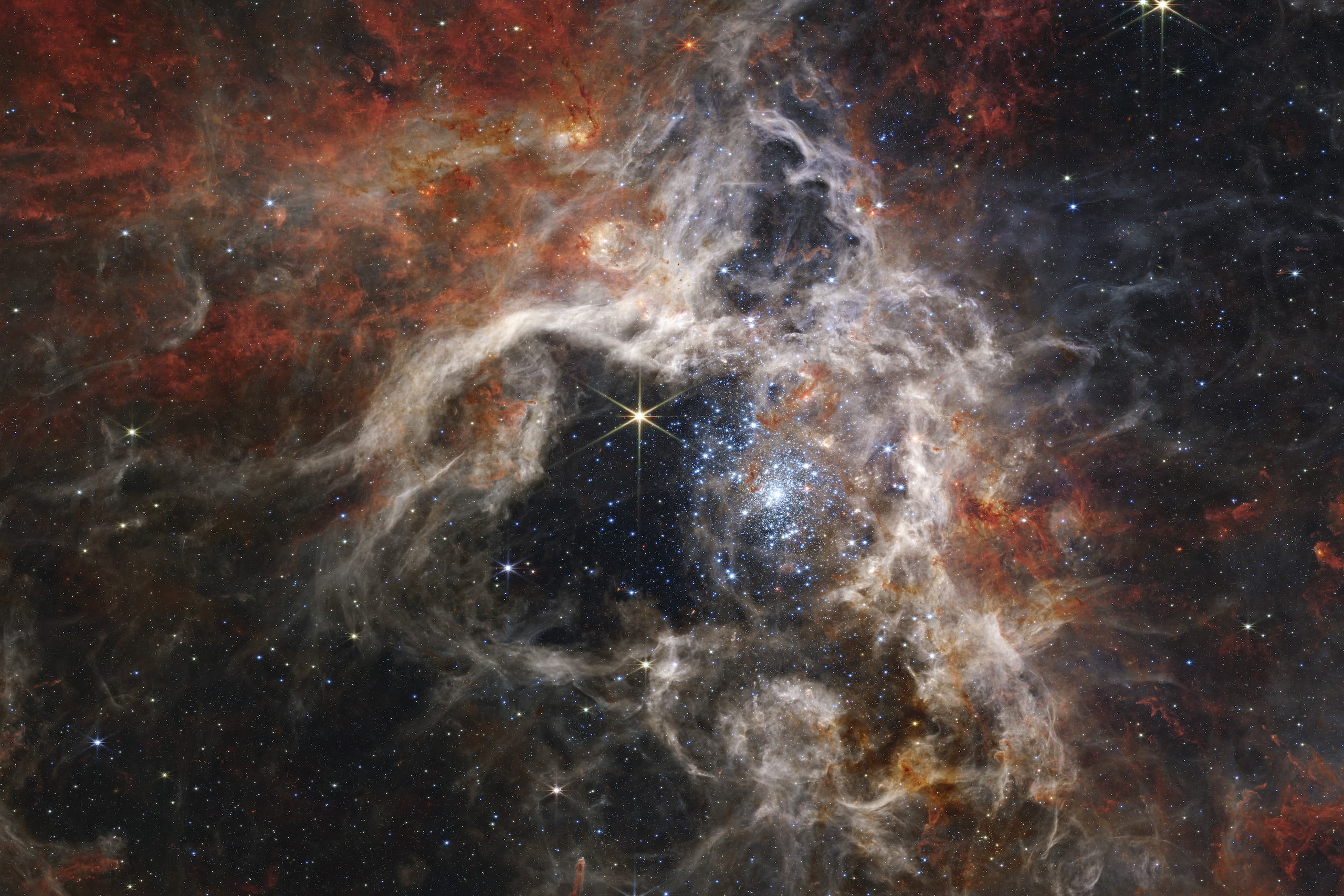
And therein lies a whole world of possibilities, to which each one of us can surely relate. Hadean hellscapes. Rocky cores. Super-Earths. Who knows what the new-found exoplanets might turn out to be? There might be other worlds like our own. There might be life forms. There might be creatures. There might be other versions of us. The implications of such a reality, were it ever to occur, are unimaginably profound, impossible to gainsay.
And while Webb’s technical abilities may not yet allow us soon to realize this in full, the telescope’s simple presence, hovering silently in the cold and dark of its orbit a million miles away, is reinforcing and underlining the speed with which our astronomical discoveries are being made. Soon, we may well come to learn the answer to the ultimate unspoken question that we, if silently, so wish the Webb to answer: if we are, or are likely to be and to remain, truly alone.
James Webb, launched so triumphantly on that recent Christmas morning, is pointing the way to handing humankind a gift of stupendous consequence. It is doing so with impeccable precision and, dare one say it, with a dignity wholly appropriate to the majestic possibilities of what it may one day encounter.