A year-long series looking back on the most significant moments of the past 25 years, how they changed our world, and how they will continue to shape the next 25.
Christina Sharpe is a writer, professor and Canada Research Chair in Black Studies in the Humanities at York University.
On May 25, 2020, George Floyd was brutally murdered by police in Minneapolis, Minn. I won’t name the cop(s) who killed Mr. Floyd. I won’t recount the harrowing details of his tortuous death. Such details would be another iteration of the brutal accounting that determines who is worthy of life and who isn’t. By now George Floyd’s name, his death, and the uprising it instantiated resonate all over the world.
I will say this: George Floyd had lived in the city of Minneapolis-Saint Paul for about four years. On the day of his death, Mr. Floyd was living his life – moving through his day when that life was taken from him.

George Floyd.Offices of Ben Crump Law/Offices of Ben Crump Law via The New York Times
According to several accounts, he had recently lost his job as a bouncer – laid off because of the closures and shutdowns of the COVID-19 pandemic. His life ended at the conjunction of a global pandemic and anti-Blackness. And here I use the present tense: His murder is specific and horrific and it meets a series of other events unfolding in 2020 and beyond, in which, if we are paying attention to history, we come to know intimately, again (and again) that there are sets of people (Black, Palestinian, Indigenous, Trans, unhoused, without papers) to whom seemingly anything can be done with impunity.
Perhaps the extended, excruciating murder of George Floyd, and the passivity on the policeman’s face (“placid as a country lake” writes Dawn Lundy Martin) against the cries from Mr. Floyd for his mother, for breath, for relief; perhaps the busyness, the bureaucracy by the other policemen around the murder-in-progress, the ordinariness of the setting, the lack of a confrontation – simply a murder unfolding in nine common minutes; perhaps the ubiquity of cellphone recordings, enough to make the event petrifying and ordinary – perhaps this explosive conjunction of the banal and the shocking activated the realities of all the coterminous and accumulated injustices that were being lived, perhaps this murder exposed momentarily the fundamental rot at the centre of capital and Western social life.

A protester carries a U.S. flag upside down as he walks past a burning building in Minneapolis on May 28, 2020, during a protest over the death of Mr. Floyd.Julio Cortez/The Associated Press
Mr. Floyd’s murder by police was a ghastly and singular event. It was also the latest in the ongoing series of quotidian and spectacular murders of Black people by police and what Frank Wilderson calls their deputized agents. Black people were grieving before May 25, 2020, and Black people continue to grieve.
If Western so-called liberal democracy had boasted the emergence of a “post racial” society, if it claimed that it was “law and order” that held back the worst of its racist, fascist instincts instead of activating them, the brutal killing of George Floyd undid that claim. His murder exposed those claims as false to a public usually unaffected by that undergirding system that, in fact, kept those forces vigorous. For some, the “publicness” of Mr. Floyd’s killing exposed the barely hidden liberal fallacies.
To witness these deaths is to witness the gaping hole in liberal democratic discourse around policing and so-called public safety. George Floyd’s voice and its extinguishing echoed around the world. It entered and met the others who were similarly placed in capital’s social and economic ecosystem. Those at the bottom. Those who are disposable.
That video of his murder, a video that I still refuse to watch because if I were to watch it, I know that it would undo me, but which I could not avoid hearing described in its terrible minutiae, identified the forces arrayed against living, and the people dying as a necessary result. This video was not the video of a war in progress, but it was the video of a war in progress. It was the video of an ongoing attack in which the police officer was familiar to the audience as a messenger and agent, a symbol of the state, and Mr. Floyd was familiar as the person being killed in that war, by that state.
The murder of George Floyd was both singular and cumulative.
A shock wave went through us. Not because we had not seen and experienced such violence before. But there was the extremity of it. The utter brutality of the white man who killed the Black man. The commitment of the white man, expressed in those interminable nine minutes and 29 seconds, to doing his “job.” The utter waste of life and the commitment to waste of life. There were condemnations after the fact. There were meetings scheduled with “leaders” who were not leaders. Then there were the dismissals of forms of protest deemed unreasonable. Then the calls for protesters to be “peaceful.” All in the language that values property over people; that values property over the people who were once property.
All these things we heard; all of these things we had heard before:
After the killing of Trayvon Martin. After the killing of Oscar Grant. After the killing of Tamir Rice. After the killing of Eric Garner. After the killing of Michael Brown. After the killing of Korryn Gaines. After the killing of Abdirahman Abdi. After the killing of Sandra Bland. After the killing of Ahmaud Arbery. After the killing of Philando Castile. After the killing of Breonna Taylor. After each of these killings, Black people went into the streets in protest to demand change.
But by the evening of May 25, 2020, with more than 100,000 dead in the U.S. from COVID-19 and as the news and video of Mr. Floyd’s murder (recorded by a traumatized 17-year-old girl), began to circulate, people started to gather en masse.

Darnella Frazier, third from right filming, among other bystanders on May 25, 2020. The teenager pulled out her cellphone and recorded the police restraint and death of Mr. Floyd.Minneapolis Police Department via AP
There was a feeling of helplessness and rage and the need to join others, and this led people to the streets immediately. The protests started in Minneapolis and grew and spread across the U.S. and around the world.
It was 2020 and the global pandemic brought a certain alarm to cities, towns, neighbourhoods, in the relentless sounds of ambulances and sirens. There was also a certain quiet and alertness as streets were largely emptied of traffic. As movement slowed, people became more focused on who was dying and how, focused on the harm in the world and on who would be well and who wouldn’t be, on who would survive and who wouldn’t.
Contrary to the usual vocabulary of the ruling apparatus, a great deal of care now had to be deployed to deal with the global crisis; the unequal distribution of wealth became obvious, the inequities stark. Many people rightly diagnosed this act of murder as precisely what was wrong with, in, and about the world. They did not have to be awakened. People all over the world living under great economic and structural inequalities were galvanized by the sight and sound of the murder of George Floyd. They recognized a global system of harm, refused that current order, and forged a solidarity.

Terrence Floyd, centre, attends a vigil where his brother George was killed by police on June 1, 2020, in Minneapolis, Minn.Stephen Maturen/Getty Images
In the midst of a global pandemic that disproportionately harmed Black people, hundreds of thousands of Black people took to and stayed in the inhospitable streets, contravening stay-at-home orders and enduring more police brutality to demand not only something like justice in the name of George Floyd, but an end to policing in all of its forms.
As the movement grew, people took part in uprisings around the world as protests against Mr. Floyd’s murder met protests to #EndSars, the brutal Special Anti-Robbery Squad in Nigeria, met protests to end police violence in Kenya, Zimbabwe, and elsewhere, met protests to topple the monuments to slave holders, genocidaires, and colonial administrators in South Africa, Britain, Belgium, France, and North America.
After the murder of George Floyd, there was a renewed push, an expanded insistence, that things must change – fundamentally. To change the place names of subway stations and buildings that honour genocidaires and slave holders and to remove the monuments was a start but not enough – white supremacy itself would have to be dismantled. And it looked like we could win.
In the U.S. (and to a lesser extent, Canada), weeks of unrest were followed by what mainstream and liberal media pre-emptively declared a long-awaited “racial reckoning.”
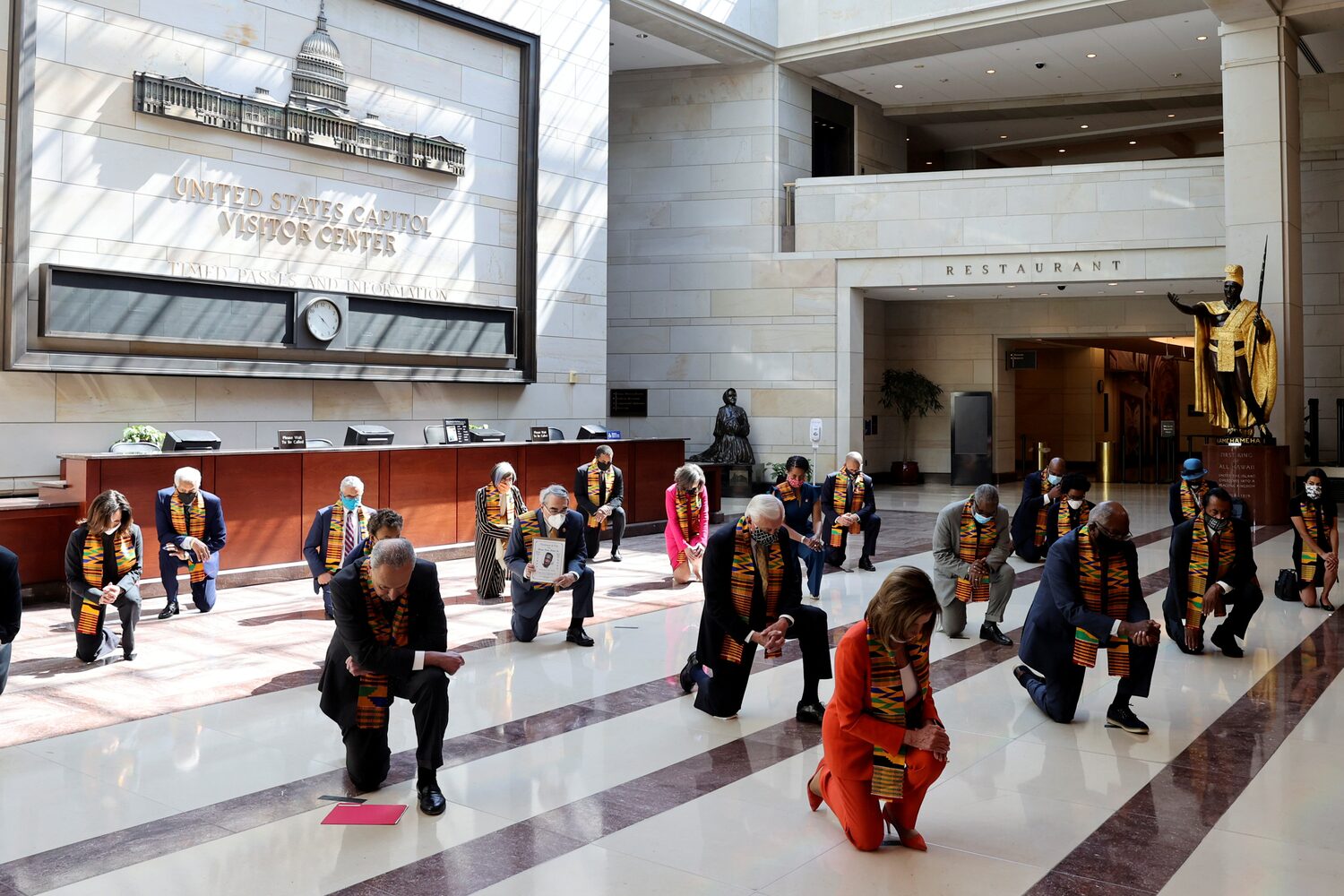
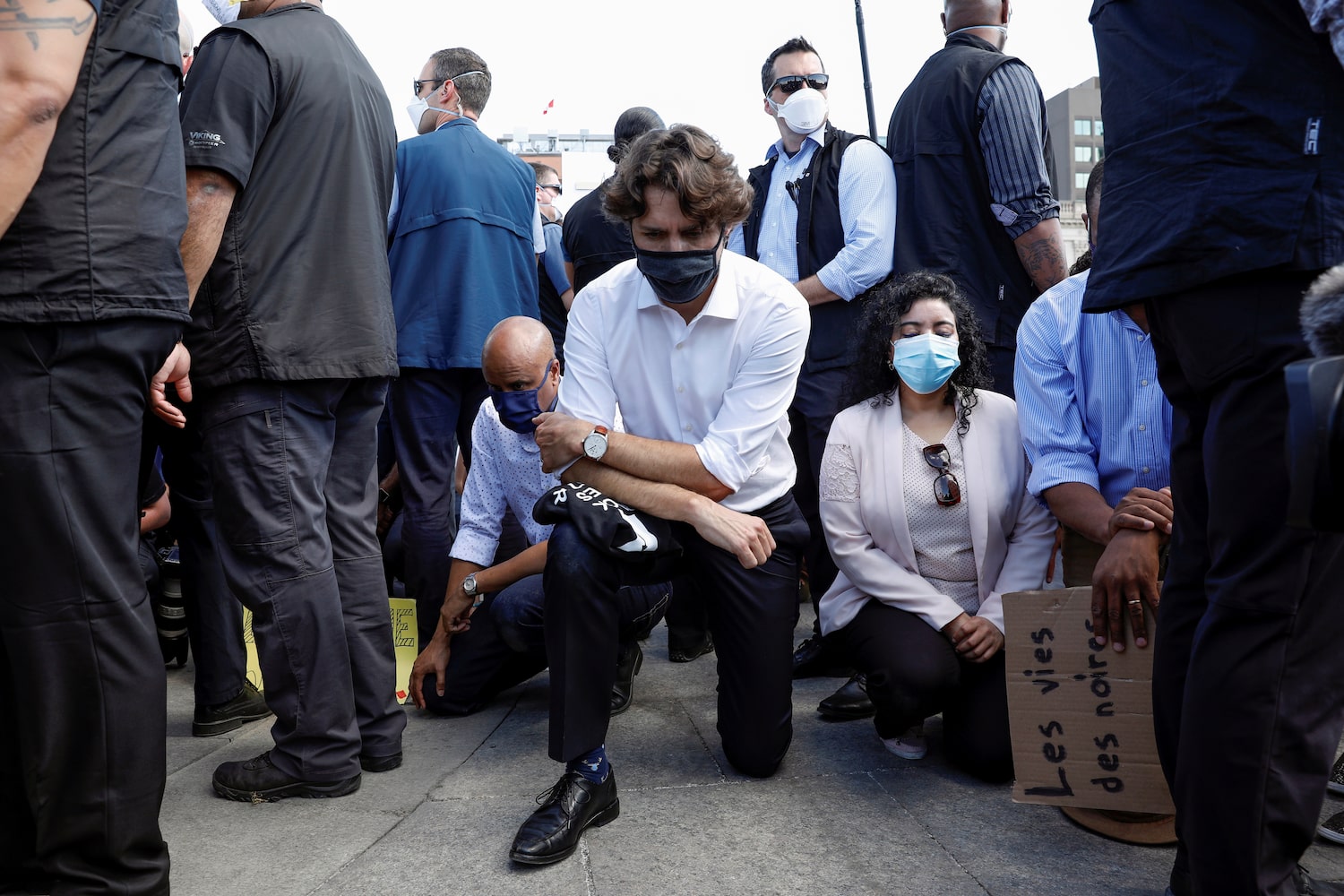
But instead of real change, there were performances of solidarity. Across the political spectrum, government officials began to “take a knee.” The transit, the gap, between symbolic and real power, between symbolic and real change, is a ruse in which Black people are supposed to be satisfied with the symbolic.
We were meant to understand that this gesture of the bended knee was one of solidarity, but in fact people in power going down on one knee was a gesture that reproduced and reiterated the posture of violence as it reprised the role of the one enacting violence and not the position of the person whose life was snuffed out by violence.
This gesture was in actuality an abdication of responsibility, a refusal to recognize institutional and structural power, and to dismantle the systems that disproportionately kill and harm black people.
Recall the U.S. Speaker of the House and Senate Democrats who with kente cloth scarves “took a knee to honour George Floyd.” Recall Toronto Police Insp. Matt Moyer, who took a knee alongside a protester at the U.S. consulate, and who said: “It’s just really great to see it in such a peaceful manner. It carries so much weight. The message has always been: ‘What you want, we want.’”

Police use chemical irritants and crowd control munitions to disperse protesters during a demonstration in Portland, Ore., on Sept. 5, 2020.Noah Berger/The Associated Press
The message was a lie. And police reform was never the demand, abolition was. Defund was merely the beginning.
In response, interim Toronto Police Chief James Ramer said, “When we hear that discussion, [about reform] I think what the community is talking about is reform and it’s talking about modernization of the police service.” Former president Barack Obama said that protesters misspoke, they could not mean abolish policing or defund policing, they must mean reform policing. Reform, however, always puts more money into the very system that needs dismantling. In Toronto, for instance, as in many North American cities, reform leaves the police the largest line item in the city’s operating budget. The activists had not misspoken, they meant defund the police; they meant abolish policing; they meant put that money into social good; they noticed the expansion of police budgets at the same time as, and as a direct result of, a decrease in money for social housing, social health, the arts, education, and public transportation.
In North America, mainstream media often mislabels solidarities. They believe in the borders of the cordoned off nation-state or they speak as if they do and they imagine that as the limit of affinity and fealty. They attempt to close off the sensibilities of people living on different parts of the planet and, they resist the idea that people can know their interests as being beyond borders; that people might understand that these borders inflict harm rather than safeguard from harm.
The mainstream media also underestimates peoples’ sense of history. And the media do not think that they are the producers and enforcers of amnesia and affect. When a global movement emerges, they are dismissive. The movement arising after the murder of George Floyd was then, to some, both opaque in its depth and surprising in its widespread response and endurance. It changed something. It brought people into the street and into relation who had never been in the street. It connected people across geographies.
With no true structural response to the demands of protesters after Mr. Floyd’s murder or to the crisis brought on by the pandemic, the responses were piecemeal and symbolic.
The theorist and cultural critic Rinaldo Walcott has named these empty promises of governments, corporations, and institutions the “George Floyd dividend.” A painfully apt phrase that describes a set of institutional and institutionalized responses in Canada and the U.S. to the murder of George Floyd. This “dividend,” which was paid out in financial terms, and in proximity to power, was not a structural response to anti-Blackness, it was a capital response to anti-Blackness which kept that very anti-Blackness in place. These responses involved the cynical black and multicultural window-dressing of capital and white supremacy’s ongoing violence in lieu of the substantive change that the uprisings demanded.
The end of the pandemic brought a fierce backlash. We faced the rise of the far right, a deep acceleration of the growth of wealth in millionaires and billionaires, and a retreat of governments from the arena of the social, from the commons, and from any desire to ameliorate harm.
This retreat was long in the making, before the pandemic, when the privatization of things that were once imagined to be social goods became de rigueur – things like health and welfare, and care for the elderly. Isn’t this, shouldn’t this be, the function of a state, the work of a state that functions in the actual interests of people?

A person wears a mask with a message on May 31, 2020, at the Minneapolis corner where George Floyd was restrained by police.Elizabeth Flores/The Associated Press
Instead, the state did the business of privatizing services that people once thought they paid taxes to maintain in the public interest. Business became the clients of the government rather than people being those “clients.” The rhetoric of making things good for business became the focus and the communal project took a subordinate role to the business project. They purported that what was good for business was good for people and the government should be run like a “business.” Governments became clients of business rather than representative of something called community; governments could underwrite business but not people, with the people’s money.
A massive wealth transfer from people to businesses was done instead of the substantive changes that people were calling for – the end of policing, livable wages, housing, education. If anything was offered, it was incorporation into the very structures that people wanted fundamentally overhauled or dismantled.
That this is so, is strikingly clear given the alacrity and violence of the rollbacks of what was supposedly gained by Black people after Mr. Floyd’s most brutal murder. What was carved out has been taken back and more – hiring freezes, program cuts, reversals.
In one of now countless examples, including Harvard and Columbia, the University of Alberta announced that it will “move away from its diversity, equity and inclusion (DEI) policies,” to a less “polarizing” acronym (ACAB – access, community, and belonging; ACAB, of course, is also an acronym wielded during the protests). These institutions ostensibly at the crux of the production of intellectual life folded. Truthout reported in 2021 that in the year since the protests against the forces that killed Mr. Floyd began, more than 100 anti-protest bills had already been introduced. Toronto passed the bubble zone bylaw earlier this year – a bylaw which at base eliminates the right to protest and could lead to fines of up to $5,000 under the Provincial Offences Act. The Confederate monuments are returning, renewed with fascism.
Since Donald Trump has returned to power, that administration has cut programs, and has begun to put in place a mythical U.S. that, as with all myths, never existed. White supremacy is the order of the day and at its core. And we are witnessing this fascist rise in Europe, in South America, and all over the world.

Protesters disperse in Seattle on June 1, 2020, as tear gas, pepper spray and flash-bang devices are deployed by police during a protest against police brutality and the death in Minneapolis police custody of Mr. Floyd.Lindsey Wasson/Reuters
The uprising after the murder of George Floyd saw activists shot by police and imprisoned, and the intentional maiming of protesters and journalists. Five years on we see the retrenchment of anti-Blackness as open policy, the creation in the U.S. of ICE as a paramilitary force, the global rise of the far right, the massive transfer of military grade equipment to cities in the U.S. used to quash dissent and populations.
This equipment is being used, now, to kidnap and disappear people from the streets of cities and towns, from Bangor, Me., to Los Angeles, Chicago, Washington, New Orleans, and all across the U.S.
In the face of this, the refusals and the solidarities ignited on May 25, 2020, continue. These protests, these solidarities, are an attempt to inaugurate a new world.
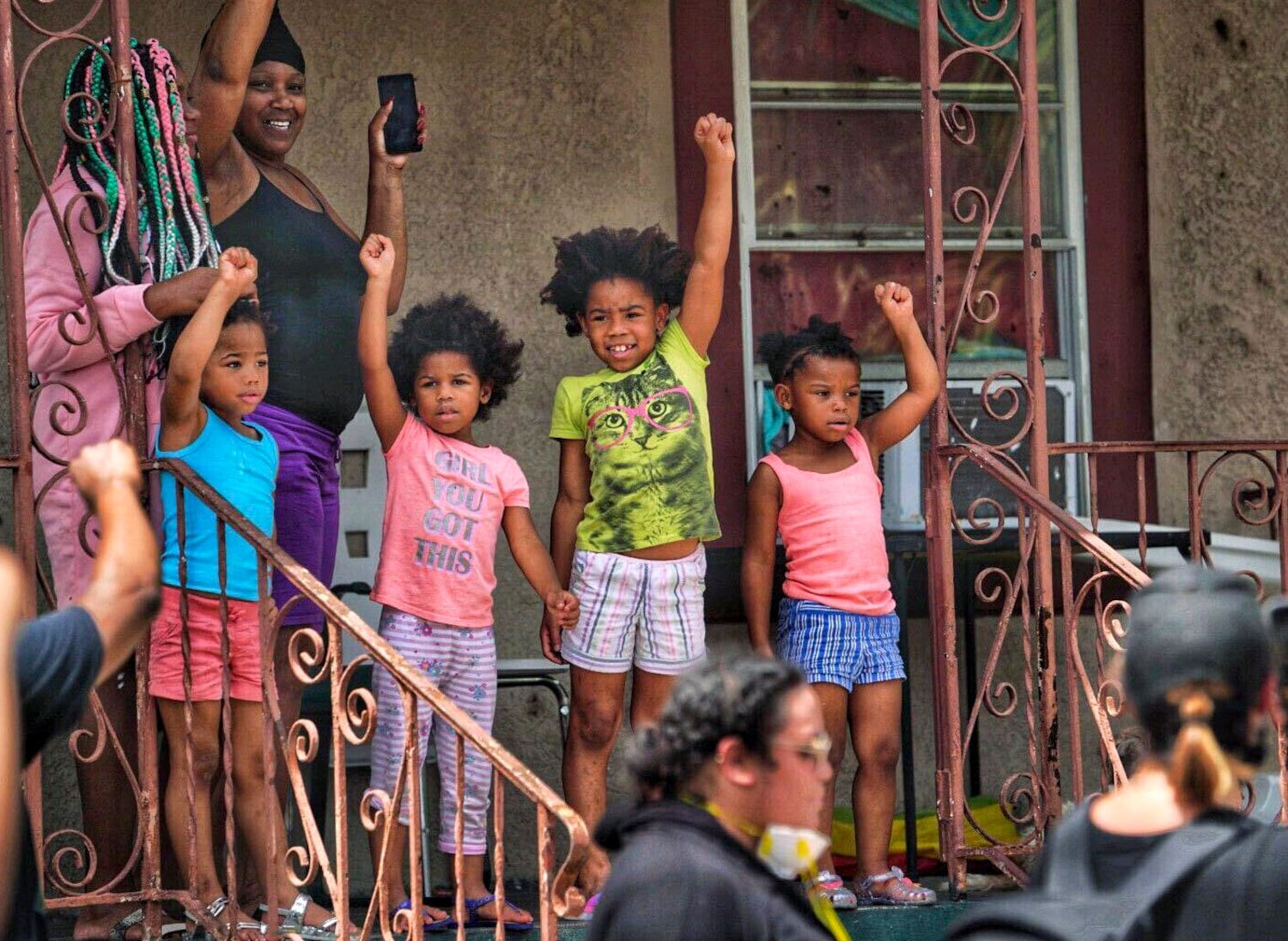
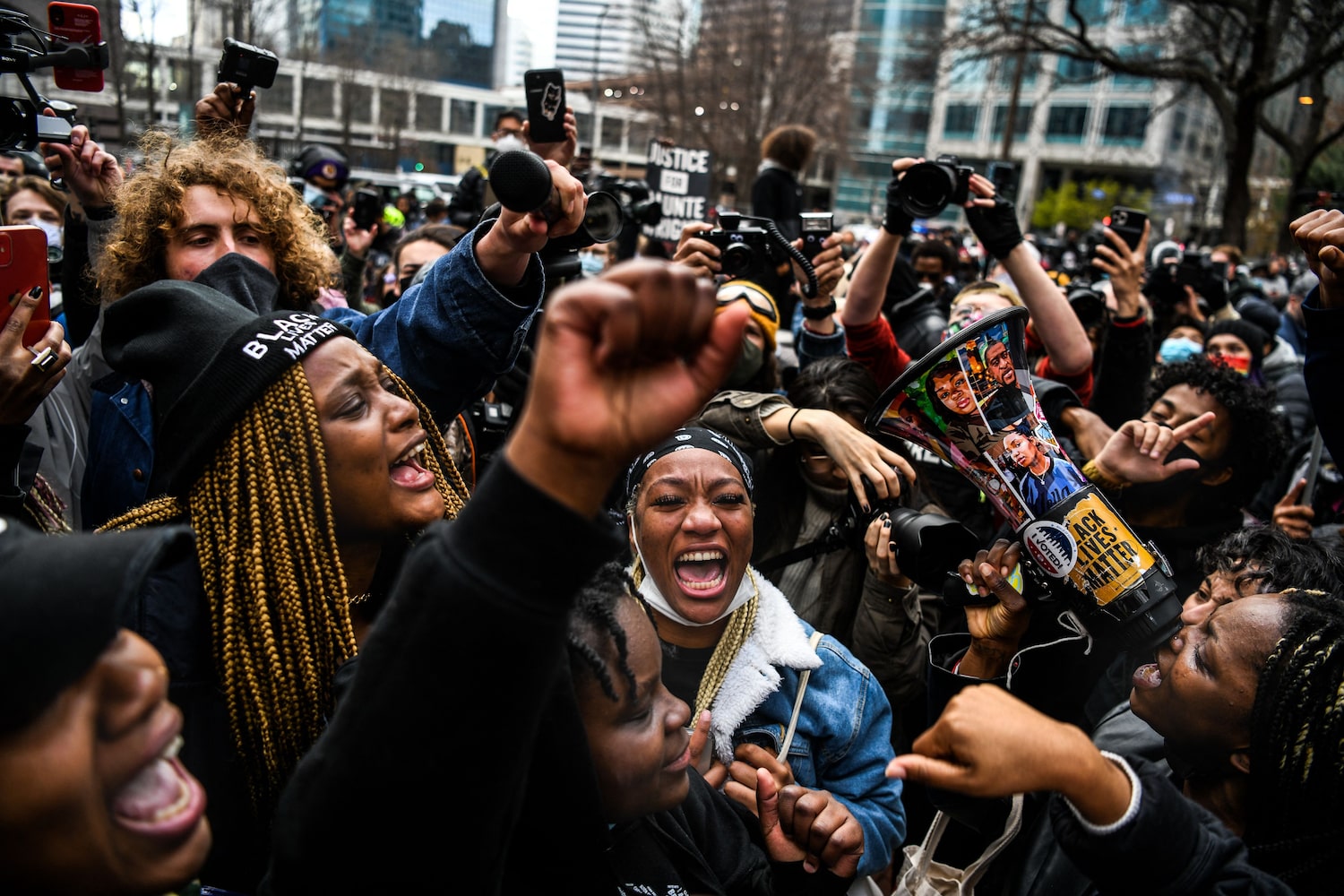

People react after the verdict, at George Floyd Square in Minneapolis.ADREES LATIF/Reuters
And those who believe in something like freedom, in something like liberation, those who believe in the world for everyone, in all for all, know, as Charles Chesnutt wrote in his novel The Marrow of Tradition that fictionalized the 1898 riot in Wilmington, N.C., the only successful insurrection in U.S. history, that “there’s time enough, but none to spare.”
George Floyd’s death was an event, but the story of his dying continues to unfold.