

Twenty years ago this month, the Supreme Court of Canada cracked open a new fault line between Quebec and rest of the country, one that would put the French-speaking province on a trajectory diametrically at odds with the multicultural values Canada had come to embody and disrupt Quebec politics for years to come.
In quashing a Quebec Court of Appeal decision that had prohibited a Sikh boy from wearing a kirpan, or ceremonial dagger, at school, the country’s top court came down squarely on the side of religious freedom as guaranteed by the Charter of Rights and Freedoms and against Quebec’s vision of la laïcité, then an emerging doctrine of separation of church and state in a province that had gone to great pains since the Quiet Revolution to replace its dominant Catholic institutions with unsparingly secular ones.
The decision sparked indignation in Quebec. Commentators in the French-language media overwhelmingly condemned it. Within hours of the ruling, La Presse had received more than 500 emails from readers; almost all of them denounced it.
In Multani v. Commission scolaire Marguérite-Bourgeoys, the court ruled that banning the kirpan in Quebec public schools based on a broad prohibition on carrying weapons was “disrespectful to believers in the Sikh religion and [did] not take into account Canadian values based on multiculturalism.”

Gurbaj Singh, left, shows his Kirpan, a religious sabre, at his home in LaSalle with his parents Daljit Kaur Multani, centre, and Balvi Singh Multani, right, in February, 2002.CHRISTINNE MUSCHI
It cast aside concerns about security raised by school officials, and echoed by the Quebec government, and rejected proponents’ contention that the kirpan ban constituted a “reasonable limit” on religious expression as permitted under Section 1 of the Canadian Charter.
Though the ruling did not come as a surprise to those who had followed similar debates in other provinces where kirpans had for years been allowed in schools, it landed amid a surge of cases in Quebec in which religious minorities – many of them Muslim immigrants – had sought accommodations of their faith practices in public and private institutions. For Quebeckers who came of age during the Quiet Revolution, these demands for accommodations ran counter to the secularist values for which they had fought so hard. “With recent Supreme Court judgments and the rapid increase in the number of religious immigrants, certain Quebeckers imagine they’ve gone back 50 years,” Le Devoir editorialist Jean-Robert Sansfaçon wrote at the time.
Indeed, rather than settling what had until then been a simmering public debate over religious accommodation, the Supreme Court ruling blew the issue wide open, leading supporters of la laïcité to demand legislative action to block intrusions of religion in the public sphere. This ultimately led to the Quebec National Assembly’s adoption, in 2019, of an Act respecting the Laicity of the State, commonly known as Bill 21.

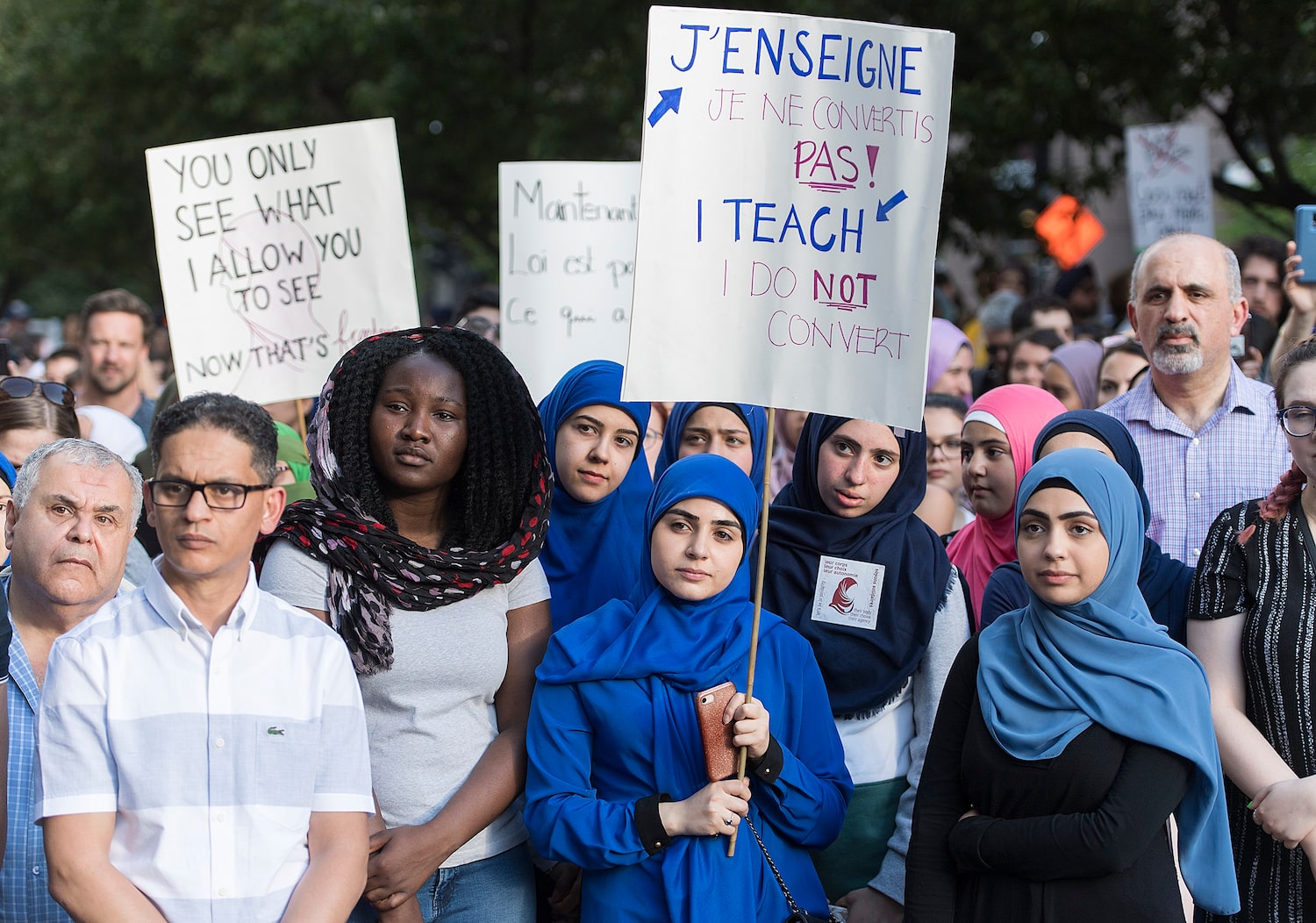
The legislation, which banned public servants in a position of authority from wearing religious symbols on the job, set parameters for the separation of church and state that went far beyond those ever considered elsewhere in modern Canada. It effectively barred certain religious minorities, such as hijab-wearing Muslim women, from becoming public-school teachers or government lawyers. The measures enjoyed broad public support in the province. Many considered Bill 21 an affirmation of Quebec’s autonomy that the rest of Canada would – like it or not – have to accept.
This is the explosive backdrop against which the Supreme Court will, beginning next week, hear a constitutional challenge to Bill 21. The case brought against the Quebec government by six groups, including the National Council of Canadian Muslims and the World Sikh Organization of Canada, will be one of the most important court challenges in Charter history. The future of the country may well hang in the balance.
“This is a turning point for the Canadian system of rights protection,” insists Laval University law professor Patrick Taillon. “Quebec has long been a fertile territory for certain individual rights, such as medical assistance in dying and abortion. But when it comes to the individual freedom to wear a religious symbol, it imposes a restriction that has no equivalent in [the rest of Canada]. Will [the Supreme Court] allow this kind of small difference or will it standardize [rights] even if it means provoking a national unity crisis?”
Even opponents of Bill 21 concede that the top court faces a delicate task in balancing Charter rights with Quebec’s long-standing efforts to protect its distinct culture and values within the Canadian federation. For decades, the Supreme Court has sought to accommodate Quebec’s moves to restrict access to English-language public schools and impose French-language requirements on businesses. It has been respectful of Quebec’s civil code, which often allows for different legal outcomes than in the rest of Canada.
The question now facing the court is whether la laïcité is, as the Quebec government contends, a fundamental characteristic of the Quebec nation alongside its language and civil law tradition that requires special consideration when adjudicating rights claims.
“This is a hard case in the sense that the court has been alert to and accommodated the fact of Quebec nationalism. It has been an act, at times, of legal genius. It has also taken immense skill,” offers Sujit Choudhry, a Toronto lawyer who represents three South Asian associations intervening to challenge Bill 21. “But this is a case where the court might not be able to accommodate everything some people want to achieve.”
Since the fall of New France, Quebec’s relationship with religion has been a determining factor in its political development, much more than anywhere else in Canada. Cut off from post-revolutionary France, Quebec’s powerful Roman Catholic clergy became the arbiters of the rights granted to the French-speaking colonists by their British conquerors. They used religion as a form of social control to enhance their own power and stay the assimilative forces that overwhelmed francophone settlements elsewhere in North America.
Because of this church control, secularization came later to Quebec than perhaps any other Western society. But when it came, it wiped out the old religious order with such zeal and efficiency that francophone Quebeckers went from having among the highest levels of religious observance in Canada to among the lowest within a decade. Most Quebeckers did not stop identifying as Catholics, but that label became for them more of a cultural marker than a religious one.

Street artists in the rue du Trésor are scrutinized by passing nuns in Quebec City, in June, 1967.Erik Christensen/The Globe and Mail
Starting in the 1960s, Quebec became a trailblazer for reproductive rights within Canada, refusing to prosecute doctors who performed abortions, even though the Criminal Code then still banned the procedure in most circumstances. In 1977, Quebec was the first province to introduce sexual orientation as prohibited grounds for discrimination in its human rights code. In the 1990s, the province replaced its religious school boards with linguistic ones, and later swapped catechism classes for a course on ethics and religious culture.
By the early 2000s, however, successive waves of immigration from South Asia and North Africa had begun to change the religious make-up of the province. Devout Sikhs and Muslims for whom religious expression was part of their daily lives sought accommodations of their faith practices at their places of work and leisure.
The initial pushback against these demands came from feminists and liberal thinkers who considered the hijab to be an instrument of oppression against women, one that many immigrant Muslims had left their countries of origin to escape.
But it was not long before conservative nationalists also began clamouring for legislation to block what they deemed to be the threat of religious minorities imposing their values on a secular, albeit culturally Catholic, francophone majority.
No incident embodied this collective angst more than the adoption, in early 2007, of a village code of conduct by the municipal council in Hérouxville, Que. (population 1,400), that banned lapidation and other aspects of sharia law.
Many saw the code as belittling of Islam and xenophobic in its form and content, and it was widely called out as such in the Quebec media. The incident nevertheless set off a political firestorm that the populist Action démocratique du Québec exploited to accuse then-premier Jean Charest’s governing Liberal Party of not doing enough to protect Quebec’s values in the face of Muslim immigration.
Mr. Charest sought to defuse the issue by creating a public commission, led by prominent Quebec intellectuals Charles Taylor and Gérard Bouchard, with a mandate “to formulate recommendations to the government to ensure that accommodation practices conform to Quebec’s values as a pluralistic, democratic, egalitarian society.”
The 2008 Bouchard-Taylor report advocated for an “open secularism” policy that reaffirmed the religious neutrality of public institutions but allowed for public employees to display their religious adherence, with one exception. The report recommended banning the wearing of religious signs by judges, Crown prosecutors, police officers, prison guards and others in a position of authority.
The Charest government sat on the report’s main recommendations, reflecting divisions within its own ranks. The Quebec Liberal Party remained heavily dependent on anglophone and ethnic voters in Montreal to maintain its hold on power. The Charest government eventually tabled legislation, in 2010, to ban face coverings in the dispensing and receiving of public services, but the bill was never passed.
The 2012 election of a Parti Québécois government renewed the push for a broad religious-symbols ban. The PQ’s controversial Charter of Quebec Values, tabled in 2013, proposed to prohibit all “personnel members of public bodies” from wearing “objects such as headgear, clothing, jewellery or other adornments which, by their conspicuous nature, overtly indicate a religious affiliation.”
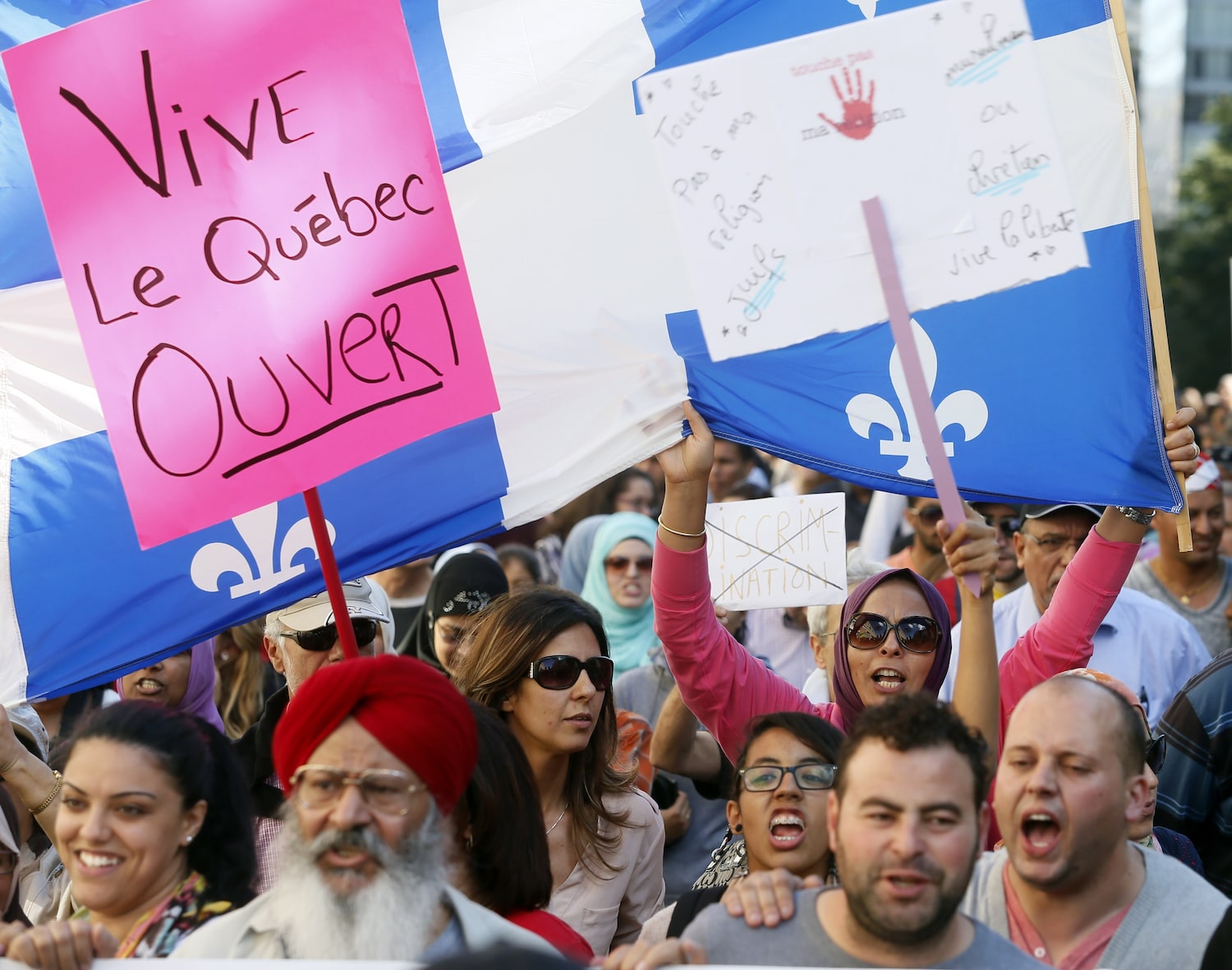
The values charter failed to pass the National Assembly before then-premier Pauline Marois called snap election in early 2014. That vote saw the Liberals returned to power under Philippe Couillard.
The Couillard government did adopt a ban on face coverings, but opponents soon obtained a court order postponing its implementation.
By the time François Legault’s Coalition Avenir Québec won a sweeping majority government in 2018, the province had endured more than a decade of failed legislative efforts to address demands for tougher action on the secularism file. During this period, similar concerns about the renewed presence of religion in the public sphere had led governments in France to adopt a ban on religious symbols in public schools and on face coverings in public. In 2014, the European Court of Human Rights upheld the French ban on religious face coverings, in the interest of le vivre-ensemble (living together or peaceful cohabitation) as described in French law. The ruling did not go unnoticed in Quebec.
Indeed, the influence of French republicanism on Quebec’s secularism debate cannot be overstated. The province’s political and intellectual elites, particularly sovereigntist ones, have long held up France’s promotion of one’s civic identity (over other cultural markers such as religion or ethnicity) as a model for Quebec to emulate.

Former French President Charles de Gaulle making his famous 'vive le Quebec libre' speech from a balcony at Montreal's city hall in July, 1967.Chuck Mitchell/CP
French schools play a central role in inculcating core republican values – liberté, égalité, fraternité, and, in recent years, la laïcité. In French society, freedom from religion is considered as important as freedom of religion. This has created deep political tensions with the more than tenfold increase in France’s Muslim population in recent decades and the rise of Islamic organizations challenging the secularist status quo.
While Quebec has not experienced a similar rise in militant Islam, its secularism debate has occurred with one eye on developments across the Atlantic. The CAQ’s move, in 2019, to legislate a ban on religious symbols for certain public-sector workers aimed to prevent a France-like deterioration in the political climate.
The CAQ rejected calls for a public-sector-wide ban on religious symbols similar to the one in the PQ’s defunct charter of values. It nevertheless went further than the Bouchard-Taylor report recommended in extending the ban to public school teachers. It also re-established the ban on face coverings that had been blocked by a previous court injunction. And, critically, it sought to insulate the law from judicial review by invoking the Charter’s notwithstanding clause, effectively suspending the rights of certain minorities.
The move drew condemnation from opinion leaders in the rest of Canada, and among non-francophones and progressives in Quebec. Some accused the CAQ government of giving in to xenophobic voters in seat-rich rural Quebec, home to few religious minorities.
Still, the CAQ government had to weigh the risks of not acting. It legitimately feared a radicalization of public opinion after years of acrid debate. “Over the past decade, governments have failed to make progress on this fundamental issue,” CAQ Justice Minister Simon Jolin-Barrette said in tabling Bill 21. “We have chosen to elaborate a law that responds to the will of Quebeckers ... Some will find that we are going too far, others not far enough. We are convinced we have found the right balance.”
The CAQ’s framing of Bill 21 as a compromise unique to Quebec will be central to the Supreme Court’s deliberations on the law. It echoes a dialectic that has occurred in previous instances where questions about the province’s specificity have come up in the Charter era. The court has usually strived to strike a balance between individual rights and Quebec’s collective efforts to protect its language and culture.
There have exceptions to this pattern – Mutani v. Commission scolaire Marguérite-Bourgeoys being one. But heightened sensitivity to Quebec’s distinctness has long been a feature of the court. This is reflected in the court’s very composition. Since 1949, the Supreme Court Act has required that three of its nine judges be from Quebec. No other province is thus formally represented on the top bench.
In 1988, when the Supreme Court struck down provisions of the province’s Charter of the French Language, which mandated French-only outdoor commercial signs, it nevertheless recognized that the Quebec government faced a “pressing and substantial concern” about the survival of French in the province. While it concluded in Ford v. Quebec that the government went too far in banning other languages, it said that “requiring the predominant display of the French language, even its marked predominance, would be proportional to the goal of promoting and maintaining a French visage linguistique.”

Pedestrians walk by a sign written primarily in English hanging on the wall of a United Church in Montreal's St-Henri Westmount district, in September, 1996. The numbers 101 have been spray painted across it, the same number of a Quebec language law that calls for unilingual French only signs.Robert Galbraith/The Canadian Press
Subsequent Quebec language laws adopted the Charter-compliant requirement of a “net predominance” of French on outdoor signage rather than banning other languages.
In 2014, the Supreme Court rejected then-prime minister Stephen Harper’s appointment of Marc Nadon, then a judge on the Federal Court of Appeal, to one of the three Quebec seats on the top court. It ruled that Mr. Nadon was ineligible for the post, since he was not a member of the Quebec bar, nor a judge on the Quebec Superior Court or Quebec Court of Appeal, as required under Section 6 of the Supreme Court Act. “The purpose of [Section 6] is to ensure not only civil law training and experience on the [Supreme] Court, but also to ensure that Quebec’s distinct legal traditions and social values (my emphasis) are represented on the Court, thereby enhancing the confidence of the people of Quebec in the Supreme Court as the final arbiter of their rights,” the court wrote in its decision.
The particular wording of the Nadon ruling is sure to come up at the Supreme Court’s hearings on Bill 21. Indeed, in its preamble, the Bill 21 refers to Quebec’s “distinct social values” to justify its religious-symbols ban, reprising the Supreme Court’s own phrasing. “The court admitted [in Nadon] that is concerned about the way it is perceived in Quebec,” Laval University’s Prof. Taillon notes. “The court’s legitimacy in Quebec is on the line every time it is in the spotlight. There is always suspicion of the court among nationalists.”
That likely explains why the Quebec government sought and obtained Justice Mahmoud Jamal’s recusal in the Bill 21 case on the grounds that he had served as chairman of the Canadian Civil Liberties Association when the organization first challenged the law in 2019. In agreeing, however reluctantly, to recuse himself, Justice Jamal helped defuse charges of a potential conflict of interest or bias on the court. His recusal will likely force Chief Justice Richard Wagner to remove another judge from the Bill 21 hearings to avoid the case resulting in a tie. His choice will matter. “There are judges with a greater sensitivity to individual rights than others; there are judges who show more deference to legislatures,” Prof. Taillon notes. “So, the one judge you exclude can alter the weighting on the court.”
The Bill 21 hearings will mark the first serious examination of the notwithstanding clause – known in legal circles as Section 33 of the Charter – since the Supreme Court set out the guidelines for its use almost four decades ago in Ford v. Quebec. In Ford, the court found that Section 33 “lays down requirements of form only, and there is no warrant for importing into it grounds for substantive review of the legislative policy.”
Courts have since interpreted the clause narrowly. In upholding Bill 21, the Quebec Court of Appeal invoked the Ford decision, ruling that the law “is protected from judicial scrutiny” by virtue of the Quebec government’s use notwithstanding clause, and “there is no reason to examine the matter or consider a declaratory judgment or any other redress.” That interpretation is consistent with idea that Section 33, included in the Charter at the insistence of Western Canadians, is intended to ensure that legislatures maintain the last word in the dialectic between the branches of government.
Repeated use of the notwithstanding clause by provincial governments in recent years, however, has led to increasing calls for controls on its exercise, if not its outright abolition. The latter would be impossible without amending the Constitution. Short of that, opponents of Bill 21 are asking the Supreme Court to revisit its 1988 decision to impose limits on the clause’s use. “This is a once-in-a-generation case,” Mr. Choudhry insists. “The notwithstanding clause has not come before the court for 38 years and it’s being used every day. The court needs to provide guidance.”
Bill 21’s main challengers argue that the denial of the Charter rights of certain religious minorities violates the “architecture” of the Canadian Constitution that has evolved over 250 years. Quebec, they note, has a long history of religious accommodation in its public institutions, dating as far back as the 1774 Quebec Act, which dispensed Catholics from taking an oath repudiating papal authority to hold public office. In 1832, Lower Canada became the second jurisdiction in the British empire, after Jamaica, to enable Jews to hold public office. “Our Constitution has for centuries espoused the conviction that public institutions cannot be closed to certain religions,” lawyers for teacher Ichrak Nourel Hak, the National Council of Canadian Muslims and the Canadian Civil Liberties Association argue in their Supreme Court factum.
It remains unclear how far the Supreme Court would risk going to tamper with the balance of power between the legislative and judicial branches that has existed since the Charter’s adoption in 1982. At the very least, opponents of Bill 21 are hoping it will clear the way for lower courts to issue declaratory judgments regarding laws that are shielded by the notwithstanding clause. Such judgments, which would spell out which Charter rights are being violated, could discourage governments from invoking the clause preventively (as Quebec did with Bill 21) by subjecting them to a public shaming of sorts by the courts. “The electorate is entitled to know whether government action is consistent with the Charter in order to meaningfully evaluate their elected officials,” argues the Federation of Ontario Law Associations, an intervener in the Bill 21 case.
Opponents of Bill 21 point to a 2025 Saskatchewan Court of Appeal ruling in which it broke with precedent by determining that the notwithstanding clause does not preclude courts from issuing declaratory judgments. The Saskatchewan case involved the provincial government’s use of the notwithstanding clause to shield its law requiring parental approval for pupils under 16 seeking to change their preferred gender pronouns at school.
In its submission to the Supreme Court on Bill 21, the federal government argues that a declaratory judgment would not run contrary to the principle of parliamentary sovereignty and would allow voters to be better informed. “Depriving these important actors in the democratic process of access to a judicial determination of the compatibility of a statute with constitutional rights and freedoms would frustrate an important accountability mechanism,” Ottawa argues, adding that “a declaratory judgment that a statute protected by [Section 33] violates a right or freedom would generally be in the public interest.”
The federal government is also asking the Supreme Court to weigh in on the Quebec government’s repeated use of the notwithstanding clause. While Section 33 imposes a five-year limit on the application of the clause, it allows for its renewal. The five-year limit corresponds to the length of the electoral cycle; governments that invoke the clause typically must face voters before they renew its application. The CAQ government, re-elected in 2022, renewed its use of the notwithstanding clause to shield Bill 21 in 2024.
Ottawa, in its submission, contends that “the prolonged impossibility of exercising a right or freedom would, in practice, be tantamount to denying its very existence, which can be done only through a constitutional amendment.” Quebec counters that, since Section 33 does not explicitly prohibit repeated use of the notwithstanding clause, the Supreme Court would be exceeding its authority and overturning “established law” if it placed new conditions on the clause’s use.
While much of the Bill 21 case could hinge on technicalities involving the precise wording of Section 33, there will be nothing technical about the impact of Supreme Court’s final ruling. Not only will the rights of thousands of members of religious minorities in Quebec hang in the balance, but the very essence of Canadian federalism could be altered for generations to come.
Gurbaj Singh Multani wears his kirpan in his home in the Montreal suburb of Lasalle, in September, 2013.The Globe and Mail
The basic question the court must answer is this: Is it acceptable, under the same Constitution, to allow for asymmetry in the application of religious rights based on one’s province of residence?
When it comes to Quebec, the Supreme Court has previously determined that the province’s “distinct social values” can justify special treatment on its part. Top court judges are also well aware that they risk triggering unintended and potentially explosive political consequences in they rule in favour of opponents of Bill 21. After all, the court’s 2006 kirpan ruling triggered the tortuous debate over religious accommodation that resulted in Bill 21’s adoption 13 years later.
Yet, amid growing concerns about repeated use of the notwithstanding clause in Quebec and other provinces, the court also faces pressure to establish guardrails and prevent abusive recourse to Section 33 by governments seeking to circumvent the judiciary.
Whichever way the Supreme Court leans on Bill 21, Canada will not be the same in its aftermath.