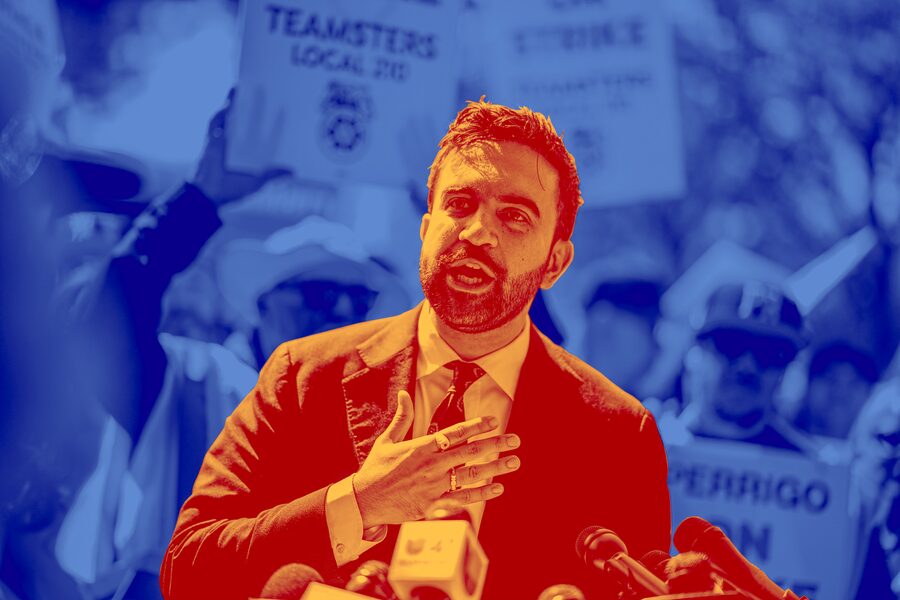

The Democratic Socialists of America are having a moment.
Once an obscure fringe organization that advocated overthrowing the capitalist system in the country whose name had long been synonymous with free markets – in other words, a seemingly lost cause if there ever was one – the DSA has been on a roll since one of its own became the front-runner to win New York’s mayoral election.
Zohran Mamdani’s improbable victory in the city’s June Democratic mayoral primary has sparked a broader debate about whether the sharp left turn that he and the DSA represent should serve as a template for the national party, which has floundered aimlessly in the wake of Kamala Harris’s 2024 presidential election loss to Republican Donald Trump.
As Mr. Trump monopolizes global attention with one jaw-dropping violation of democratic norms after another, rewarding friends and punishing foes with alacrity, Democratic leaders in Washington have appeared spineless and weak. Too many Americans are unsure of what, if anything, the Democratic Party stands for, or feel it is elitist and disconnected from their bread-and-butter concerns. Nearly two-thirds of voters view the party unfavourably.
Enter the charismatic Mr. Mamdani, the 34-year-old Ugandan-born son of upwardly mobile Indian immigrants, who stunned the establishment and landed on Mr. Trump’s enemies list by beating former New York governor Andrew Cuomo in the primary. He is widely favoured to top Mr. Cuomo, now running as an independent, in the Nov. 4 mayoral election.
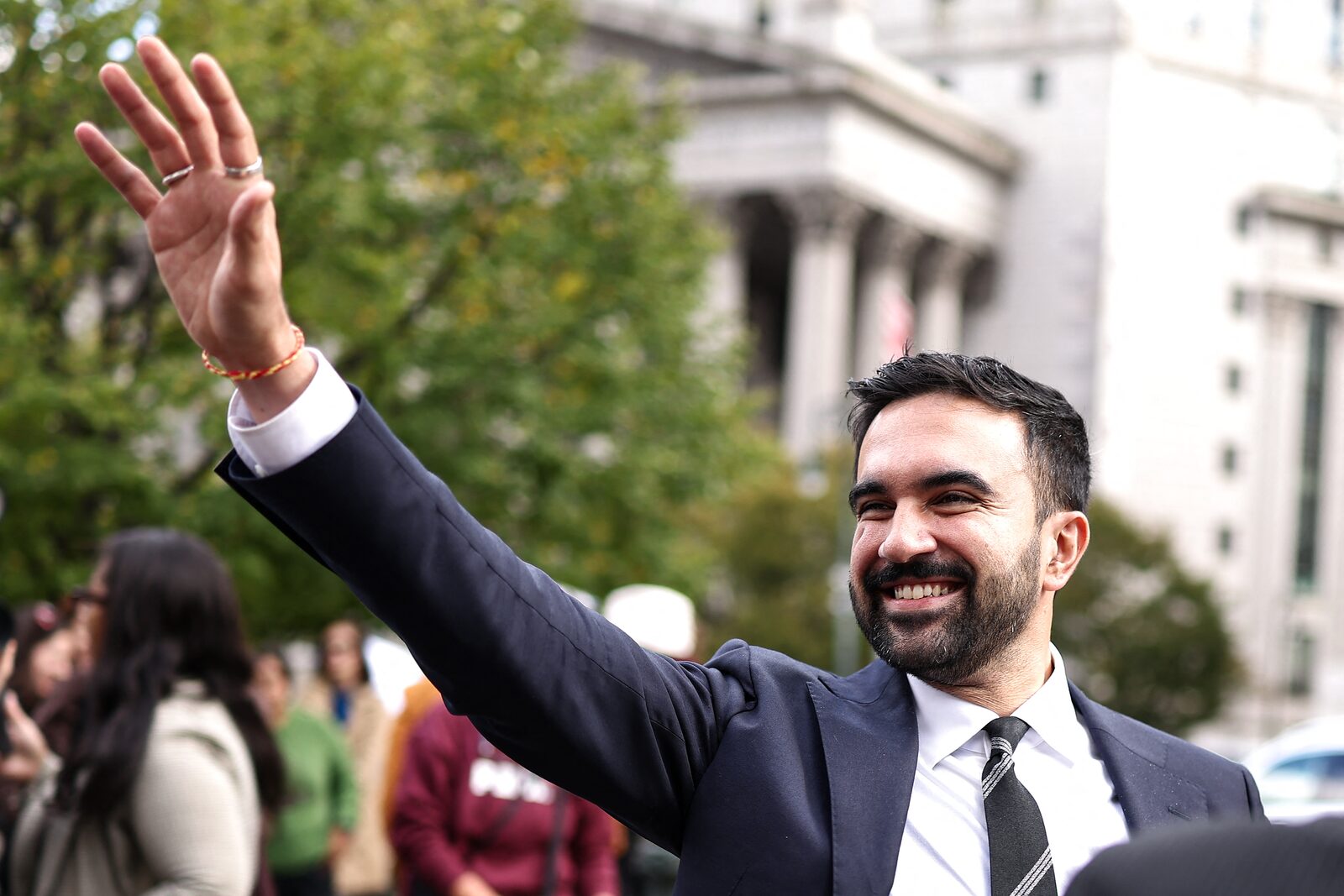

“In New York City, socialism has won,” DSA crowed after Mr. Mamdani’s primary victory. “These election results are a rejection of the Democratic Party political establishment and point to a widespread desire for an alternative to the status quo, and the need for the working-class political party DSA is building.”
In a mayoral campaign fuelled by thousands of DSA-recruited volunteers, Mr. Mamdani, a third-term member of the New York state assembly, has galvanized progressive voters by paying more than lip service to the statist policies they espouse. He has also built a multiethnic coalition of working-class New Yorkers with his promises to tax the wealthy, freeze rents and offer free buses and child care. He has put making life affordable for working-class New Yorkers at the crux of his crusade to take on the rich, couching his socialist politics in language average voters can understand – he coined the term “halalflation” in a canny outreach to Muslim New Yorkers and food-truck aficionados alike.
Mr. Mamdani has drawn in apolitical or disillusioned New Yorkers with smart, funny and hip videos that have revealed communications skills perfectly suited to the digital age, and which make his older rival (Mr. Cuomo is 67) look awkward and out of touch. Behind a seemingly permanent and infectious smile, Mr. Mamdani has displayed a singular knack for the jugular, a critical political weapon in the no-holds-barred Trump era that establishment Democrats decidedly do not possess.
He has deftly ridden the zeitgeist as more New Yorkers question their country’s unwavering support for Israel. He has mobilized young voters with his unambiguously pro-Palestinian politics, accusing Israel of “genocide” in Gaza and vowing to arrest Prime Minster Benjamin Netanyahu (the subject of an International Criminal Court warrant for war crimes) if he steps foot in the city, positions Mr. Cuomo and establishment Democrats eschew.
“He has captured younger residents. The 18- to 25-year-old cohort shows up less in elections than any other age group. But they appear to be energized by Mamdani’s candidacy, given the New York City Democratic leadership, which is a pretty tired group,” says Fordham University political-science professor Bruce Berg, referring to Senate Minority Leader Chuck Schumer, House of Representatives Minority Leader Hakeem Jeffries and Mr. Cuomo, who resigned as governor in 2021 amid a slew of sexual-harassment allegations.

The excitement around Mr. Mamdani's campaign has extended far beyond New York City.Angelina Katsanis/The Associated Press
Indeed, compared to potential 2028 Democratic presidential candidates who wear their ego and ambition on their sleeve – California Governor Gavin Newsom, Illinois Governor JB Pritzker, Pennsylvania Governor Josh Shapiro or former Chicago mayor Rahm Emmanuel – Mr. Mamdani is seen as an authentic and fearless warrior of the anti-Trump resistance. The excitement surrounding his campaign extends far beyond New York’s five boroughs. Since winning the primary, he has become a national sensation and a symbol of generational change within the Democratic Party.
“It’s clear this election has become nationalized,” says Sheri Berman, a political-science professor at Columbia University’s Barnard College, and expert on the political left. “There is coverage of this everywhere. He is being spoken of as representative of a potential future path for the Democratic Party. And then there’s the contrast with Trump. You’ve seen in the reaction to Trump’s second presidency part of the left become further radicalized.”
Prof. Berman is careful to distinguish between Mr. Mamdani’s platform and his ideology. “His economic program is not entirely different from something that [Vermont Senator and former presidential candidate] Bernie Sanders would advocate. It is a kind of social democratic platform that a Canadian can understand. It’s just not as far left as the U.S. has ever been. His membership in DSA indicates something more radical. DSA advocates the abolition of capitalism. That is just not going to happen at the New York City level.”
Still, Mr. Mamdani’s rise has arguably focused more attention on socialism in the United States than at any time since the early 20th century, when the pro-union Socialist Party of America briefly became a political force, mostly in municipal politics. At a time when corruption was rife, public services rare and industrial pollution unregulated, socialist mayors pledged to build sewers and municipal water and electricity systems and end graft in municipal government. What became known as “sewer socialism” emphasized the efficient delivery of public goods rather than the nationalization of the means of production.

During the Cold War, the term 'socialist' was an insult. But Mr. Mamdani's rise has brought with it a renewed attention and acceptance of the political ideology in the U.S.Illustration by Yuki Iwamura
With the onset of the Cold War, however, the terms “socialist” and “communist” came to be used interchangeably as slurs employed by the right to discredit politicians who favour a bigger role for government in the economy. The tactic worked for decades. But younger Americans who were born or came of age after the fall of the Soviet Union are not scared off by the socialist label.
At the same time, more Americans of all ages have been experiencing a crisis of faith in the capitalist system itself amid growing wealth inequality since the 2008-09 financial crisis. More than half of Democratic Party supporters now hold an unfavourable view of capitalism. More important, two-thirds of self-identifying Democrats have a favourable view of socialism, according to Gallup poll released last month.
Mr. Trump, meanwhile, has replaced the Republican Party’s traditional support for free markets with protectionist policies that employ the coercive power of the state to direct corporate behaviour on Wall Street and in Silicon Valley alike. The invisible hand has given way to Mr. Trump’s executive orders and jawboning. The President practises a form of crony capitalism that distorts markets and tips the scales in favour of the anointed few.
The context does seem ripe, then, for self-proclaimed socialists such as Mr. Mamdani to offer Democrats a path out of the wilderness with an unapologetically progressive economic platform that pulls no punches when it comes to taking on corporations and Mr. Trump.
“[T]he moment for building a great progressive majority party has arrived, a coalition asserting itself against a sclerotic political elite, our economic overlords in Big Tech and Wall Street and a radical right crusading against its own country,” George Washington University historian Timothy Shenk wrote last month in a New York Times essay that called on Democrats to embrace Mr. Mamdani’s “eat-the-rich” populism. “Turning Democrats into the vehicle for this coalition will take a struggle – a bruising, messy contest to seize the reins from a party establishment that will be scrambling for its life. But working people fight much harder battles every day. It’s about time they had somebody in their corner.”

New York Gov. Kathy Hochul is one of few Democratic leaders who have endorsed Mr. Mamdani.Michael M. Santiago/Getty Images
Talk like that still rattles Democratic leaders in Washington. Neither Mr. Schumer nor Mr. Jeffries, the Senate and House minority leaders, respectively, have endorsed Mr. Mamdani. They have continued to toe a cautiously centrist line, arguing that the best response to right-wing populism – and most credible path to a Democratic victory in next year’s midterm congressional elections – is to look reasonable in the face of the President’s erraticism.
Many centrist Democrats fear that a win by Mr. Mamdani in the mayoral race could sink their party’s chances of retaking the House and Senate in 2026. Indeed, they worry Mr. Trump – who has called him a “100 per cent Communist lunatic” – may welcome a Mamdani victory as a chance to cast all Democrats as “radical lefties” and socialists.
Still, in a sign of shifting winds within the Democratic Party, New York Governor Kathy Hochul did endorse Mr. Mamdani in September after initially hesitating for weeks. A centrist Democrat who is up for re-election in 2026, Ms. Hochul appears to have concluded that the Democratic rank and file is moving more in Mr. Mamdani’s direction than that of Mr. Schumer and Mr. Jeffries and that establishment figures like her need to adapt to survive.
At the same time, Mr. Mamdani has moved to moderate his positions on a number of hot-button issues, making it easier for cautious politicians such as Ms. Hochul to embrace him.
Before running for mayor, Mr. Mamdani left a trail of incendiary comments on social media. In 2020, at the height of the Black Lives Matter protests, he described the New York Police Department as “racist, anti-queer & a major threat to public safety” and supported calls to defund it. He recently apologized for those comments and promised that, as mayor, he would maintain police staffing levels and create a new department of Community Safety to handle mental-health calls to enable the NYPD to focus on crime.
Mr. Mamdani’s initial refusal to condemn the expression “globalize the intifada” also made him too hot to handle for much of the Democratic establishment. He has since said he would “discourage” pro-Palestinian activists from using the phrase, which critics denounce as a call to violence against Jews. But he has not backed away from his tough stand on Israel, insisting in an Oct. 16 mayoral debate: “I would not recognize any state’s right to exist with a system of hierarchy on the basis of race or religion.” He has continued to liken the situation between Arabs and Jews in Israel to that of apartheid-era South Africa.
There is no doubt that a Mamdani victory next month would make him a preferred target of Mr. Trump. The President has already frozen billions of dollars in federal grants for infrastructure projects in New York and has threatened to cut more federal funding if Mr. Mamdani takes control of city hall. He has not yet sent in the National Guard – not yet anyway – as he has in other Democratic-controlled cities. But Mr. Mamdani appears to be gearing up for a clash with the President, saying last month that he considered “inevitable” the National Guard’s deployment in his city.
“We are in a period of political darkness,” Mr. Mamdani told an Oct. 13 campaign rally. “Donald Trump and his [U.S. Immigration and Customs Enforcement] agents are snatching our immigrant neighbours from our city right before our eyes. His authoritarian administration is waging a scorched-earth campaign of retribution against any who dared oppose him.”

Supporters of New York mayoral candidate Zohran Mamdani hold posters at a rally in the Manhattan on Oct. 13, 2025.Angelina Katsanis/Reuters
Although Mr. Mamdani has maintained a healthy double-digit lead in the polls over Mr. Cuomo and Republican candidate Curtis Sliwa, his election will hinge on which New Yorkers show up on Nov. 4. Only about a quarter of New York’s roughly 4.7-million registered voters typically turn out in mayoral elections. The scandal-plagued incumbent, Mayor Eric Adams, dropped out of the race in September amid single-digit poll numbers. Many of his supporters have turned to Mr. Cuomo, who is also backed by well-heeled New Yorkers – the city counts about 350,000 millionaires – and business owners who have warned that Mr. Mamdani’s policies would lead to a flight of capital and undermine New York’s status as a global financial centre. Mr. Mamdani also underperformed in the primary among Black voters, who associate him with gentrification efforts that have priced them out of their traditional neighbourhoods. He has strived since to change that perception.
If he wins, the focus will immediately shift to Mr. Mamdani’s ability to implement his policies, the costliest of which would include free child-care for children under five and free city buses. To pay for those policies, Mr. Mamdani has pledged to levy a special 5.9-per-cent income tax on millionaires (the city’s current top rate of 3.9 per cent applies to all income over US$50,000) and increase the corporate income tax rate to 11.5 per cent from 7.25 per cent. Those rates would apply on top of state and federal income taxes, leaving New York with among the highest marginal tax levels in the country, and higher than some Canadian provinces.
Mr. Mamdani would need the backing of the state assembly and Governor to adopt his tax proposals. While Ms. Hochul has been cool to the idea of raising taxes, several Democratic leaders in Albany have voiced support for his plan. His proposals to roll out city-owned grocery stores in each borough and freeze rents on the city’s one million rent-stabilized apartments would not entail major upfront costs, but they would face stiff opposition from mom-and-pop bodega owners and landlords alike, not to mention many economists. But by far the biggest challenge to Mr. Mamdani’s leftist agenda would come from Washington.
“For a New York City mayor to be transformational, he’ll need the support of the city council, he’ll need the support of the Governor and he may well need an infusion of federal money,” offers Fordham University’s Prof. Berg. “If Trump cuts all federal funding, Mamdani will spend most of his mayoralty trying the patch the city budget.”
Whatever happens, the whole world will be watching. If a Mamdani-led socialist experiment in New York goes badly, Democrats across the United States could pay the price at the ballot box. But if his 21st century brand of sewer socialism – focusing on public goods that improve the lives of working-class New Yorkers – proves more successful than the naysayers predict, Mr. Mamdani may just show the Democratic Party its path back to power in Washington and the country a way out of Trumpism.