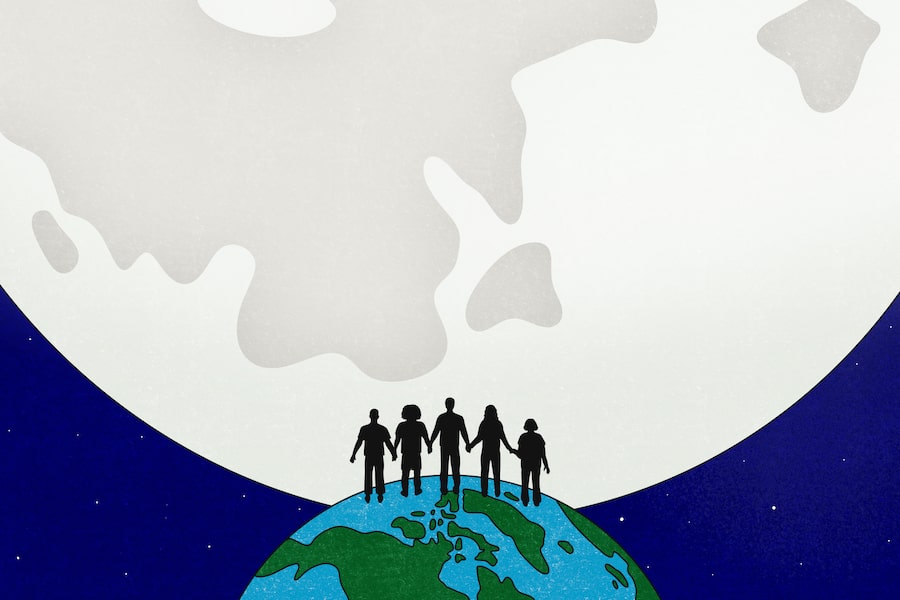
The crew of the Orion spacecraft Integrity splashed down about 100 kilometres off the coast of California, ending a 10-day journey that gave millions a reason to look up and showed that humanity – for the first time in more than half a century – is ready to build for a future that only distant generations will ever see.
The four astronauts landed back on Earth having viewed it from more than 400,000 kilometres away – a distance that resolves the planet to a small, bright disc. From that vantage point, there are no borders – only continents and oceans, deep blue water, blankets of soft white cloud.

NASA's Orion spacecraft Integrity carrying the Artemis II astronauts splashes down in the Pacific Ocean near San Diego on Friday.NASA/Josh Valcarcel/Reuters
They returned to Earth having crossed new frontiers of human endeavour, gathering new data that will lead to new scientific discoveries, showing how human ingenuity, invention and collective effort can be sustained over time in pursuit of something larger than any one life.
And they returned to a world that has recently experienced one of the deadliest pandemics in history, sharp economic downturns, trade wars and the sudden ubiquity of artificial intelligence – a technology that has generated existential anxiety across the global workforce. For the generations walking the Earth today, this is an era that can’t seem to go a full month without fracture.
And yet.
Decades from now, hundreds of years from now, a moment that feels fractious will be measured against the steps taken by the Artemis crew toward building on the moon, toward using the moon as a launching pad to Mars and to setting humanity on a course of exploration across the cosmos.

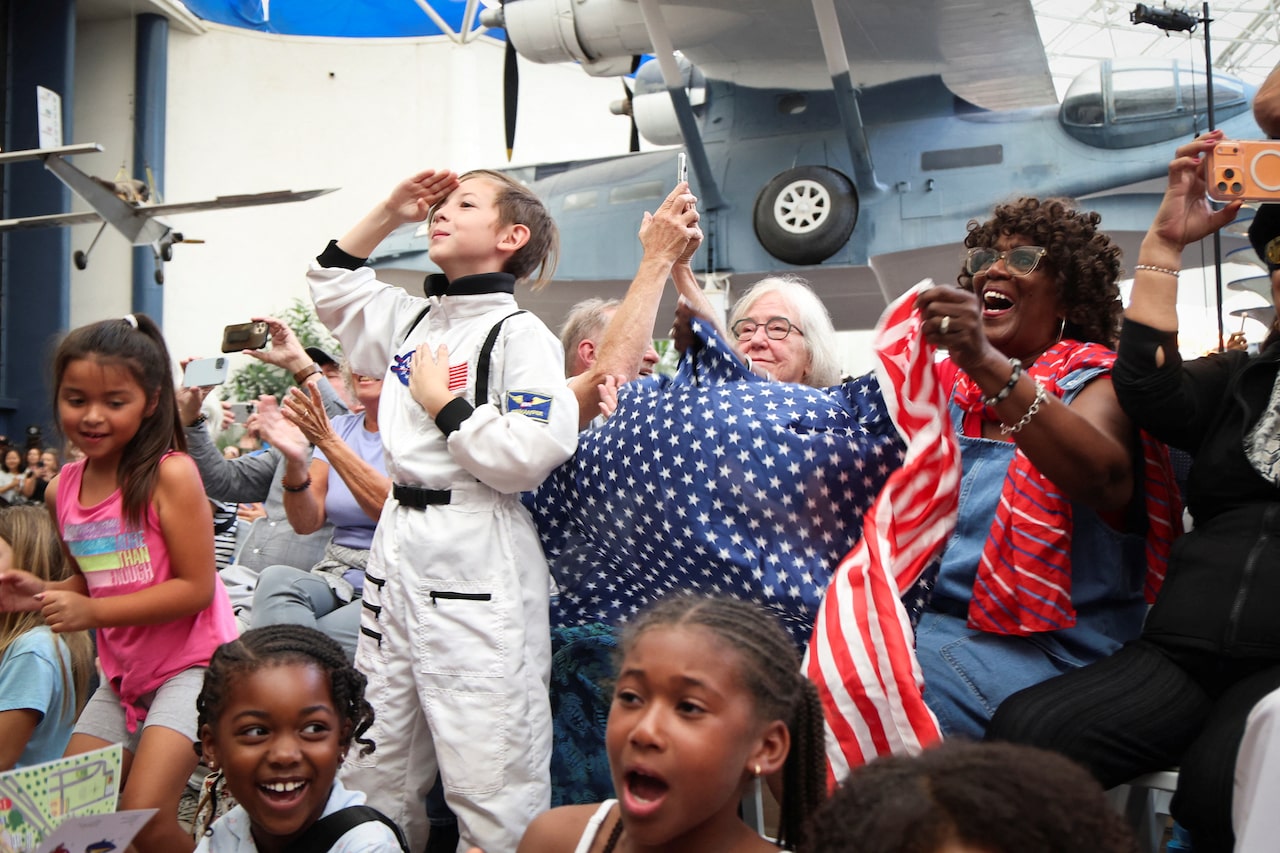
The next generation
Astronauts have described the Earth they see from space as a beautiful, interconnected system, where no separation could be seen between countries or states, and an overwhelming sense of oneness and connectedness. The less detail they saw of the planet, the more they understood it.
Moments before losing contact with Houston for the 48 minutes it would take to cross the far side of the moon, Canadian astronaut Jeremy Hansen said he owed that same view to “the generations of astronauts who made the journey possible.” But most importantly, he said, as the spacecraft travelled farther from Earth than any human crew before it, “we choose this moment to challenge this generation – and the next – to make sure this record is not long-lived.”
That record could fall within the decade, as the United States and China race toward sustained human presence on the moon and seek to shape the rules and infrastructure that will informally govern its use – including how water and other local resources are extracted to support long-term habitation. But the next generations Mr. Hansen may have had in mind are the ones who would use that lunar architecture as a launchpad for Mars – the ultimate human mission articulated by Artemis.
NASA’s agenda places a crewed mission to the Red Planet in the 2030s or early the following decade, but that timeline is already in question. It depends on technologies not yet proven, a lunar base designed to support months-long habitation and funding and co-ordination sustained over decades – conditions that have historically proven difficult to maintain.

Echoing the iconic Earthrise photo captured by the Apollo 8 astronauts in 1968, the NASA Artemis II crew captured a shot of Earthset as they passed behind the Moon’s far side during the seven-hour lunar flyby on April 6, 2026.NASA/Reuters
Particularly through periods of conflict and economic worry, asking a population to fund a program whose payoff is decades or even centuries away is a difficult proposition. For NASA, that tension has been the source of financial strain since its inception, and plays no small part in its focus on prioritizing the economic benefits of space exploration.
Why plant trees?
Neither NASA nor the public it relies on are the first to grapple with a demand that the present pay for a future it will never see.
Civilizations separated by centuries have been united by having inhabited eras defined by mass disruption, and by a similar idea from those inflection points: that to plant trees one would never see mature was an argument for continuity in a world where future generations might thrive under conditions of uncertainty.
Nearly 2,000 years ago, Cicero, writing in the final years of the Roman Republic, drew upon an adage to argue that lawmaking, civic institutions and public duty retained their value because they contributed to a political order that would endure beyond any one life. "Serit arbores quae alteri saeclo prosint," the Roman statesman and philosopher wrote. Plant trees, so that they may serve another generation.
After Cicero came Hyacinthe Loyson, the 19th‑century French preacher who used tree planting as a metaphor for the duty owed to the world’s descendants in an era of seismic political shifts and industrial disruption.
And in 1951, as the world emerged from the Second World War and came to terms with technologies capable of ending civilization outright, American theologian D. Elton Trueblood observed that “a man has made at least a start on discovering the meaning of human life when he plants shade trees under which he knows full well he will never sit.”
That this aphorism has travelled so far through time doesn’t suggest a romantic notion of civilization learning to take more frequent leaps in the right direction. Rather, it suggests that time and again, through periods of radical upheaval, civilization has needed a reminder of what it was capable of. And, at crucial moments, those reminders were heeded.

The Artemis II crew (clockwise from left), Mission Specialist Christina Koch, Mission Specialist Jeremy Hansen, Commander Reid Wiseman and Pilot Victor Glover, takes a group photo on the journey home after successfully crossing the far side of the moon.NASA/Getty Images
The U.S. program’s best hopes for keeping Mars within reach this lifetime will depend on working more openly with its long-standing allies. Through the Artemis Accords, more than 60 signatory countries agreed in 2020 to a set of principles governing how countries operate on the moon and beyond.
They’ve also agreed to share technology, expertise, resources and costs. Artemis is a NASA-led program, but it’s fundamentally global: The service module attached to the Orion is built by the European Space Agency; the Lunar Gateway, a small space station orbiting the moon set to take shape later this decade, relies on contributions from partners across Europe, Canada and Japan. And Canada is supplying Canadarm3, a robotic system that will maintain the station and assist visiting spacecraft.
And then there is the motivating factor of competition. Today, as in the sixties, the U.S. finds itself pressed by a communist rival. China is aggressively pursuing its own program for a crewed lunar landing in the 2030s, and developing the rockets, spacecraft and lunar base infrastructure required to sustain a long-term presence alongside a joint research station with Russia.

NASA's Artemis II mission lifts off from the Kennedy Space Center in Cape Canaveral, Fla., on April 1. Artemis is a NASA-led program, but it’s fundamentally global, relying on technology, expertise, resources and financing from Europe, Canada and Japan.Joe Skipper/Reuters
Whoever lands on Mars first gains the symbolic victory of being the first nation to plant a flag on another planet, but also early influence over what follows through landing sites, communication systems and other infrastructure that carry more practical consequence than any earthly accord.
To get there, however, human explorers would need to withstand sustained exposure to deep‑space radiation, live for years within closed‑loop life‑support systems without resupply, endure the physiological and psychological strain of long‑duration isolation and land and launch heavy cargo through a planet’s thin atmosphere.
Given the sheer magnitude of everything that would have to go right, those astronauts are several years, if not decades, away.
And while that moment would represent the close of a successful mission to Mars, it would open a new chapter of exploration for generations far into the future. So far, in fact, that it’s hard to imagine in concrete terms the timelines, the gaps in technology and the amount of money and political support it would take to get there.

Canadian astronaut Jeremy Hansen arrives aboard the USS John P. Murtha after he and fellow crewmates splashed down in the Pacific Ocean on Friday. After the successful mission, Hansen became the first Canadian to fly around the moon.NASA/Bill Ingalls/Reuters
The call of the future
But history is filled with examples of systems built to endure beyond those who began them – and that same ambition will be familiar to anyone who has left professional status behind so their children, and the generations that follow, can grow up safely and receive a better education. Throughout history, civilization has thrived owing to the people who have heard a call from the future and answered with lasting care.
The success of the Artemis program may rest on many motivations. But that calling sits at the core of the legislation that created NASA in 1958: “the expansion of human knowledge of phenomena in the atmosphere and space.”
In time, what may now feel like an era defined by conflict will instead be remembered for opening the door to deeper exploration of the cosmos – a moment best understood as an act of intergenerational obligation, a tree planted long before its height comes into view.