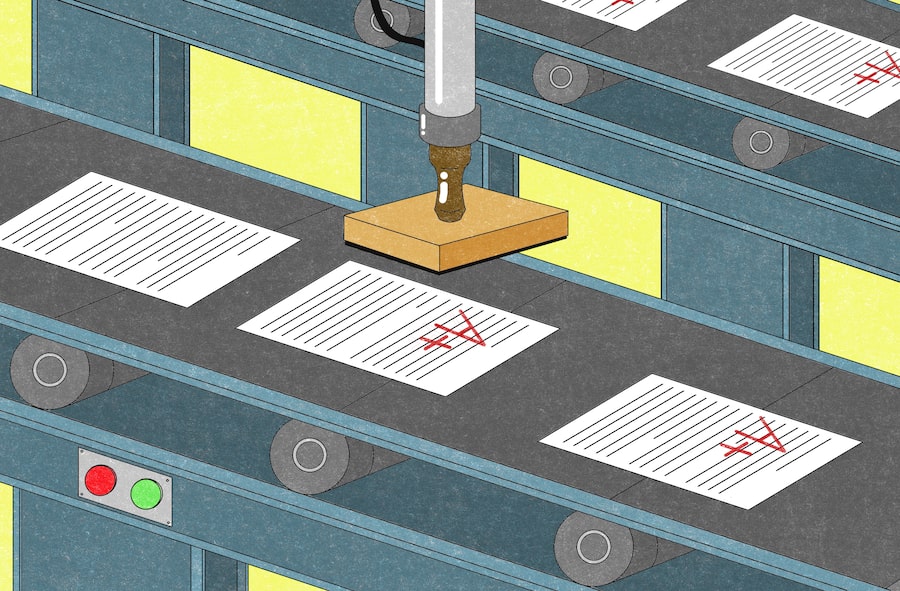
Children across the country will get their report cards this week. It’s a safe bet to say that A grades will be plentiful, while Fs will be exceptionally rare.
While many parents and students will be pleased to see report cards awash with As, the devaluing of grades – and the untethering of marks from student achievement – is creating a series of cascading problems across the education system.
Grade inflation – the practice of assigning grades that are higher than in the past for the same level of achievement – has been a problem at all levels of education for decades, but it has become worse since the onset of the pandemic. The rise of high school grades is a particular cause for concern, as elevated marks are making it difficult for universities to distinguish between applicants.
The trend has been fuelled by good intentions, but over the long term, easy grading isn’t doing children any favours. Just like how monetary inflation makes your dollars less valuable, the perceived worth of high grades – and a high school education in general – is dropping. Ministries of education, school boards and universities need to take decisive action to reverse the trend before grades become entirely meaningless and students are left without any signal about their true performance.
How high school valedictorians are inspiring their graduating classes in times of change
Reaching for the top
The grades of Ontario high school students entering university have been rising over the last two decades.
As shown in the chart below, the average grades of applicants who entered the University of Toronto in 2006 was 83.9 per cent. In 2023, it was 90.2 per cent. Students entering McMaster University in 2006 had an average of 84.1 per cent; in 2023 it was 91.7 per cent.
This second chart shows the percentage of students with a 95 average or higher seeking admission to university has soared. At the University of Waterloo, for example, 4.9 per cent of enrolled applicants had a 95 average or higher in 2006. In 2021, as high schools loosened grading during the pandemic, an astonishing 42.4 per cent of students applying to Waterloo who enrolled hit that benchmark. The number has since dropped to 32.7 in 2023, but it’s still higher than it was before the pandemic.
The trend is most noticeable in the more sought after schools, but it holds true across the board. Other provinces, such as Manitoba, have observed similar trends. If grade inflation isn’t stopped, eventually there will be a flood of students getting perfect marks of 100, and on paper, they will be indistinguishable from one another.
Could the reason be because children are learning more these days, and are reaching higher levels of achievement? Sadly, no.
Canadian students’ performance in international tests for math and reading show substantial declines in recent decades. “There is a mountain of evidence that marks have gone through the roof, and that they bear little or no relationship to actual achievement levels,” says educator and author Paul W. Bennett. “There’s no objective evidence that the students are performing better.”

Students attend Welcome Week at McMaster University in August, 2025. With universities raising their admission cutoffs as average entry grades rise, they become caught in the cycle of grade inflation.Laura Proctor/The Globe and Mail
Easy As and automatic Ds
Teachers have every incentive to raise students’ grades, and every disincentive to not to. With more students applying to university, competition is fierce, and students and parents pressure teachers to boost scores to get into desired programs. Students concerned about keeping their grades high avoid elective high school courses with reputations for tough marks, making it difficult for those teachers to continue offering them.
A teacher who doesn’t raise grades may face blowback – sometimes from school administrators wanting their graduates to make it into prestigious programs – and their students will have a disadvantage compared to those in classes where teachers are inflating grades.
Education techniques meant to boost mental health and help struggling kids have led to more lax standards in recent years. There are fewer exams, and teachers give out more subjective assignments that tend to lead to grade escalation. Students today have more leeway to make up for poor marks by redoing tests and assignments.
When schooling was disrupted during the initial years of the COVID-19 pandemic, ministries of education and school boards encouraged easy marking to help students cope. Grades soared, and this decoupling of achievement from marks didn’t entirely go back to normal after.
Many high school grades cluster in the A+ range, and just above 50 per cent, the cutoff for a passing mark. It’s very rare for elementary students to fail a grade these days, and schools are encouraged to give struggling high school students passing marks so they can graduate. It’s a well meaning policy that has boosted graduation rates, but it contributes to grade inflation as middling and high achieving students’ scores are boosted in turn.
Just like monetary inflation, grade inflation creates a vicious cycle. Universities raise their cutoffs as marks rise, leading to pressure again for teachers to boost grades so students can get into their desired programs.

Students gather for a convocation ceremony at Toronto Metropolitan University in June, 2025. With more students applying to university, higher grades are required to secure spots in competitive programs.Fred Lum/The Globe and Mail
A coddled cohort?
Some educators have downplayed the problems with grade inflation, saying it doesn’t make a big difference given that today’s high school graduates are measured against each other.
It does matter because easy grading has effectively lowered the bar for everyone. Many students learn they don’t need to put effort in to get high marks, yet they are bolstered by a false confidence that they have mastered the material. Some find they are unprepared for higher education when they get there. There can be real life consequences down the road, as students who have coasted through their school years without much effort may be unprepared for the demands of the workplace.
School boards’ “no fail policies” have clear benefits, but also downsides. With marks inflated to keep low performers moving through the grades, these students can end up struggling more, with reading and math levels far below other students.
The resulting higher graduation rates – 84 per cent of Canadian students now complete high school on time, with 91 per cent finishing within five years of starting Grade 10 – means a diploma has become a standard qualification, contributing to “credential inflation” as employers demand more post-secondary qualifications. Some people are getting pushed into universities, when in reality, they might be better suited for technical work or other options.
There’s also the growing problem of distinguishing between students when so many are graduating high school with the same stellar marks. Some universities are leaning more on essays and interviews. The University of Waterloo’s engineering program has a controversial system, where it adjusts student marks depending on what high school they attend.
Individual schools and teachers can’t tackle the problem alone – system-wide reform is needed from provincial ministries of education. Educators can learn from Alberta, which still has provincial exams, a practice that tends to result in less grade inflation. In Quebec, in addition to individual marks, CEGEP students get an “R-score” that compares a student’s grades against others’.

Graduating students attend a convocation ceremony at Simon Fraser University, in June, 2024. System-wide reform is needed from provincial ministries of education to tackle the vicious cycle of grade inflation.DARRYL DYCK/The Canadian Press
Ontario can start restoring rigour to grading by making high school teachers cap the number of As they can give out. A grading curve could be created to distribute the rest of the grades. Harvard University is currently moving toward capping As to deal with grade inflation, which it sees as a threat to the university’s reputation. Its cap will limit the number of As a teacher can give out to 20 per cent of the students, with more flexibility given in smaller courses.
In addition, universities could administer admission tests, where they can properly evaluate the students they are admitting. Reintroducing standard provincial Grade 12 exams would have a similar effect.
Every grading system has its advantages and drawbacks, says Sachin Maharaj, an assistant professor in education at the University of Ottawa. In Harvard’s case, students are opposing the capping of As, saying it will increase stress and penalize students if their peers are high performers.
As changes are implemented, special attention needs to be paid to low-performing students. The real solution for these kids is not falsely inflating their grades, but providing extra support so they can catch up and properly learn the material.
Grade inflation is just another symptom of the broader problems in Canada’s education system, which has seen an erosion in standards and discipline in recent years. While Canada shouldn’t return to a strict 1950s classroom environment, pressure does need to be applied to boost attendance, and spur kids to properly learn math and reading. Bringing grades back to earth is another piece of the puzzle.
While it may not feel as good in the short term as handing out easy As, in the long term, our children will be better for it.