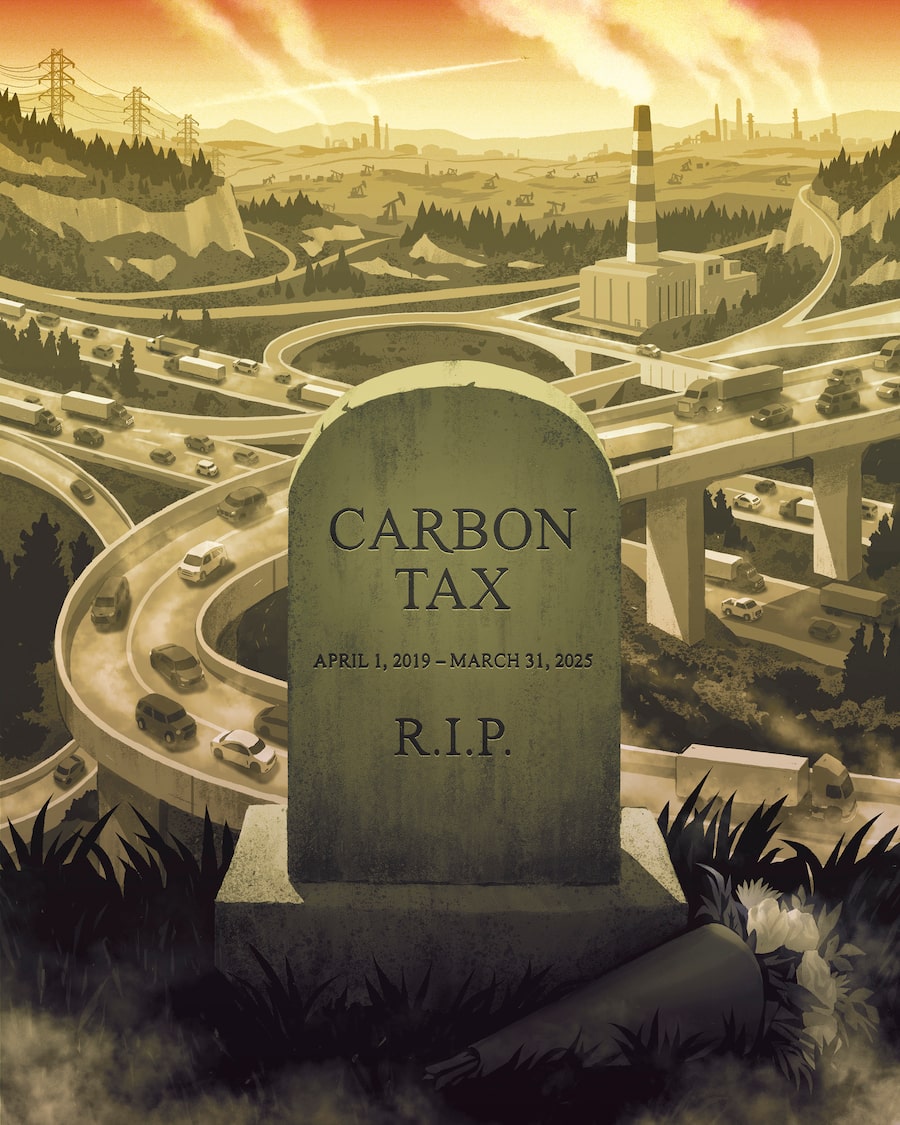
Here lies Canada’s carbon price, which exited our earthly realm on March 31, 2025.
Mark Carney, mere hours after becoming Prime Minister, signed the death certificate in front of TV cameras he had summoned to witness the act. In that final moment, the carbon price was surrounded by many ministers who had spent years defending it in increasingly half-hearted tones. At its deathbed, they were silent.
The policy is survived by the thriving political career of the flexible and pragmatic Mr. Carney, and by that of a wistful and slightly too effective Pierre Poilievre. It was predeceased by Justin Trudeau’s political career.
The carbon price – or carbon tax, to its many detractors – was followed into the grave by the electric vehicle mandate; the oil and gas emissions cap is expected to be buried nearby soon.
There will be no memorial service. Mourners are invited to read Mr. Carney’s book Value(s) for solace, and some idea of what the future holds.
So, there’s the obituary. RIP and so on.
But what was the cause of death?
Mr. Carney said the policy had to go because it was too “divisive” – so did it contract that fatal illness because of Mr. Trudeau, or Mr. Poilievre? Was it an economist’s darling that was never meant for the real world, or was it the most efficient way to get people and companies to make greener choices, until cynical politics gave it a raging case of sepsis?
Was it the centrepiece of a plan to finally make Canada a serious global player that would deliver on its climate commitments, instead of making and breaking promises while wearing the same prim smile? Or was it pointless and punitive, squeezing ordinary Canadians to get a rounding error’s worth of carbon reductions, while foreign smokestacks belched into the sky?
The carbon price was smugly oblivious to the lives of everyone who didn’t live in a big city with boutique grocery stores and a nice, efficient transit system. Or maybe it had the misfortune to live during a bonkers public health emergency that led to choking inflation, and it was blamed for an affordability crisis it didn’t cause.
At the moment, the appetite for climate policy appears to be waning as it bumps up against economic urgency. And Canada has a raft of other big, wicked problems to solve: housing, the cost of living, regional frictions, how to reorient our economy without losing our collective shirts.
So, in a moment when we need to tackle other difficult things as a country, what does the short life and swift death of the carbon price tell us about how public policy comes to life, why it dies and who’s responsible?

ILLUSTRATION BY ED KWONG
The campaign that would carry his party to a majority was six months away when Mr. Trudeau announced in early 2015 – at the Petroleum Club in Calgary, no less – that his government would implement a national carbon-pricing plan.
“Many in this room believe that a price on carbon is good for the environment, for the economy and for Alberta’s oil and gas sector,” he told an industry audience. “You know Canada needs to have a price on carbon.”
In the first two years they were in government, Gerry Butts, Mr. Trudeau’s principal secretary at the time, says their “situational awareness” was that big things would need to get done by the federal and provincial governments together, and they had a brief window before the political gears clicked into a less congenial configuration.
“That included of course a lot of Liberal governments across the country, but it also included a Prime Minister with a lot of political capital at the time,” he says. “I’ve always been one to believe that when you have political capital, you either invest it and choose the things you invest it in, or it naturally dissipates. And to Justin’s credit, he made a decision to invest it rather than just let it fritter away.”
The carbon price was born in a moment when global momentum was on the side of climate efforts: 195 countries signed the Paris Agreement, an international treaty pledging to limit climate change, with an air of great collective ambition and urgency at COP21, just weeks after the Liberals formed government.
That fall, the premiers agreed in principle to an economy-wide carbon price, and left their First Ministers’ meeting promising to work out the details. Eventually, it became clear that wasn’t going to happen, so in October, 2016, Mr. Trudeau announced that the provinces would each need a carbon pricing plan that met the federal standard by the beginning of 2018, or the federal government would impose one.
It wasn’t long before the moment shifted. A newly elected Donald Trump promised as president to make coal great again. In Ontario, Doug Ford’s Progressive Conservatives won a majority and killed the province’s cap-and-trade program, and in Alberta, Rachel Notley’s NDP government and its carbon pricing plan would soon be felled by the United Conservative Party. In the face of industry pushback about competitiveness, the federal government watered down its industrial thresholds for carbon pricing.
The Greenhouse Gas Pollution Pricing Act received royal assent in June, 2018, but the carbon price kicked in more than a year later than scheduled, starting at $20 a tonne on April 1, 2019, and rising each year to hit $50 a tonne by 2022.
Ontario, Alberta and Saskatchewan fought the policy all the way to the Supreme Court, arguing that it was an unconstitutional infringement; the court ultimately ruled in 2021 that climate change demanded a coordinated national approach and the federal government had jurisdiction.
In the lead-up to the 2021 election, the federal government announced a stepped-up annual increase, building toward a much heftier $170 a tonne by 2030.
Mr. Butts – who was out of the PMO by that point – thinks that announcement was basically the end, it just didn’t become obvious right away. And when he lays it out – each April 1, when the carbon price went up by $15 a tonne, was like a scheduled annual rage holiday to organize around, conveniently positioned at tax time, when people already felt screwed over by the government – it does start to sound like a gift to the opponents of the carbon price.
“The mistakes you make on Tuesday in government don’t show up on Wednesday,” Mr. Butts says. “They show up like a year and a half or two years later.”
Another way to think about what went wrong: Timing is everything in politics, but time never stands still. When you’re building policy, you have to pick the right moment to make something happen, and then you have to realize when the moment has changed.
When the COVID-19 pandemic finally receded, it left two parting gifts – stifling inflation and simmering antigovernment distrust – that would shiv incumbent governments all over the world. Those two elements took all of the inherent weaknesses of the carbon price and cranked them up to 11, but the government seemed oblivious that everything had changed; the policy had no chance of survival.

ILLUSTRATION BY ED KWONG
Andrew Leach, an energy and environmental economist at the University of Alberta who advised Alberta premier Rachel Notley and the federal government on climate policy, thinks of its demise in these terms: Its natural enemies are obvious, but who championed it?
“If I had walked into a meeting of environmental groups in 2014 and I would have said, ‘In a year from now, we’re going to have a commitment to an economy-wide carbon tax and a coal phase-out in Alberta. And then a year after that, we’re going to have a commitment to a federal national carbon price. And a couple of years after that, we’re going to have one going to $170 a tonne,’ people would have told me I was on drugs and there’s no possible way that would happen,” he says. “Like, ‘Nice dream you’ve got there, Andrew, but that’s never going to happen.’ ”
But when all of that became reality instead of some eco-acid trip, the instinct of the environmental movement, to him, was not to celebrate the win and promote the policy, but to push for more.
Asked to offer his version of the life story of the carbon price, Wab Kinew, the Premier of Manitoba, hits it all with pithy efficiency.
“Mr. Trudeau made a play to adopt that as the progressive path forward on climate. Progressives I think relatively soon after accepted it as dogma – mistakenly, I think. And then it was pretty much status quo until inflation hit 8 per cent,” he says. “And then when inflation skyrocketed and people’s lives got hard because of struggling to pay the bills, the carbon tax – I think reasonably – became a source of anger.”
He figures it would have eventually run into serious problems anyway because of how it increased costs and affected different groups of Canadians in wildly disparate ways, but inflation accelerated all of that.
When Mr. Kinew started publicly pushing back in the spring of 2024, it carried a different weight than Mr. Poilievre’s constant “Axe the Tax” drumbeat. Here was an NDP premier who was trying to make Manitoba Hydro completely green, pointing out that a whole lot of his fellow Manitobans fill up their trucks and drive a lot because that’s just their life, not because they’re bad people.
“I’ve never seen an electric vehicle on a reserve,” he says, adding, “The reality for many people who live on the Prairies is that they have to drive hundreds of kilometres to get to a Costco or a medical appointment, or to work. And if you want your climate vision to succeed in the real world and not just in theory, you have to make sure that Prairie resident is sitting at the table.”
Ian Brodie, former chief of staff to prime minister Stephen Harper and now a political-science professor at the University of Calgary, doesn’t like to lean too hard on regional tensions because that obscures what to him is the bigger issue: more shafting of rural people.
“To focus on ‘This is a Western Canada thing’ I think is to miss that the carbon tax hits grassroots consumers directly and visibly, and that’s a problem everywhere that it’s applied, not just in Western Canada,” Mr. Brodie says. “If this was just a Western Canada problem, the Liberals could have survived it.”
In established urban neighbourhoods, he says, it’s easy for people to forget that two or three generations back, someone else paid for the robust transit system that now makes it easy for them to leave their car in the driveway and wonder what all the fuss is about. Meanwhile, someone in a distant suburb living in a new house they can barely afford wonders what they get for their taxes, and how that’s fair when the downtown crew gets infrastructure by inheritance.
“The design of the program was always going to be more complicated than the textbook said,” Mr. Brodie says.
And there was Mr. Poilievre, all over the country and the internet with a jerry can and a book of matches. He seamlessly grafted the carbon price onto inflation, relentlessly reinforcing the idea that Canadians were choking on every grocery trip and gas tank fill-up entirely because of a tax that needed to be axed.
Last fall in a speech, he predicted the carbon price would unleash a “nuclear winter” on the Canadian economy and cause “mass hunger and malnutrition,” adding, “Our seniors would have to turn the heat down to 14 or 13 C just to make it through the winter.”
In fact, the Bank of Canada calculated that the carbon price added 0.7 per cent to inflation. The Parliamentary Budget Officer estimated that most households would come out ahead with the quarterly rebate they received to offset the fuel charge; when indirect economic costs were taken into account, higher-income Canadians would be slightly in the red, while low-income people would remain better off.
But Mr. Poilievre – using about 17 times the energy and clarity with which the government defended its policy – did the thing at which he excels. He took something that was a little bit true (the carbon price slightly increases costs) and twisted it into a willful act of starvation and misery foisted upon the Canadian people by a government that sure must hate them.
The carbon price became a full-blown culture war that the Liberals lost badly.
“I give the Conservatives credit for this: They were able to transform the debate into, ‘Would you like cheaper gas and cheaper food?’” Mr. Leach says. “And Trudeau – your culture war comment – tried to make it, ‘Would you like action on climate change?’ ”
What utterly baffles Alex Marland, the Jarislowsky Chair in trust and political leadership at Acadia University, is that the Trudeau government prided itself on using public opinion research to shape policy. The swelling resentment toward the carbon price – particularly among rural residents – had to be showing up in their intel, he says, but the government didn’t appear to care.
“It almost seems like they thought it would promote itself,” Mr. Marland says.
To him, the short, violent life of the carbon tax offers a few crucial lessons for future policy-making.
“One answer is when your opponents really start ganging up on you, sometimes it’s useful to back down a little bit,” he says, though he notes that the stubborn refusal to do so is endemic to politics in general at the moment.
Mr. Marland also detects the carbon price, from beyond the grave, is reminding us that it’s easy always to say other people should do things – and people don’t like constant reminders that they’re paying for something. On that last point, the carbon price had it rough, with light-up billboards outside every gas station shoving the cost in people’s faces. The problem the policy was supposed to fix, meanwhile, was as distant and hazy as the Canadian skies during wildfire season.
And here we circle back again to recognizing the moment you’re in. Mr. Leach points out that policy, like everything in life, comes in waves. Mr. Harper’s climate policy from 2008 – including mandatory carbon capture and storage on all new oil sands facilities – was arguably more stringent than anything Mr. Trudeau did. And current Conservative policy under Mr. Poilievre makes the previous three Tory leaders look like “climate-change zealots,” he says.
What Mr. Leach sees when he looks around right now is climate policies dropping everywhere.
“I think the takeaway is it’s hard to convince people to take action on climate change,” he says. “It’s asking you today to give up something in order to alleviate environmental damages that occur both across the world and across multiple generations. Anything like that is going to be tough.”
Mr. Kinew stumbled onto his own small, personal case study on this recently.
Back in 2019, he brought his kids to the climate strike inspired by Greta Thunberg at the legislature in Winnipeg; a massive crowd of 10,000 people turned up, including lots of their friends from school.
And then a year ago, those same friends of his kids went to one of Mr. Poilievre’s Axe the Tax rallies.
“I think that’s a bit of a microcosm for the challenge that the carbon tax had,” Mr. Kinew says. “We might lose the public will of the majority of Canadians to do the environmentally friendly thing because they don’t think it’s in their best interests.”
And so, we bid our final farewell to Canada’s carbon price, returned once more to the cosmic dust from which it came.
We might ask ourselves the same question you could ask at any graveside: How will future generations, happening upon this place, tell the story contained in the dash between the date of birth and the date of death?