
The national housing fund has helped speed up the approval of close to 30,000 residential building permits, comprising 70,000 homes, in Alberta’s largest cities, including Calgary.Amir Salehi/The Globe and Mail
Recently recognized as top-performing communities by Canada Mortgage and Housing Corp. (CMHC), Calgary and Edmonton epitomize the success of the Housing Accelerator Fund, a federal incentive program launched in the spring of 2023 to bolster the supply of housing across the country by eliminating red tape and improving efficiency.
In less than two years, the Housing Accelerator Fund has helped speed up the approval of close to 30,000 residential building permits, comprising 70,000 homes, in Alberta’s largest cities. The sizable impact of this program not only demonstrates the strengths of supply-side solutions, it also reveals the opportunities that lie ahead.
“I think the idea of the Housing Accelerator Fund was excellent,” says Carolyn Whitzman, a housing researcher and adjunct professor at the University of Toronto’s School of Cities. “Because it co-ordinated all levels of government.”
However, when measured against the overarching goal of the National Housing Strategy, which aims at realizing the right to adequate housing in Canada, she believes the Housing Accelerator Fund misses the mark.
Explainer: What is the Housing Accelerator Fund?
Although the $4-billion program steps in with much-needed funding to improve municipal processes and upgrade infrastructure across the country, omitting from its agreements requirements such as unit size, accessibility, security of tenure and affordability relative to income – that is, the aspects that determine housing adequacy – means that the bulk of the supply incentivized doesn’t necessarily meet the needs of those who need it most, Ms. Whitzman says. “It’s not making things better for poor people.”
This situation is evident in Calgary and Edmonton, where despite significant gains in the number of dwellings that have received a building permit in the months following their Housing Accelerator Fund agreements, the large majority of the homes permitted are set to be built in a car-oriented neighbourhood, where access to public transit, services, and amenities remains limited, increasing the share of household income spent on transportation.

A recent report identifies the need for at least 4.4 million homes that Canadians earning less than a median income can afford.Louis Oliver/The Globe and Mail
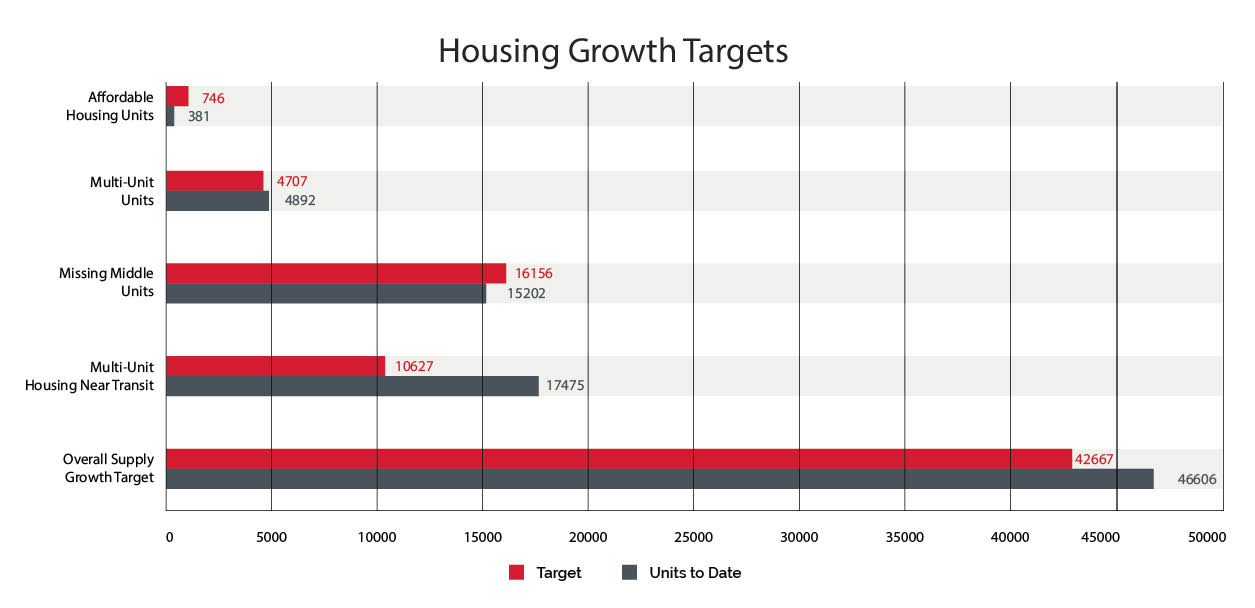
Between Nov. 1, 2023, and July 31, 2025, the City of Calgary issued building permits for more than 46,600 homes, or an additional 16,000 dwellings relative to the 20 months prior. Roughly 40 per cent of these dwellings are located within 600 metres from a light-rail belong or bus-rapid-transit hub, the city reports, and one-third of the units permitted belonging to the missing-middle, a building typology made up by townhouses and multiplexes.
But the devil lurks in the details.
According to publicly available building permit data, close to 60 per cent of dwellings permitted in Calgary since the fall of 2023 are set to be constructed in a building-out neighbourhood on the city’s outskirts, including about 10,500 apartments and townhouses, more than 3,000 secondary suites and more than 7,000 single-detached homes.
“We have to work with the market that we’re in,” says Reid Hendry, the City of Calgary’s chief housing officer, noting that suburban growth is essential to support the choices available to Calgarians and meet the prairie city’s growing demand for housing.
“The housing gap is north of 100,000 units that we need so that we can adequately house over 200,000 Calgarians currently struggling with their housing.”
In Edmonton, the situation isn’t much different.
Since signing its Housing Accelerator Fund agreement in November, 2023, the City of Edmonton has permitted 26,903 dwellings, including 10,575 missing-middle and 7,133 transit-oriented homes.
These three housing markets are bucking national trends, and Trump is one reason why
Nevertheless, more than 80 per cent of missing-middle units permitted in Alberta’s capital city are located in a developing neighbourhood near the city’s edge, according to data provided by the City of Edmonton’s housing action team. On the flip side, the 6,083 transit-oriented homes permitted so far are set to be constructed in an area undergoing redevelopment.
“We weren’t really interested in accelerating single-family residential housing,” says Christel Kjenner, director of the City of Edmonton’s housing action team. “We were looking at accelerating building permits in the categories that are typically harder to achieve.”
The success of the Housing Accelerator Fund in Alberta’s largest cities reveals the limitations of an approach to supply largely reliant on market forces, as the development of affordable housing continues to lag.

Calgary has so far only met 51 per cent of its affordable housing target.Amir Salehi/The Globe and Mail
So far, Calgary has only met 51 per cent of its affordable housing target, pegged at a meagre 746 dwellings. Similarly, the City of Edmonton has permitted 870 affordable units, which is 1,070 homes short of the city’s target.
To overcome this challenge, both cities are leveraging some of the funding granted by the Housing Accelerator Fund to meet their affordable housing supply targets by 2026.
The City of Edmonton has earmarked $99-million from the $192.6-million the city expects to receive from the federal incentive program to help create 500 affordable homes on surplus school sites across the city. In Calgary, a portion of the $22.8-million top-up the city received in March for exceeding its overall supply target should be leveraged to create 520 nonmarket homes downtown.
For Canadians searching for affordability, Edmonton is a top choice
But even if Calgary and Edmonton meet their modest affordable housing targets, and new construction triggers vacancy chains, the affordability needs of at least 100,000 low- and moderate-income households are unlikely to be met.
“There is a lot about our building and zoning codes that’s keeping us from building significantly cheaper,” Ms. Whitzman said. “But the private sector is not well suited to meet the needs of lower-income Canadians.”
This issue isn’t unique to Alberta.
A recent report co-authored by Ms. Whitzman identifies the need for at least 4.4 million homes that Canadians earning less than a median income can afford. To do this, the authors propose a bold solution: an annual $40-billion in federal investment to build no less than 200,000 nonmarket homes on government-owned land over the next decade, or roughly 20 per cent of the target proposed by Prime Minister Mark Carney during his election campaign.
“To meet the need for units that rent for $385 to $1,050 a month,” Ms. Whitzman says. “It’s going to take more of a mission-oriented developer.”
Editor’s note: Based on a misstatement from the source, a previous version of this article quoted housing researcher Carolyn Whitzman as saying that there is a need for units that rent for $385 to $500 a month. The higher end of that range is $1,050 a month.